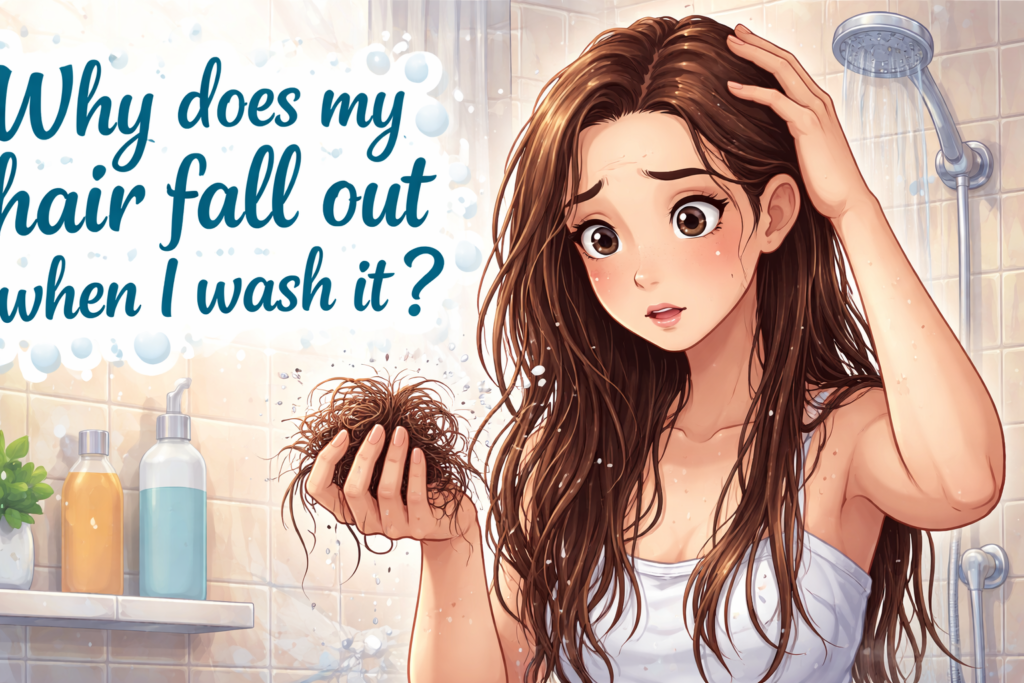
Why Does My Hair Fall Out When I Wash It?
It always seemed to happen at the worst possible moment.
I’d step into the shower, expecting nothing more than a quiet few minutes to myself—a pause in the day. The warm water would hit my scalp, my hands would move almost automatically through my hair, and then… there it was.
Strands.
At first, just a few wrapped around my fingers. Then more, slipping down with the water, clinging to the tiles, gathering near the drain like something I couldn’t ignore anymore.
I remember freezing for a second, staring at my hand as if it held an answer. Is this normal? Or is something wrong?
That question stayed with me long after the shower ended.
The Illusion of “More Hair Loss” in the Shower
Here’s something I didn’t understand at the beginning: it’s not that your hair suddenly decides to fall out because you’re washing it.
It’s that the shower is where everything finally shows up at once.
Throughout the day, your hair naturally sheds. It’s part of the normal growth cycle—some hairs are growing, some are resting, and some are ready to fall out. On average, people can lose anywhere from 50 to 100 strands a day, sometimes even more depending on different factors.
But here’s the catch: not all of those strands fall out immediately.
Some stay loosely attached, caught between other hairs, waiting.
And when you step into the shower—when water, shampoo, and your fingers start moving through your hair—you’re not causing the shedding. You’re simply releasing what was already on its way out.
It just feels like more because it all happens at once.
The First Time It Feels Like Too Much
Still, knowing that didn’t fully calm me.
Because there’s a difference between a few strands and what feels like a handful.
There was a day when I turned off the water, looked down, and felt that quiet drop in my stomach. It wasn’t panic exactly—but it wasn’t nothing either.
I started counting, even though I knew it wouldn’t help.
I started paying attention in a way I hadn’t before—watching how much came out when I brushed my hair, noticing what was left on my pillow, wondering if my ponytail felt thinner.
It’s strange how something so small can slowly take up so much mental space.
Why Washing Makes It More Noticeable
Washing your hair creates the perfect conditions for shedding to become visible.
The water loosens hair that has already detached from the scalp. Shampoo reduces friction, allowing strands to slide free more easily. And your fingers, as gentle as you try to be, act like a comb—bringing everything out at once.
If you haven’t washed your hair for a couple of days, the effect can feel even more dramatic.
It’s not that you’re suddenly losing more hair in that moment—you’re just seeing the accumulation of what would have fallen out gradually over time.
And that distinction matters.
Because what feels like a sudden problem is often just a delayed reveal.
When It’s Not Just “Normal Shedding”
But here’s the part no one really tells you clearly: sometimes it isn’t just normal.
Sometimes, the amount increases beyond what feels familiar.
And even if you can’t measure it exactly, you can feel the difference.
For me, it wasn’t just the shower anymore. It was everywhere.
Hair on my clothes.
Hair on my desk.
Hair caught in my brush more than usual.
That’s when the question changed from “Is this normal?” to “What’s causing this?”
Stress Shows Up in Unexpected Ways
Looking back, I can trace it to a period that didn’t seem dramatic at the time.
There wasn’t a single big event. No obvious trigger.
Just a stretch of days that felt… heavy.
Too many thoughts. Not enough rest. A constant sense of needing to keep up.
It didn’t feel like “stress” in the way people usually describe it. But my body noticed.
Hair has this strange way of reflecting what’s happening beneath the surface. And sometimes, it reacts later—weeks or even months after the stressful period has passed.
So when the shedding starts, it can feel disconnected from the cause.
You think, “But things are fine now.”
Your body quietly replies, “I’m still catching up.”
The Role of Routine (or Lack of It)
There was also something else I had to admit to myself.
My routine wasn’t as steady as I thought.
Some days I skipped meals without realizing it. Other days I slept less than I needed. Hydration came and went depending on how busy I felt.
None of it seemed extreme.
But taken together, it was enough to shift something.
Hair growth depends on consistency—nutrients, rest, balance. When those things fluctuate, even slightly, your body adjusts.
And sometimes, that adjustment shows up in the shower.
Hormones: The Invisible Factor
There’s also a layer you can’t really see or feel directly—hormones.
They don’t announce themselves loudly. They don’t always come with clear signs.
But they influence more than we realize.
Changes in hormones can affect how long hair stays in its growth phase, how quickly it sheds, and how strong each strand feels.
And the frustrating part?
You might not even know it’s happening.
You just notice the result.
The Emotional Loop
What surprised me most wasn’t just the hair loss—it was how quickly it became a cycle.
You notice more hair falling out.
You start worrying about it.
That worry creates more stress.
And that stress… can make the hair loss worse.
It’s subtle. But it builds.
And before you know it, something that started as a physical change becomes something mental too.
You check more often.
You think about it more often.
You feel it more than you want to.
Learning to Look at It Differently
At some point, I realized I had two choices.
I could keep reacting with fear every time I saw those strands.
Or I could start understanding what was actually happening.
That shift didn’t happen overnight.
But it started with small changes—paying attention without overreacting, noticing patterns instead of jumping to conclusions.
Understanding that the shower wasn’t the cause—it was just the moment everything became visible.
Gentle Care Over Force
One mistake I almost made was trying to “fix” everything immediately.
Switching too many products.
Washing more—or less—without really knowing why.
Trying every tip I came across.
But hair doesn’t respond well to panic.
It responds better to consistency.
Gentle handling. Balanced routines. Giving it time.
Sometimes, doing less—but doing it steadily—matters more than doing everything at once.
When to Pay Closer Attention
There is a point, though, where it’s worth looking a little deeper.
Not with panic—but with awareness.
If the shedding continues for a long time without slowing down…
If your hair starts to feel noticeably thinner…
If you see changes not just in the shower, but throughout your day…
Those are signs that your body might need more attention.
Not alarm—just attention.
The Quiet Process of Recovery
What I didn’t expect was how slow things would be.
Not in a frustrating way—just in a quiet, steady one.
At first, nothing seemed different.
Then, gradually, the shedding felt less intense.
The handful became a few strands again.
The worry softened.
It wasn’t dramatic.
There was no single moment where everything “went back to normal.”
Just a series of small changes that, over time, added up.
Redefining What “Normal” Means
One thing I had to accept is that “normal” isn’t a fixed number.
It’s not about counting exact strands.
It’s about recognizing your own baseline—what feels usual for you.
And understanding that it can shift slightly depending on what you’re going through.
Your body isn’t static.
It’s responsive.
And your hair is part of that response.
A Different Kind of Awareness
Now, when I step into the shower, I still notice.
But it feels different.
Less like a threat.
More like information.
A way of checking in with my body, rather than questioning it.
And most days, that’s enough.
So, Why Does Your Hair Fall Out When You Wash It?
Because those strands were already ready to go.
Because your body works in cycles, not moments.
Because the shower is where everything gathers, all at once, in a way that’s hard to ignore.
And sometimes…
Because your body is asking for a little more care, a little more attention, a little more balance.
Final Thought
If you’ve ever stood in the shower, holding more hair than you expected, wondering what it means—you’re not the only one.
That moment, as small as it seems, carries a lot of questions.
But it also carries something else.
An opportunity to listen.
Not with fear—but with curiosity.
Because more often than not, your body isn’t working against you.
It’s trying to tell you something.
And the sooner you start listening, the less confusing it all begins to feel.