What to Know Before Buying Hair Growth Products
A reflective, narrative-style exploration
I still remember the first time I stood in front of a shelf filled with hair growth products. Bottles of every size and color lined up in neat rows, each one making promises that sounded almost too good to be true—thicker hair in weeks, visible regrowth, clinically proven results. At the time, I didn’t question much. I just wanted something—anything—that worked.
So I picked one.
Then another, a few weeks later.
And then another.
It wasn’t until much later, after spending more money than I’d like to admit, that I realized something important: buying hair growth products isn’t just about choosing the “best” one. It’s about understanding what your hair actually needs, and what these products are really offering beneath the marketing.
The Emotional Side of Hair Loss
Hair, for many of us, is deeply personal. It’s tied to identity, confidence, even memories. A bad haircut can ruin your mood for days. Noticeable hair thinning? That can linger much longer.
When I first noticed changes in my own hair—subtle at first, then harder to ignore—I didn’t approach it logically. I reacted emotionally. And that’s exactly where many brands position themselves: right at the intersection of vulnerability and hope.
It’s not inherently wrong. Wanting to feel better about your appearance is completely human. But emotions can cloud judgment. They can make bold claims seem believable, and expensive products feel necessary.
That’s why the first thing to understand before buying any hair growth product isn’t about ingredients or price—it’s about mindset. You need a bit of distance, a moment of clarity, before making a decision.
Not All Hair Loss Is the Same
One of the biggest misconceptions I had early on was assuming that all hair loss had the same cause—and therefore, the same solution.
It doesn’t.
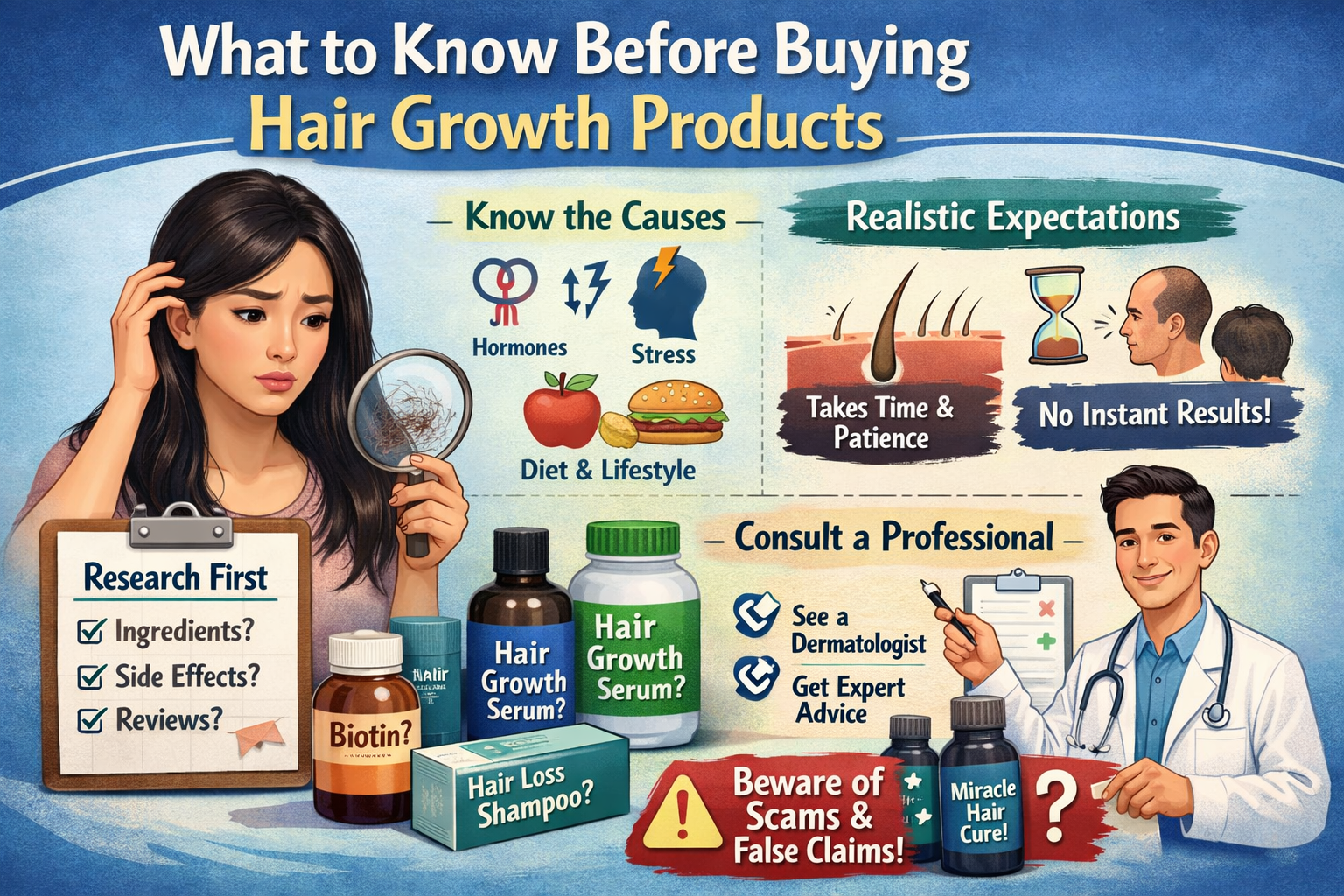
Hair loss can be influenced by genetics, stress, hormonal changes, diet, medical conditions, or even how you treat your hair daily. And each of these causes responds differently to treatment.
I learned this the hard way. I spent weeks using a product designed for hormonal hair loss, when my issue at the time was largely stress-related. The result? Little to no improvement—and a growing sense of frustration.
Understanding the root cause changes everything. It narrows your options, saves you time, and helps you avoid products that were never going to work for you in the first place.
The Language of Marketing
If you’ve ever read the label on a hair growth product, you’ve probably noticed certain recurring phrases: “clinically tested,” “natural formula,” “dermatologist approved.”
At first glance, they sound reassuring. But over time, I realized that these terms often mean less than we assume.
“Clinically tested” doesn’t always mean “clinically proven.” It might simply mean the product was tested in some capacity—not necessarily that it delivered significant results.
“Natural” sounds appealing, but natural doesn’t always mean effective. Nor does it guarantee safety for every individual.
And “dermatologist approved”? That could mean one dermatologist, somewhere, at some point, gave it a nod.
This doesn’t mean all products are misleading. But it does mean that marketing language should be read with a critical eye. What matters more are the actual ingredients, the evidence behind them, and whether they align with your specific needs.
Ingredients Over Hype
At some point, I stopped focusing on brand names and started paying attention to ingredient lists. That shift changed how I approached everything.
Instead of asking, “Is this product popular?” I began asking, “What’s inside this product, and what does it actually do?”
Certain ingredients have more research behind them than others. Some are known to support scalp health. Others may help strengthen hair or reduce breakage. A few are specifically associated with promoting regrowth under certain conditions.
But here’s the part that often gets overlooked: no ingredient works in isolation from your overall habits.
You can use the most advanced formula available, but if your diet is lacking essential nutrients, or if stress levels remain high, the results may still fall short.
Hair growth isn’t just topical—it’s systemic.
Patience Is Not Optional
This was, perhaps, the hardest lesson for me to accept.
In a world where we expect quick results—next-day delivery, instant downloads, rapid transformations—it’s easy to assume that hair growth should follow the same pattern.
It doesn’t.
Hair grows slowly. Changes take time. And most products, even effective ones, require consistent use over weeks or months before noticeable results appear.
I remember checking the mirror almost daily, looking for signs of progress. It became a habit—one that often led to disappointment.
What I didn’t realize then was that inconsistency was part of the problem. Switching products too quickly, stopping too soon, or using them irregularly all reduced the chances of seeing real results.
Patience isn’t just helpful—it’s essential.
The Cost of Experimentation
There’s a hidden cost to trying multiple products, and it’s not just financial.
Each new product comes with a reset—a new routine, new expectations, and often, new uncertainty. Over time, this cycle can become exhausting.
I reached a point where I had a collection of half-used bottles, each representing a different attempt, a different hope. Looking at them, I realized that the issue wasn’t just the products—it was my approach.
I had been chasing solutions without fully understanding the problem.
Once I shifted to a more informed, selective approach, things became simpler. Fewer products, more consistency, and a clearer sense of direction.
The Role of Professional Advice
There’s a moment, often overlooked, where self-research reaches its limit. Articles, reviews, and videos can only take you so far.
For me, that moment came after months of trial and error. I decided to consult a professional—not because things had gotten worse, but because they weren’t getting better.
That conversation changed my perspective. What felt complicated and overwhelming suddenly became more structured. I had clearer answers, realistic expectations, and a plan tailored to my situation.
It’s not always necessary, but it can save time, money, and unnecessary frustration.
Managing Expectations
One of the most subtle traps in the world of hair growth products is expectation.
We often imagine dramatic transformations—before-and-after images that show striking differences. And while those results are possible for some, they’re not guaranteed for everyone.
Hair growth is influenced by too many variables to promise uniform outcomes.
What I learned, gradually, was to shift my expectations from dramatic change to gradual improvement. Instead of asking, “Will this completely fix everything?” I began asking, “Will this make a meaningful difference over time?”
That shift made the process feel less like a gamble and more like a journey.
Building a Sustainable Routine
Eventually, I realized that no single product was going to solve everything. What mattered more was the routine I built around it.
A consistent schedule. Gentle hair care practices. Attention to diet and overall health. Managing stress where possible.
The product became just one part of a larger system.
And interestingly, that’s when I started noticing real changes—not sudden, dramatic ones, but steady, encouraging progress.
A Final Reflection
If I could go back to that moment in front of the shelf—the one filled with endless options and bold promises—I wouldn’t necessarily choose a different product.
I would choose a different approach.
I would take more time to understand, to question, to observe. I would spend less time chasing quick fixes and more time building a foundation for long-term results.
Because buying a hair growth product isn’t just a transaction. It’s a decision that sits at the intersection of science, habit, emotion, and time.
And perhaps the most important thing to know before making that decision is this:
There is no perfect product.
Only the one that fits your needs, your routine, and your patience.
Everything else is just noise.