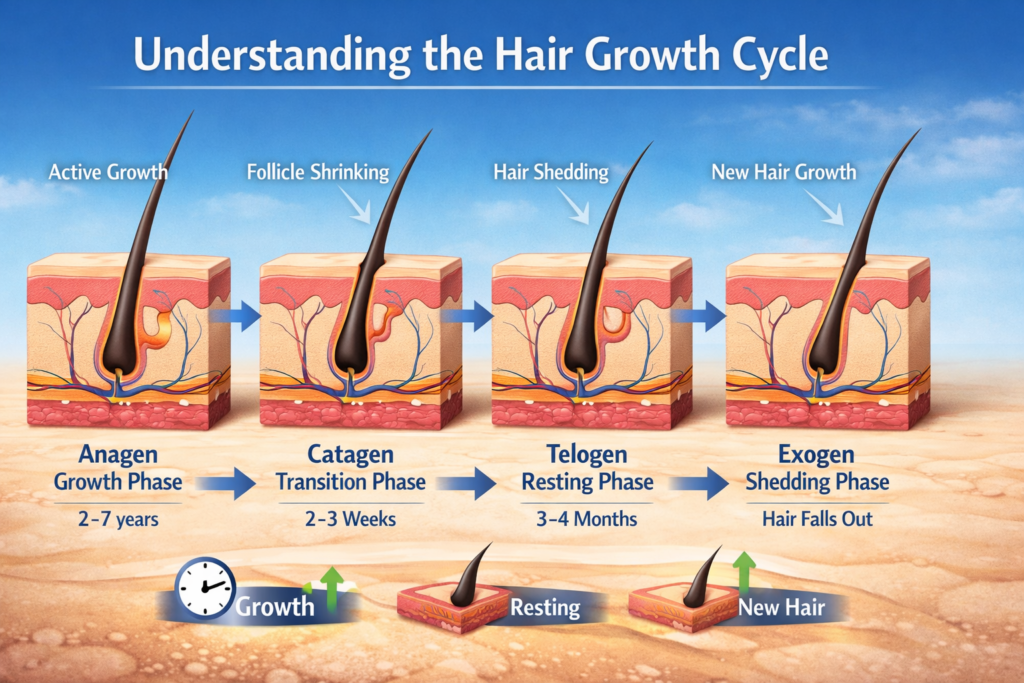
Understanding the Hair Growth Cycle
I used to think hair growth was simple.
It grows.
It falls out.
It grows again.
That was it. A basic loop, something predictable and automatic. I never questioned it, never really thought about what was happening beneath the surface.
Until something changed.
Until I started noticing more hair falling out than I expected… and less growing back than I hoped.
And suddenly, what once felt simple became something I didn’t understand at all.
When the Cycle Stops Feeling Like a Cycle
The first time I questioned it wasn’t dramatic.
It was quiet.
I noticed more hair in the shower. Then in my brush. Then on my pillow. Each moment felt small on its own, but together, they created a pattern.
And patterns lead to questions.
If hair grows back… why does it feel like it’s not?
That question led me somewhere I hadn’t expected—to the idea that hair doesn’t just grow and fall.
It moves through phases.
And those phases matter more than I ever realized.
The Cycle You Don’t See
Hair doesn’t grow continuously in the same way.
Each strand lives its own timeline.
Independent.
Unaware of the others.
At any given moment, your hair is in different stages—some growing, some resting, some preparing to fall.
And because these stages overlap, your hair appears stable.
Balanced.
But that balance is more fragile than it seems.
The Growth Phase: Where Everything Begins
The first phase is growth.
This is when the hair is actively developing, extending from the follicle, becoming visible.
It can last for years.
Not days.
Not weeks.
Years.
Which is why some people can grow long hair while others feel like their hair never reaches a certain length.
Because the length of this phase determines how far your hair can go.
When Growth Feels Slower
There was a time when my hair seemed to grow effortlessly.
Length came naturally.
I didn’t think about it.
But then, something shifted.
Growth felt slower.
Less noticeable.
And I started wondering if it had stopped.
But it hadn’t stopped.
The phase had just changed.
The Transition You Never Notice
After the growth phase, hair enters a brief transition.
You don’t see it.
You don’t feel it.
But internally, the follicle begins to prepare.
Growth slows.
The strand disconnects slightly from its source.
It’s no longer actively developing—but it hasn’t fallen out yet.
It’s in between.
And that “in between” stage is easy to overlook.
The Resting Phase: The Quiet Pause
Then comes the resting phase.
This is where everything feels still.
The hair remains in place.
Not growing.
Not falling.
Just… there.
And this phase can last for weeks or months.
Which means that even when nothing seems to be happening, something is.
Or more accurately—something is waiting.
When Waiting Feels Like Nothing
This was one of the hardest parts to understand.
Because from the outside, it looks like nothing is happening.
No growth.
No change.
And that stillness can feel frustrating.
Especially when you’re expecting movement.
But stillness is part of the cycle.
Not a failure of it.
The Shedding Phase: What You Actually See
Finally, the hair enters the shedding phase.
This is the part we notice.
The part we react to.
The part that feels like something is going wrong.
Hair falls out.
Strands appear in places you didn’t expect.
And suddenly, everything feels different.
Why Shedding Feels Bigger Than It Is
Shedding is visible.
Which makes it feel significant.
But what I didn’t realize is that shedding is not the problem.
It’s part of the process.
A necessary step to make room for new growth.
The issue isn’t that hair falls out.
It’s when the cycle becomes unbalanced.
When the Balance Shifts
At any given time, most of your hair is in the growth phase.
Only a small percentage is in the shedding phase.
That’s what keeps everything looking full.
But when something shifts—stress, illness, nutrition, hormones—more hair can move into the shedding phase at once.
And that’s when you notice it.
The Delay That Confuses Everything
What makes this even more complicated is the delay.
The hair that falls out today might have been affected months ago.
Which means the cause and the effect don’t happen at the same time.
And that disconnect makes everything harder to understand.
Because you’re looking at the present—but the answer is in the past.
When Regrowth Doesn’t Feel Immediate
After shedding, the expectation is regrowth.
But regrowth doesn’t start instantly.
The follicle needs time to reset.
To re-enter the growth phase.
And during that time, it feels like nothing is happening.
But something is.
It’s just not visible yet.
The Illusion of a Broken Cycle
There was a point where I felt like my hair cycle was broken.
Like something had gone wrong.
Because I saw the shedding—but not the return.
But over time, I realized the cycle wasn’t broken.
It was delayed.
Slowed.
Shifted.
And that’s a very different thing.
The Role of Everything Else
Hair doesn’t exist in isolation.
It responds to your body.
Your habits.
Your environment.
Everything you experience becomes part of how your hair behaves.
Which means the cycle isn’t fixed.
It’s responsive.
And that’s why it changes.
When You Start Seeing Patterns
The more I paid attention, the more I noticed patterns.
Periods of more shedding.
Periods of stability.
Moments where things felt better.
Moments where they didn’t.
And those patterns told a story.
Not of something failing—but of something adjusting.
The Importance of Patience (Once Again)
Hair teaches patience in a way few things do.
Because it operates on a timeline that doesn’t match your expectations.
You can’t rush the cycle.
You can’t skip phases.
You can only support it.
And wait.
What Helped Me Understand It Better
Understanding the cycle didn’t fix everything.
But it changed how I saw it.
It turned confusion into clarity.
Fear into awareness.
Because once you understand the process, it feels less random.
Less out of control.
You’re Not Just Losing Hair—You’re Seeing a Phase
That was the thought that stayed with me.
I wasn’t just losing hair.
I was witnessing a phase of a cycle that continues—whether I notice it or not.
And that shift made everything feel more manageable.
So, What Is the Hair Growth Cycle?
It’s not just growth and loss.
It’s a series of phases:
Growth
Transition
Rest
Shedding
Each one necessary.
Each one connected.
Each one part of a larger system.
Final Thought
Understanding the hair growth cycle doesn’t stop hair from falling out.
But it changes how you experience it.
Because instead of seeing loss, you start seeing process.
Instead of seeing something going wrong, you start seeing something unfolding.
And maybe that’s the most important shift—
Realizing that your hair isn’t working against you.
It’s following a rhythm.
One that takes time to understand.
And even more time to fully trust.