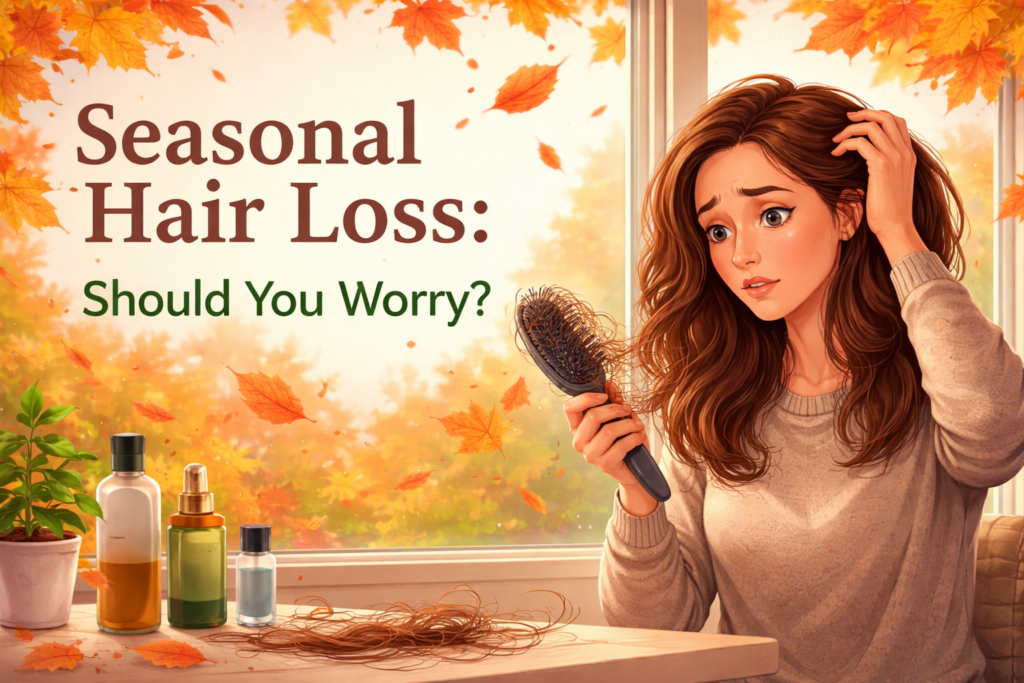
Seasonal Hair Loss: Should You Worry?
I didn’t notice the pattern at first.
To me, it just felt like one of those random phases—like something slightly off, but not enough to question too deeply. A bit more hair in the shower. A few extra strands on my pillow. Nothing dramatic, nothing urgent.
Just… different.
It wasn’t until it happened again—months later, in a strangely familiar way—that I paused.
Same feeling.
Same quiet increase in shedding.
Same subtle shift that I couldn’t quite explain.
And that’s when the thought came to me, almost casually:
Could this be seasonal?
When Change Feels Cyclical
There’s something oddly unsettling about patterns you didn’t expect to find.
Because once you notice them, you start looking backward.
Trying to connect moments that once felt unrelated.
And the more I thought about it, the more it made sense.
There were certain times of the year when my hair seemed… less stable.
Not drastically different.
But enough to notice.
Enough to wonder.
And maybe most confusing of all—enough to question whether I should be worried.
The Seasons You Don’t See—But Feel
We often think of seasons in obvious ways.
Temperature changes.
Weather shifts.
Different clothes, different routines.
But what we don’t always consider is how those changes affect the body internally.
Light exposure.
Sleep patterns.
Stress levels.
Even what we eat tends to shift slightly throughout the year.
And the body responds to all of it.
Quietly.
Gradually.
Without asking for permission.
Hair Has Its Own Rhythm
What I didn’t realize at the time is that hair, like many things in the body, follows rhythms.
Not just daily.
Not just monthly.
But sometimes… seasonally.
There are periods when more hair enters the shedding phase.
And if that phase happens to align with a certain time of year, it can feel like something new—when in reality, it might be part of a repeating cycle.
The problem is, we don’t track our hair that closely.
So when it happens, it feels unexpected.
Even if it isn’t.
The First Time It Feels Like Too Much
Still, knowing that didn’t immediately make it easier.
Because there’s always that moment.
The one where you’re standing in the shower, looking at more hair than usual, and something inside you tightens just a little.
You tell yourself it’s probably nothing.
But your mind doesn’t fully let it go.
Because “probably nothing” still leaves room for doubt.
Why Seasonal Shedding Happens
Over time, I started to understand that seasonal hair loss isn’t as random as it feels.
Changes in daylight can affect hormones.
Temperature shifts can influence scalp health.
Even subtle lifestyle changes—like sleeping patterns or stress levels—can play a role.
And then there’s the delayed effect.
Just like with stress, hair doesn’t always respond immediately.
What you experience now might be connected to something from weeks—or even months—ago.
So by the time shedding increases, the cause isn’t always obvious.
The Autumn Effect (and Beyond)
There’s a period—often around late summer into autumn—where people tend to notice more shedding.
I didn’t know this at first.
But once I experienced it, it started to make sense.
The timing.
The repetition.
The feeling that this wasn’t entirely new.
But seasonal hair loss isn’t limited to one specific time.
It can vary.
Different people, different patterns.
Which makes it harder to define—and easier to question.
When Awareness Turns Into Overthinking
Once I noticed the pattern, I started paying attention more closely.
Too closely, maybe.
Every strand became something to analyze.
Every shower, a quiet check.
Every brush, a small moment of evaluation.
And while awareness can be helpful, there’s a line where it turns into overthinking.
Where observation becomes tension.
And that tension?
It doesn’t help.
The Emotional Side of Uncertainty
What makes seasonal hair loss tricky isn’t just the physical change.
It’s the uncertainty.
Because it’s not constant.
It comes and goes.
Which means you never fully settle into understanding it.
Just when you start to relax, it might happen again.
And that unpredictability keeps the question alive:
Is this normal—or is something wrong?
Learning to Look at Patterns, Not Moments
One of the most helpful shifts I made was this:
Instead of focusing on individual moments, I started looking at patterns over time.
Not how much hair fell out in a single day.
But how things changed across weeks.
Across months.
And when I did that, something became clearer.
The shedding wasn’t permanent.
It had a rhythm.
It increased.
Then it slowed.
Then things returned to what felt like normal.
The Body’s Way of Adjusting
It helped me to think of it this way:
The body is constantly adjusting.
To environment.
To routine.
To internal balance.
And sometimes, hair becomes part of that adjustment.
Not because something is wrong.
But because something is shifting.
And shifts don’t always feel comfortable.
When Should You Actually Worry?
This was the question I kept coming back to.
And the answer, I realized, isn’t about one moment.
It’s about consistency.
If the shedding is temporary—lasting a few weeks, maybe a couple of months—and then slows down, it’s often part of a natural cycle.
But if it continues without improvement…
If your hair starts to feel noticeably thinner over time…
If you don’t see any signs of stabilization…
That’s when it’s worth paying closer attention.
Not with panic.
Just with awareness.
The Importance of Not Overreacting
There’s a temptation to act quickly.
To change everything at once.
New products.
New routines.
New habits.
But hair doesn’t respond well to sudden, reactive changes.
It responds better to consistency.
To gentle care.
To giving it the time it needs to move through its cycle.
The Subtle Signs of Recovery
Just like the shedding didn’t start suddenly, the improvement didn’t either.
It was gradual.
Almost easy to miss.
Less hair in the drain.
Less on my clothes.
Less in my hands when I ran my fingers through it.
Not zero.
Just… less.
And that “less” felt like reassurance.
Trusting the Process (Even When It’s Quiet)
One of the hardest parts of seasonal hair loss is trusting something you can’t fully see.
Because the process is slow.
Subtle.
Quiet.
But over time, it reveals itself.
Not in a dramatic transformation.
But in a return to balance.
So, Should You Worry?
Maybe a little.
But not in the way you think.
Not with fear.
Not with urgency.
More like awareness.
Curiosity.
A willingness to notice patterns without immediately assuming the worst.
Because in many cases, seasonal hair loss is just that—
Seasonal.
Temporary.
Part of a cycle that your body already understands, even if you don’t fully see it yet.
You’re Not the Only One Noticing This
If you’ve found yourself wondering about this—questioning why your hair seems to shed more at certain times—you’re not alone.
It’s something many people experience.
They just don’t always connect the dots right away.
Final Thought
Looking back, I realize that what felt random wasn’t random at all.
It was rhythmic.
Subtle.
Easy to miss until you stepped back and saw the bigger picture.
Seasonal hair loss isn’t always something to fear.
Sometimes, it’s something to understand.
A reminder that the body moves in cycles—
Even when we expect it to stay the same.
And maybe, instead of asking “Should I worry?”…
The better question is:
“Am I paying attention in the right way?”