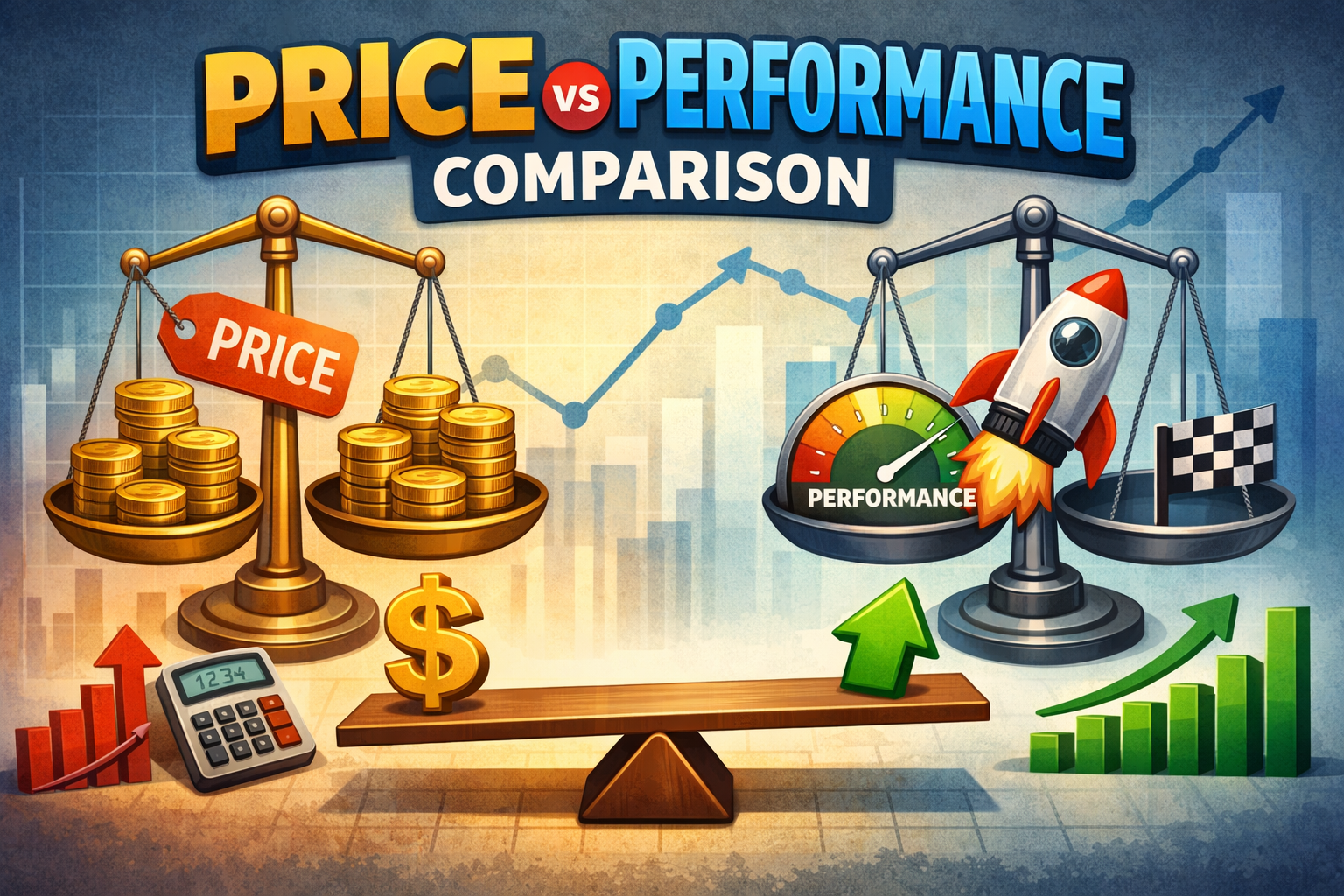
Price vs Performance: The Story We All Live Through When Choosing Tech
I still remember the first time I truly understood what “price vs performance” meant—not from a YouTube review, not from a spec sheet, but from a mistake.
It was a quiet afternoon, and I had just saved up enough money to buy my first “serious” laptop. I spent days—no, weeks—scrolling through product pages, watching comparison videos, and reading comments from strangers who all sounded like experts. Some said, “Always go for the cheapest option that gets the job done.” Others insisted, “If you don’t buy the best, you’ll regret it.”
Caught between those two extremes, I made a choice that felt logical at the time: I picked the cheapest laptop that seemed powerful enough.
And for a while, it worked.
The Illusion of “Good Enough”
At first, everything felt fine. The laptop turned on quickly, handled basic tasks, and didn’t look bad sitting on my desk. I convinced myself I had made a smart decision—after all, why spend more when this already worked?
But then the cracks began to show.
A few browser tabs turned into a frozen screen. Editing a simple video became a test of patience. Even typing started to feel sluggish, as if the machine was quietly resisting every command I gave it.
That’s when I realized something important: performance is not just about whether something works—it’s about how it feels while it works.
And that feeling? It matters more than we admit.
The Hidden Cost of Cheap Choices
When people talk about price, they usually mean the number on the receipt. But in reality, price has layers.
There’s the initial cost—the money you pay upfront.
Then there’s the hidden cost—the time you lose, the frustration you build up, and sometimes even the opportunities you miss.
That cheap laptop I bought? It didn’t just cost me money. It cost me time. Hours waiting for things to load. Minutes lost every day to small delays that added up. And perhaps worst of all, it drained my motivation. Tasks that should have felt exciting started to feel like chores.
That’s when I began to understand the deeper meaning of price vs performance:
It’s not about spending less or more—it’s about spending wisely.
When Expensive Doesn’t Mean Better
But here’s the twist in the story.
After that experience, I swung to the other extreme. The next time I upgraded, I told myself: “This time, I’ll get the best.”
I bought a high-end machine with specs that sounded impressive—more power than I realistically needed. It was fast, smooth, and honestly, a joy to use.
But after a few months, a different kind of realization hit me.
I wasn’t using even half of what the machine could do.
The extra power I paid for? It sat there, unused, like a sports car stuck in traffic.
And that’s when another truth revealed itself:
Overpaying for performance you don’t need is just as inefficient as underpaying and struggling.
The Balance We’re All Trying to Find
Price vs performance is not a formula. It’s not something you can calculate perfectly with numbers. It’s a balance—one that depends on who you are, what you do, and what you value.
For a student writing essays and browsing the web, “good enough” might truly be enough.
For a video editor, designer, or gamer, performance isn’t a luxury—it’s a necessity.
And for someone in between? That’s where things get complicated.
We often think the goal is to find the “best deal,” but what we’re really searching for is the right fit.
The Emotional Side of Technology
What surprised me most in this journey wasn’t the technical side—it was the emotional side.
We don’t just buy devices. We build relationships with them.
A slow device can make you feel stuck. A reliable one can make you feel capable. A powerful one can make you feel inspired.
Think about it: how often has a lagging app ruined your mood? Or how satisfying it feels when everything just works seamlessly?
Performance isn’t just about speed. It’s about confidence.
When your tools don’t get in your way, you start to focus on what actually matters—your ideas, your work, your creativity.
The Myth of Future-Proofing
One of the most common arguments in favor of spending more is “future-proofing.”
It sounds logical: buy something powerful now so it lasts longer, right?
But in reality, technology evolves so quickly that “future-proof” often becomes “overpaid.”
That top-tier device you buy today might feel outdated in a few years—not because it stopped working, but because something newer and more efficient replaced it.
So instead of asking, “Will this last forever?” a better question might be:
“Will this serve me well for the next few years?”
Because in the world of technology, longevity isn’t just about durability—it’s about relevance.
Learning to Define Your Own Needs
If there’s one lesson I’ve learned, it’s this: no review, no influencer, and no spec sheet can tell you what’s right for you.
They can guide you, yes. But they can’t define your needs.
Only you can do that.
Start by asking simple questions:
- What do I actually use this for every day?
- Where do I feel frustrated with my current setup?
- What would make my experience smoother or more enjoyable?
These questions don’t have flashy answers, but they lead to smarter decisions.
Because once you understand your needs, the price vs performance equation becomes clearer.
The Sweet Spot
Somewhere between “too cheap” and “too expensive” lies what I like to call the sweet spot.
It’s not the most powerful option. It’s not the cheapest either.
It’s the one that feels right.
The one where you don’t hesitate every time you open your wallet, but you also don’t feel limited every time you use it.
Finding that sweet spot isn’t always easy. It requires patience, research, and sometimes even a few mistakes along the way.
But once you find it, everything changes.
A Personal Shift in Perspective
These days, when I look at new devices, I no longer ask, “Is this the best?”
Instead, I ask, “Is this the best for me?”
It’s a small shift, but it makes a huge difference.
I’ve learned to value my time more than I used to. I’ve learned that a smoother experience can be worth paying for—but only up to a point.
And most importantly, I’ve learned that the goal isn’t perfection.
It’s satisfaction.
The Quiet Satisfaction of a Good Choice
There’s a unique kind of peace that comes from making a well-balanced decision.
It’s not the excitement of buying something flashy. It’s not the pride of owning the most expensive option.
It’s quieter than that.
It’s the feeling of using something every day without thinking twice about it. No frustration, no regret—just a smooth, reliable experience.
That’s when you know you got it right.
Final Thoughts: It’s Never Just About the Numbers
Price vs performance is often presented as a technical comparison—benchmarks, specs, charts.
But in reality, it’s a human story.
It’s about how we make decisions, how we learn from mistakes, and how we gradually understand what truly matters to us.
Sometimes we go too cheap and regret it. Sometimes we spend too much and realize we didn’t need to.
And somewhere along the way, we begin to find balance.
So the next time you’re faced with a decision, don’t just look at the numbers.
Think about your experience. Your needs. Your daily life.
Because in the end, the best choice isn’t the cheapest or the most powerful.
It’s the one that makes your life just a little bit easier, every single day.