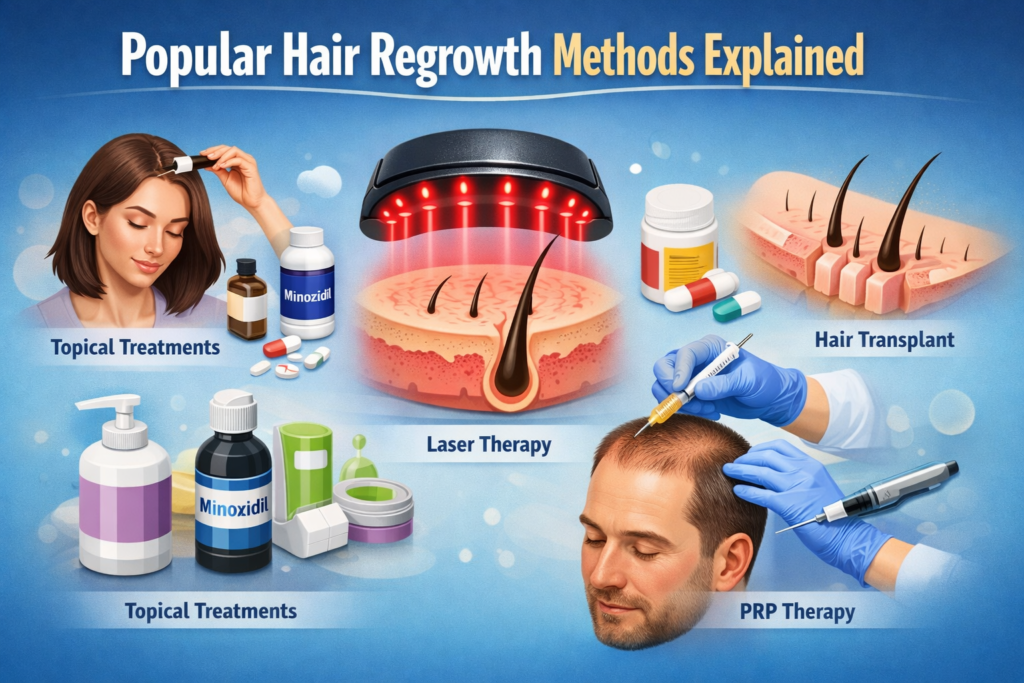
Popular Hair Regrowth Methods Explained
I didn’t start by understanding the methods.
I started by feeling lost.
Because once you realize your hair isn’t growing the way it used to—or worse, that it’s slowly thinning—you begin searching. Not casually, but urgently. You want answers. Solutions. Something that feels reliable.
And what you find… is everything.
Too many options.
Too many promises.
Too many voices saying this is what works.
And that’s where the confusion begins.
The Overwhelm of Too Many Choices
At first, it all blends together.
Serums.
Oils.
Treatments.
Supplements.
Devices.
Every option claiming to help.
Every method sounding just convincing enough to try.
And when you’re already uncertain, that amount of choice doesn’t feel empowering.
It feels overwhelming.
The Need to Understand, Not Just Try
I realized quickly that trying everything wasn’t the answer.
Because without understanding, you’re just guessing.
Switching from one method to another.
Hoping something works—without knowing why it should.
So I paused.
And started asking a different question:
What do these methods actually do?
Not All Methods Work the Same Way
That was the first thing that became clear.
Hair regrowth methods don’t all target the same thing.
Some focus on the scalp.
Some on the hair cycle.
Some on internal support.
And understanding that difference changes how you see them.
Because now, they’re not just options.
They’re approaches.
1. Topical Treatments: Working on the Surface
These are the most common.
Serums.
Solutions.
Things you apply directly to your scalp.
At first, they feel like the most logical choice.
Because they’re immediate.
Visible.
Easy to use.
But their role is specific.
They support the environment of the scalp.
They may stimulate follicles.
But they don’t always address deeper causes.
And that distinction matters.
2. Natural Oils: Gentle, Consistent Support
Oils felt simpler.
Less clinical.
More traditional.
Massaging them into the scalp became part of a routine—not just a treatment.
And while they don’t create dramatic, fast results, they support balance.
Moisture.
Circulation.
Consistency.
They’re not a quick fix.
But they can be part of a long-term approach.
3. Supplements: Supporting from Within
This was where things started to feel different.
Because instead of applying something externally, you’re supporting your body internally.
Vitamins.
Minerals.
Nutrients your hair depends on.
But supplements only work if there’s something missing.
They don’t create growth out of nothing.
They support what your body is already capable of doing.
4. Medical Treatments: Targeting the Process
Some methods are more direct.
More focused.
Designed to influence the hair cycle itself.
These approaches don’t just support—they intervene.
And that makes them more effective in certain cases.
But also more specific.
They’re not for everything.
And they require understanding before use.
5. Scalp Treatments and Therapies
This includes things like:
Massage techniques
Microneedling
Light-based therapies
At first, they sounded complicated.
But their goal is simple:
Improve the environment where hair grows.
Increase circulation.
Stimulate activity.
And over time, these methods can support regrowth—especially when combined with other approaches.
6. Lifestyle Adjustments: The Overlooked Factor
This wasn’t something I expected to matter as much as it did.
Sleep.
Stress.
Diet.
Daily habits.
They don’t feel like “treatments.”
But they influence everything.
Because hair doesn’t grow in isolation.
It reflects your overall balance.
And without that balance, other methods have limited effect.
When Methods Don’t Work the Way You Expect
One of the most frustrating parts is this:
You try something.
You follow it consistently.
And nothing seems to change.
But that doesn’t always mean the method doesn’t work.
It might mean it’s not the right method for your situation.
The Importance of Matching the Cause
Hair loss has different causes.
And each cause responds differently.
So a method that works for one person might not work for another.
Not because it’s ineffective—
But because it’s not aligned with the cause.
The Mistake of Expecting One Solution
At first, I wanted one answer.
One method that would fix everything.
But hair regrowth doesn’t usually work that way.
It’s layered.
Multiple factors working together.
And the most effective approach often combines methods.
When You Start Seeing Patterns
Instead of focusing on individual methods, I started noticing patterns.
What supports the scalp?
What supports the body?
What reduces damage?
What encourages growth?
And once I saw those patterns, everything felt clearer.
The Role of Time (Again)
No method works instantly.
Even the most effective ones take time.
Weeks.
Months.
Because hair growth itself is slow.
And that means every method requires patience.
The First Signs of Progress
The changes weren’t dramatic.
But they were real.
Less shedding.
Slightly thicker strands.
Small improvements that built over time.
And those small signs mattered.
Because they showed that something was happening.
You’re Not Choosing a Product—You’re Choosing an Approach
That was the realization that stayed with me.
It’s not about finding the perfect product.
It’s about understanding the approach behind it.
And choosing what aligns with your situation.
You Don’t Need to Try Everything
Trying everything creates confusion.
What matters is choosing thoughtfully.
Understanding what you’re using.
And giving it time to work.
So, What Should You Know About Hair Regrowth Methods?
That they work differently.
That they target different aspects of the process.
That no single method works for everyone.
And that effectiveness depends on alignment—with your specific situation.
You’re Not Out of Options—You’re Learning to Choose
That shift changed everything.
I wasn’t running out of solutions.
I was learning how to choose the right ones.
Final Thought
Hair regrowth methods can feel overwhelming at first.
Too many options.
Too many promises.
Too much uncertainty.
But once you understand how they work, the noise fades.
And what’s left is clarity.
Because it’s no longer about trying everything—
It’s about choosing what makes sense.
And giving it the time it needs to work.
Because real progress doesn’t come from doing more.
It comes from doing what’s right—
Consistently,
Patiently,
And with understanding.