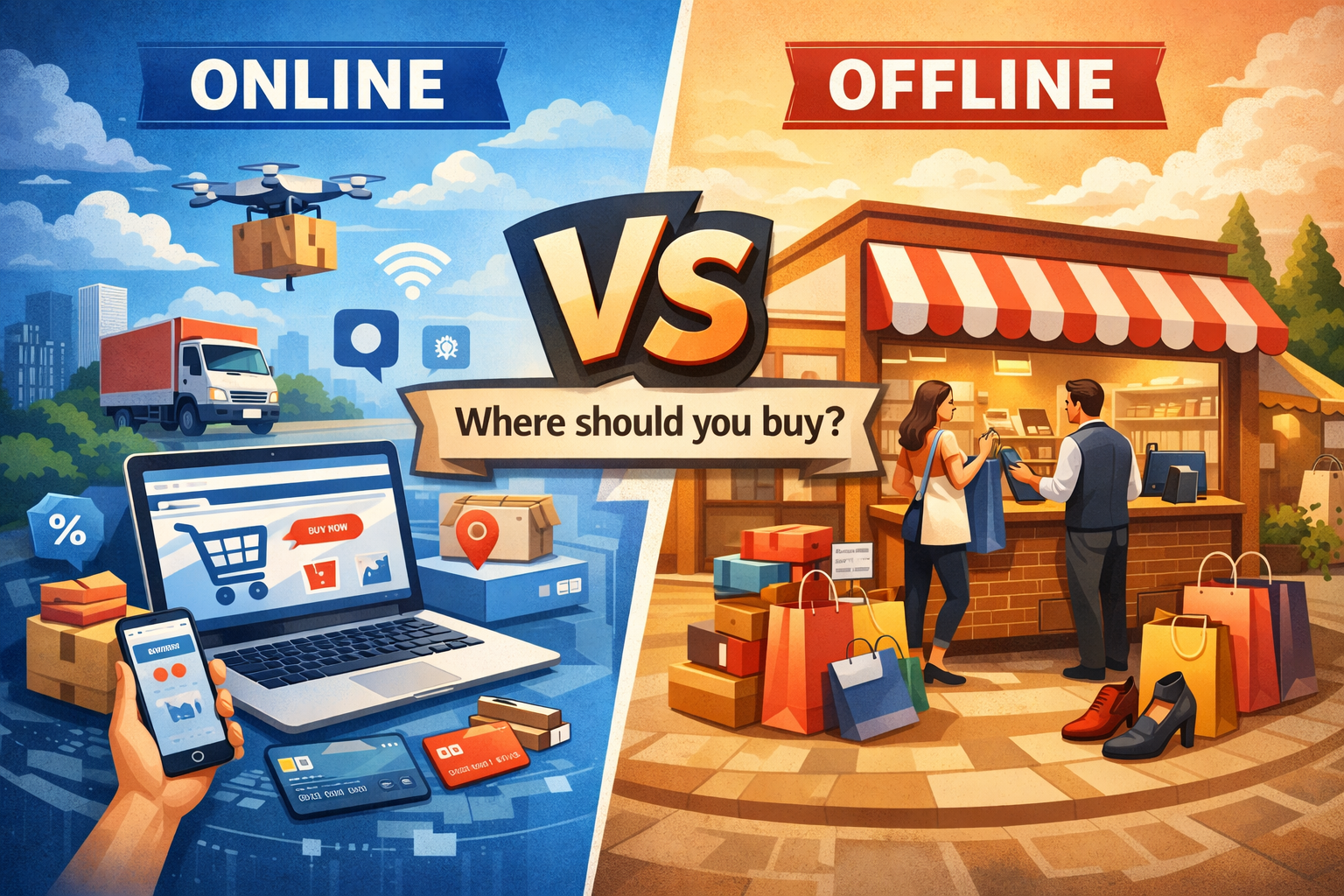
Online vs Offline: Where Should You Buy?
A personal reflection on choices, habits, and the quiet psychology behind how we shop
I didn’t realize I had developed a “shopping personality” until one rainy afternoon changed the way I looked at buying things.
It started with something simple—a pair of headphones. Mine had stopped working the night before, right in the middle of a playlist I had been saving for a long time. The silence that followed felt strangely louder than the music itself. So the next day, I decided to replace them.
At first, I instinctively reached for my phone. Within seconds, I was scrolling through dozens of options—different brands, colors, prices, reviews, ratings. It was all there, neatly organized, waiting for me to choose. Online shopping had always felt like that: fast, efficient, almost too easy.
But then, something made me pause.
Maybe it was the rain tapping against the window, or the thought of stepping outside after a long week indoors. Whatever it was, I put my phone down, grabbed my jacket, and decided to walk to a nearby electronics store instead.
That small decision opened up a comparison I hadn’t fully considered before—not just between online and offline shopping, but between two entirely different experiences of making a choice.
The Convenience of Online Shopping
Let’s be honest—online shopping is incredibly convenient. There’s no travel, no waiting in line, no need to interact with anyone unless you want to. Everything is available at your fingertips, 24/7.
That day, before leaving the house, I had already seen at least 50 different headphone options online. I could filter them by price, brand, features, even by customer ratings. It felt like having a personal assistant who had already done all the searching for me.
And then there are the reviews.
Reviews are powerful. They give you a sense of confidence, a feeling that you’re not making the decision alone. Hundreds, sometimes thousands, of people have already tried the product and shared their thoughts. It creates a kind of collective wisdom that’s hard to ignore.
But as helpful as reviews are, they also introduce something else: doubt.
I remember scrolling through comments where one person praised the sound quality while another complained it broke within a week. One called it “perfect,” another called it “a waste of money.” The more I read, the harder it became to decide.
Online, you don’t just see options—you see opinions. And sometimes, too many opinions can make the decision heavier than it needs to be.
The Experience of Offline Shopping
Walking into the store felt different immediately.
There was no endless scroll, no filters, no comparison tabs. Just shelves, products, and the quiet hum of people browsing. It was simpler, but also more real.
I picked up a pair of headphones and turned it over in my hands. The weight, the texture, the way it folded—these were things I couldn’t fully understand through a screen. I tried them on, listened to a sample track, adjusted the fit.
In that moment, the decision became less about specifications and more about experience.
A store assistant approached me—not in a pushy way, but just enough to offer help. We talked briefly. He pointed out a model I hadn’t considered, explained a feature I didn’t know I needed, and answered my questions without overwhelming me.
That interaction, small as it was, added something human to the process.
Offline shopping, I realized, isn’t just about buying a product. It’s about engaging with it—physically, directly, and sometimes even emotionally.
The Hidden Cost of Convenience
On the surface, online shopping often appears cheaper. Discounts, promo codes, flash sales—they’re everywhere. It creates the impression that you’re getting a better deal.
But over time, I started noticing something subtle.
Because it’s so easy to buy things online, I was buying more than I actually needed.
A discounted item here, a “limited-time offer” there. Each purchase felt justified in the moment, but later, I would look back and realize that many of those things weren’t essential.
Convenience, in this sense, has a hidden cost. It reduces the friction of decision-making, which sounds good—but that same friction is sometimes what helps us pause and think.
When I walked to the store that day, the effort it took—the time, the movement, the intention—made the purchase feel more deliberate. I wasn’t just clicking a button. I was choosing.
Time: Saved or Spent Differently?
One of the biggest arguments in favor of online shopping is that it saves time. And in many ways, it does.
You don’t have to travel, search through aisles, or wait in line. A few clicks, and you’re done.
But I’ve started to question whether it truly saves time—or simply redistributes it.
Think about how long we spend comparing products, reading reviews, checking different websites for better prices. What was supposed to take five minutes can easily turn into an hour.
Offline shopping, on the other hand, often compresses that time. You go to the store, see what’s available, make a decision, and leave. The process is more contained.
That day, my trip to the store took about an hour in total—including the walk. But the decision itself felt quicker, clearer, and somehow lighter.
It made me realize that time isn’t just about duration—it’s about how that time feels.
Trust: Digital vs Physical
Trust plays a huge role in how we shop.
Online, trust is built through systems—ratings, reviews, return policies, brand reputation. It’s structured, measurable, and often reliable.
Offline, trust is more immediate and sensory. You trust what you can see, touch, and test. You trust the environment, the people, the experience.
Neither is inherently better, but they operate differently.
I’ve had moments where an online product looked perfect but didn’t match expectations when it arrived. And I’ve had moments in stores where something felt right instantly, without needing much analysis.
That day with the headphones, trust came from hearing the sound myself. No review could replace that.
The Emotional Side of Buying
This is something we don’t talk about enough—shopping isn’t just a logical process. It’s emotional.
Online shopping often feels transactional. Efficient, yes—but also detached. You click, you buy, you wait.
Offline shopping can feel more like an experience. There’s a beginning, a middle, and an end. You enter the store, explore, decide, and leave with something in your hands.
There’s a sense of closure to it.
When I walked out of the store with my new headphones, the rain had stopped. I remember putting them on as I walked home, the music returning in a way that felt earned.
It wasn’t just about the product—it was about the process.
So, Where Should You Buy?
If there’s one thing I’ve learned, it’s that this isn’t a question with a single answer.
Online and offline shopping aren’t competitors in a strict sense—they’re tools. And like any tool, their value depends on how and when you use them.
- Online shopping is ideal when you know exactly what you want, when you need convenience, or when you’re comparing a wide range of options.
- Offline shopping shines when experience matters—when you want to see, touch, try, or simply slow down the decision-making process.
Over time, I’ve found myself using both, but more intentionally.
Sometimes, I’ll research online and buy in-store. Other times, I’ll check a product in-store and order it online later. The boundary between the two is no longer fixed—it’s fluid.
A Personal Balance
That rainy afternoon didn’t turn me into someone who avoids online shopping. I still use it—probably more than I should.
But it did make me more aware.
Aware of how I make decisions.
Aware of when I’m choosing out of convenience versus intention.
Aware of the subtle ways time, effort, and experience shape the value of what I buy.
Now, whenever I’m about to make a purchase, I pause—not for long, just enough to ask myself a simple question:
Do I want this to be quick, or do I want this to be meaningful?
Sometimes, the answer is quick. And that’s fine.
But other times, I choose to step outside, walk into a store, and experience the process fully.
Because in the end, it’s not just about where you buy.
It’s about how you choose.