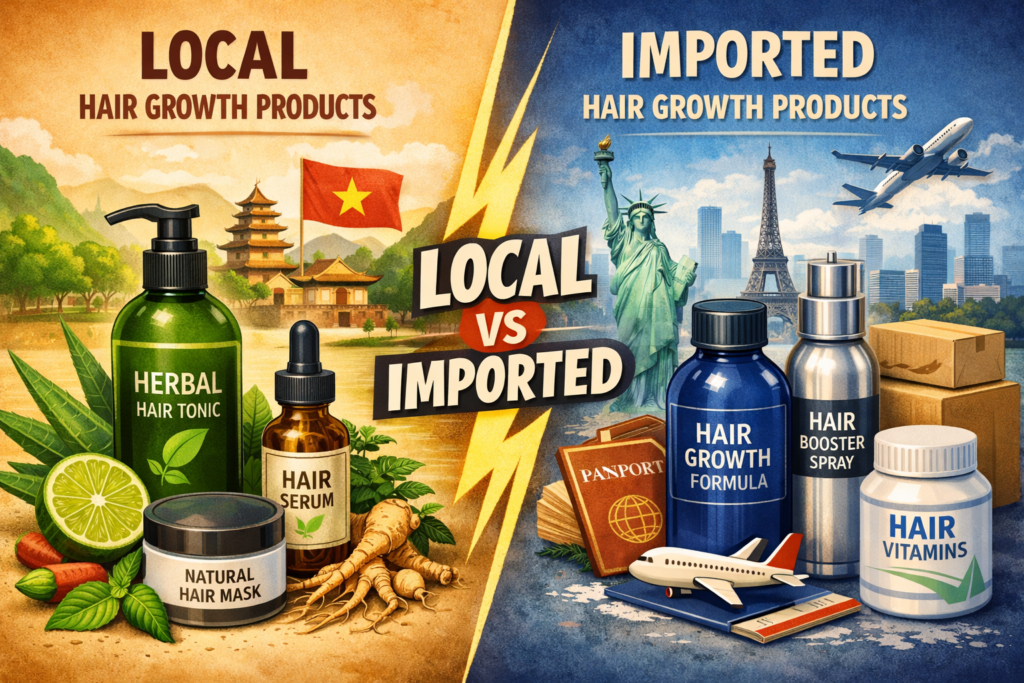
Local vs Imported Hair Growth Products: A Personal Journey Through Choices, Doubts, and Discoveries
I didn’t think much about hair care—until the day I noticed more strands than usual clinging to my fingers in the shower.
At first, I brushed it off. Stress, I told myself. Maybe the weather. Maybe I’d been tying my hair too tightly. But as days turned into weeks, the shedding didn’t slow down. My once thick, easy-to-manage hair began to feel thinner, weaker, almost unfamiliar. That’s when I found myself standing in front of shelves—both physical and online—filled with hair growth products, caught between two worlds: local and imported.
And that’s where the real journey began.
The First Temptation: Imported Products
Like many people, my instinct was to trust imported products first.
There’s something about sleek packaging, foreign brand names, and glowing reviews from influencers that makes imported products feel… superior. I remember scrolling through endless posts—“miracle serums,” “clinically proven formulas,” “results in 7 days.” It was hard not to be convinced.
I ended up buying a well-known imported hair growth serum. It wasn’t cheap. In fact, it cost more than I was comfortable admitting. But I justified it: If it works, it’s worth it.
When it arrived, everything about it felt premium—the scent, the texture, even the dropper. I followed the instructions religiously. Morning and night, massage into the scalp, be patient.
And to be fair, there were changes.
After a few weeks, my hair did feel softer. There were tiny baby hairs sprouting along my hairline. It gave me hope. But at the same time, I noticed something else: my scalp became slightly irritated. Not painfully, but enough to make me pause.
I began reading the ingredient list more carefully. Many of the active components were unfamiliar to me—chemical names I couldn’t pronounce, extracts sourced from places I’d never heard of. It made me wonder: Is my scalp struggling to adapt?
Still, I didn’t want to give up. I had invested money, hope, and time.
A Shift in Perspective: Discovering Local Products
It wasn’t until a casual conversation with a friend that I started reconsidering my approach.
She laughed when I told her how much I’d spent. Then she said something simple that stuck with me:
“Why don’t you try local products first? They’re made for people like us.”
At first, I was skeptical.
Local products, in my mind, had always felt less “advanced.” Less scientific. Less effective. But curiosity got the better of me. I started researching—not through ads, but through real user reviews, small community forums, and even traditional remedies passed down through generations.
What I found surprised me.
Many local hair growth products focused heavily on natural ingredients—things like herbal extracts, oils derived from plants grown in familiar climates, and formulations designed specifically for local hair types and environmental conditions.
I decided to try one.
The Experience: Local vs Imported
The first thing I noticed about the local product was how… simple it felt.
No overly strong fragrance. No complicated instructions. Just a straightforward routine and a list of ingredients I could actually recognize.
I started using it with cautious optimism.
Days passed. Then weeks.
The results didn’t come as dramatically as the imported product had promised. There were no instant transformations. No sudden bursts of new hair growth.
But something else happened instead.
My scalp felt calmer.
The irritation I had experienced before disappeared. My hair began to feel stronger—not necessarily thicker overnight, but more resilient. Less breakage. Less shedding in the shower.
It was a quieter kind of progress. The kind you don’t notice day by day, but suddenly realize after a month when your hairbrush isn’t as full as it used to be.
Breaking Down the Differences
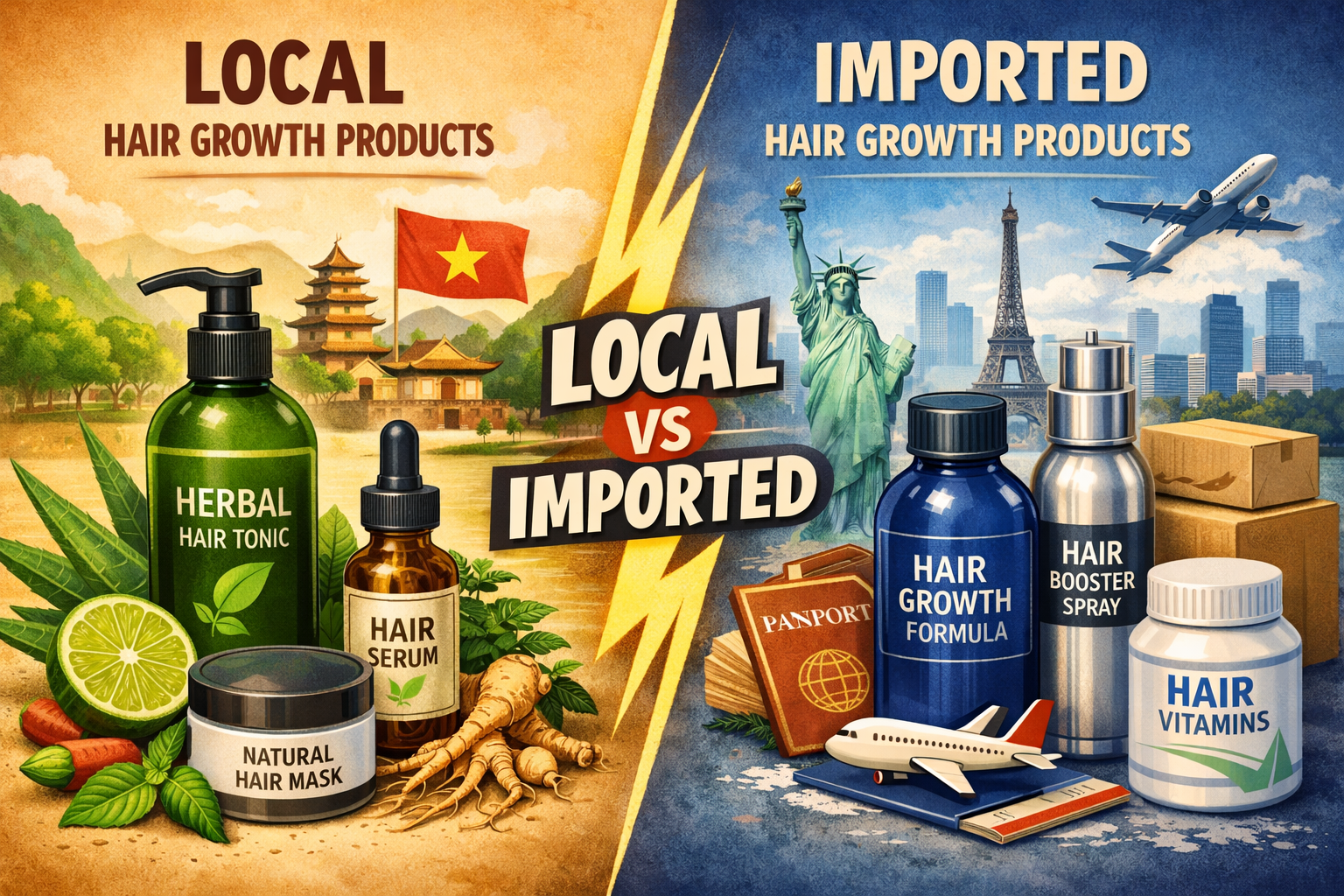
As I continued using both types of products at different times, I began to understand the deeper differences between them—not just in results, but in philosophy.
1. Formulation and Ingredients
Imported products often emphasize cutting-edge formulas and scientifically engineered compounds. They aim for fast, visible results, sometimes at the cost of sensitivity.
Local products, on the other hand, tend to focus on balance. They prioritize compatibility with local hair textures, climates, and common scalp conditions.
It’s not that one is better than the other—it’s that they serve different purposes.
2. Speed vs Sustainability
If you’re looking for quick changes, imported products can be appealing. Many are designed to deliver noticeable effects in a short time.
But local products often play the long game. They aim to improve overall hair health gradually, making the results more sustainable over time.
I realized that my expectations had been shaped by marketing. I wanted immediate results, but what I actually needed was consistency.
3. Cost and Accessibility
This was one of the biggest differences.
Imported products often come with higher price tags—not just because of quality, but also due to shipping, branding, and import costs.
Local products are generally more affordable and easier to repurchase regularly. And when it comes to hair care, consistency matters more than luxury.
4. Cultural and Environmental Fit
This was something I hadn’t considered before.
Hair responds to climate—humidity, temperature, water quality. Local products are often formulated with these factors in mind, making them more adaptable to daily conditions.
Imported products, while effective, may not always align perfectly with local environments.
The Emotional Side of the Journey
What surprised me the most wasn’t just the difference in products—it was the emotional journey that came with it.
Hair loss, even in small amounts, can affect confidence in ways that are hard to explain. It’s not just about appearance—it’s about identity, control, and self-perception.
At first, I felt frustrated. Then anxious. Then impatient.
I kept searching for a “perfect solution,” something that would fix everything quickly. But over time, I learned that hair care isn’t about quick fixes—it’s about understanding your body and responding to it with patience.
Switching between imported and local products wasn’t just about comparison—it was about learning what worked for me.
So, Which One Should You Choose?
If you’re expecting a clear answer—local or imported—you might be disappointed.
Because the truth is, it depends.
If you’re dealing with severe hair loss and need targeted treatment, some imported products with clinically tested ingredients might be helpful.
If your goal is to maintain healthy hair, reduce breakage, and support gradual growth, local products could be a better fit.
But more importantly, it’s about how your scalp reacts.
No product—no matter how expensive or highly rated—can guarantee results for everyone.
What I Learned in the End
Looking back, I realize that my journey wasn’t really about choosing between local and imported products.
It was about shifting my mindset.
I stopped chasing trends and started paying attention to how my hair actually felt. I stopped expecting instant results and started valuing gradual improvement.
Today, my routine is a mix.
I still use certain imported products occasionally, especially when I want targeted treatment. But my foundation—the products I rely on daily—is local.
Not because they’re cheaper. Not because they’re trendy.
But because they work for me.
A Final Thought
If you’re standing where I once stood—staring at shelves, scrolling through reviews, unsure of what to choose—here’s something worth remembering:
The best product isn’t the one with the most hype.
It’s the one your hair quietly agrees with over time.
And sometimes, the answer isn’t far away. It might already be right where you are—simple, familiar, and waiting to be trusted.