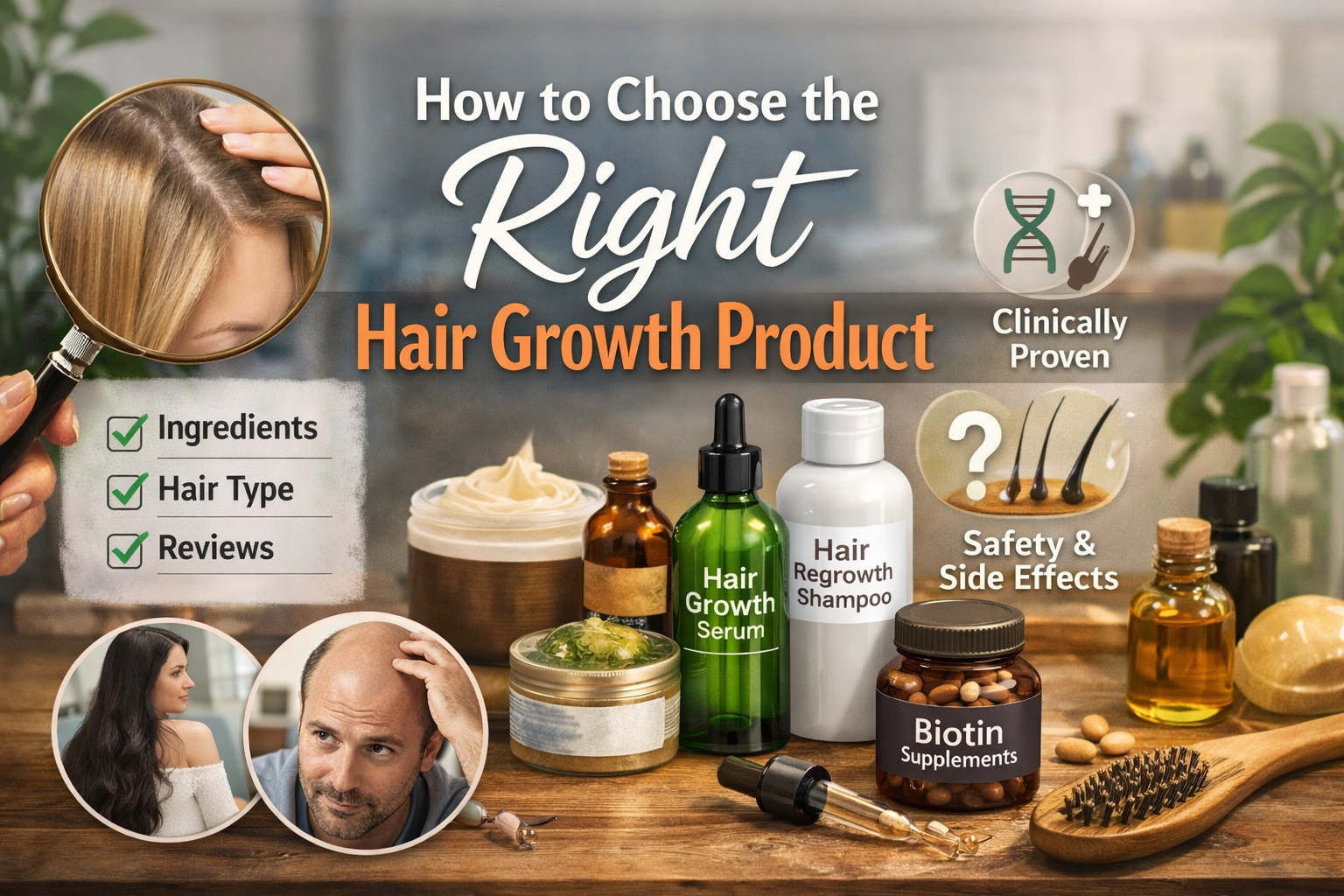
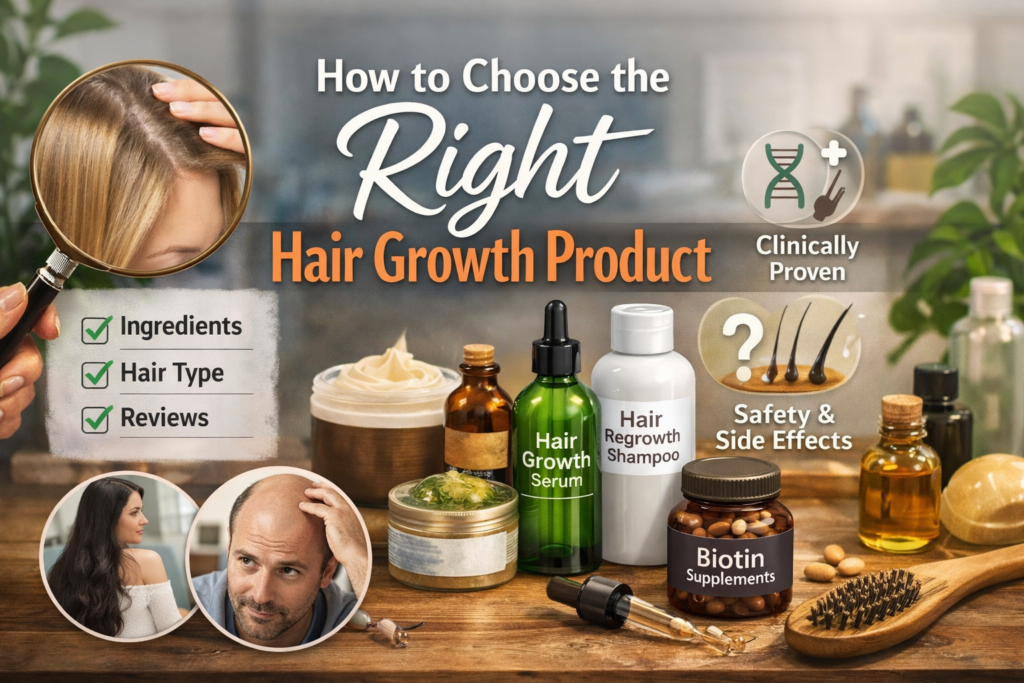
How to Choose the Right Hair Growth Product
A personal journey through trial, error, and finally—understanding what actually works
I still remember the first time I noticed my hair thinning.
It wasn’t dramatic. No clumps falling out in the shower, no sudden bald patches. Just a quiet, almost unnoticeable change. My ponytail felt lighter. My hairline looked a little different in photos. At first, I convinced myself it was just stress, or maybe bad lighting. But deep down, I knew something was changing—and I didn’t know how to deal with it.
Like most people in that situation, I turned to the internet.
And that’s when things got confusing.
There were hundreds of products—oils, serums, shampoos, pills, masks—each one claiming to be the solution. “Guaranteed regrowth.” “Clinically proven.” “Miracle formula.” It felt less like a helpful search and more like walking into a crowded market where everyone is shouting at once.
So how do you actually choose the right hair growth product?
It took me a while—mistakes, wasted money, and a lot of learning—but I eventually figured out a way to approach it that made sense. This isn’t a quick fix or a magic answer. It’s a story of understanding your hair, your body, and the truth behind all those promises.
Step 1: Understand Why Your Hair Is Changing
Before you even look at products, you need to ask yourself a simple question:
Why is this happening?
This is something I ignored at first, and honestly, it cost me time and money.
Hair loss or slow growth isn’t a single problem—it’s a symptom. It can be caused by many different things:
- Stress
- Hormonal changes
- Diet and nutrition
- Genetics
- Scalp health
- Overstyling or heat damage
- Medical conditions
I realized that buying a product without understanding the cause is like trying to fix a leaking roof without finding the hole.
For example, if your hair issues come from stress, no shampoo alone will solve it. If it’s nutritional, your body needs support from the inside. If it’s scalp-related, then topical treatments might help more.
The turning point for me was when I stopped asking, “What product should I buy?” and started asking, “What does my hair actually need?”
Step 2: Don’t Fall for Marketing—Learn to Read Ingredients
This part was overwhelming at first, but it changed everything.
Most hair products are sold through emotional marketing—beautiful models, dramatic before-and-after photos, and words like “natural,” “advanced,” or “scientific.” But those words don’t mean much without substance.
What matters is the ingredient list.
Here are a few ingredients that are often associated with supporting hair growth or scalp health:
- Minoxidil – One of the most researched ingredients for hair regrowth
- Biotin – A vitamin linked to hair strength (helpful if you’re deficient)
- Caffeine – Sometimes used to stimulate hair follicles
- Ketoconazole – Often found in medicated shampoos for scalp conditions
- Essential oils (like rosemary oil) – May support circulation and scalp health
But here’s the important part:
Just because a product contains these ingredients doesn’t mean it’s effective.
Concentration matters. Formulation matters. Consistency matters.
I once bought a shampoo because it had biotin listed on the label—only to realize it was near the bottom of the ingredient list. That meant there was barely any of it in the product.
It taught me to look deeper, not just at what’s included, but how much and how it’s used.
Step 3: Decide Between Internal vs External Solutions
One mistake I made early on was assuming everything could be fixed from the outside.
I bought oils, serums, masks—anything I could apply directly to my hair. And while some of them made my hair feel softer or look shinier, they didn’t address the root of the issue.
Hair growth starts inside your body.
That doesn’t mean supplements are always necessary, but it does mean you should think about:
- Are you eating enough protein?
- Are you getting essential vitamins and minerals?
- Are you sleeping well?
- Are you under constant stress?
External products (like serums or shampoos) work best when your internal health is also supported.
Think of it like watering a plant. You can spray the leaves all you want, but if the roots aren’t getting what they need, growth will still struggle.
Step 4: Choose Based on Your Hair and Scalp Type
Not all hair is the same—and this is something the beauty industry doesn’t emphasize enough.
What works for someone else might not work for you.
Ask yourself:
- Is your scalp oily, dry, or sensitive?
- Is your hair thick, thin, curly, straight, or chemically treated?
- Do you experience dandruff or irritation?
For example:
- If you have a sensitive scalp, strong treatments might cause irritation
- If your scalp is oily, heavy oils might clog follicles
- If your hair is dry, alcohol-heavy products might make things worse
I once followed a trend and tried a popular oil treatment that everyone seemed to love. But for me, it made my scalp itchy and uncomfortable. That experience reminded me that popular doesn’t mean suitable.
Step 5: Be Patient—Real Growth Takes Time
This was probably the hardest lesson.
We live in a world where everything is fast—instant results, overnight success, quick transformations. Hair growth doesn’t work like that.
Hair grows slowly. On average, about half an inch (around 1–1.5 cm) per month.
That means:
- You won’t see real results in a week
- Even a month might not be enough
- Most products need consistent use for 3–6 months
I remember checking my hair every few days, hoping to see a difference. It was frustrating. But once I adjusted my expectations, things became easier.
Progress became something I tracked over time—not something I demanded immediately.
Step 6: Watch Out for Red Flags
There are a few signs that a product might not be trustworthy:
- Claims like “instant hair growth” or “guaranteed results”
- Lack of ingredient transparency
- Overly dramatic before-and-after images
- No real customer reviews (or only overly perfect ones)
A good product doesn’t need to exaggerate.
It will explain what it does, how it works, and what you can realistically expect.
Step 7: Simplicity Often Wins
At one point, my routine had too many steps:
- Special shampoo
- Conditioner
- Leave-in treatment
- Hair oil
- Growth serum
- Weekly mask
It felt productive—but it was overwhelming.
Eventually, I simplified everything.
I focused on a few products that actually suited my needs and used them consistently. That’s when I started noticing real improvement—not dramatic, but steady and meaningful.
Sometimes, doing less—but doing it consistently—is more effective than doing everything at once.
Step 8: Listen to Your Hair (and Adjust)
Your hair will tell you what’s working—if you pay attention.
- Does your scalp feel healthier?
- Is there less breakage?
- Does your hair feel stronger?
- Are you noticing small signs of regrowth?
If something doesn’t feel right—itchiness, dryness, excessive shedding—it’s okay to stop and reassess.
There’s no perfect product that works for everyone forever. Your needs can change over time, and your routine can change with them.
Final Thoughts: It’s Not Just About Products
Looking back, I realize something important:
Choosing the right hair growth product isn’t just about the product.
It’s about understanding yourself.
Your habits. Your health. Your expectations.
The product is just one part of a bigger picture.
If I could go back and give myself advice at the beginning, I would say this:
Don’t rush. Don’t chase every trend. Don’t expect miracles.
Take the time to learn what your hair needs. Be patient with the process. And remember that real, lasting results come from consistency—not quick fixes.
Because in the end, it’s not just about growing your hair.
It’s about building a routine—and a mindset—that actually supports you.
If you want, I can also rewrite this blog in a more casual style, SEO-optimized version, or split it into sections for a website.