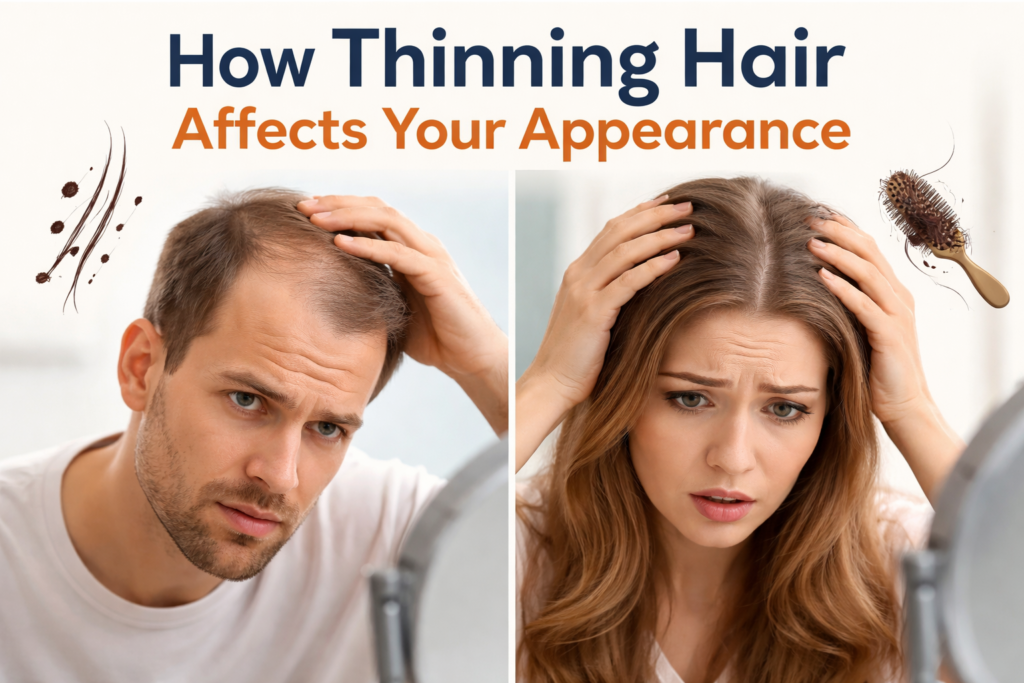
How Thinning Hair Affects Your Appearance
I didn’t notice it in the mirror at first.
That’s what surprised me the most.
Because the mirror is where you expect to see change. It’s where you look, adjust, recognize yourself. But when my hair started thinning, the mirror didn’t tell me right away.
It was too familiar.
Too consistent.
Too… forgiving.
The First Time It Looked Different
It wasn’t until I saw a photo that something felt off.
Not a posed one.
Not one where I had time to prepare.
Just a random moment, captured from an angle I wouldn’t normally see.
And there it was.
My hair looked flatter.
Less full.
Less like I remembered it.
Not dramatically—but enough to pause.
Enough to look again.
When Volume Quietly Disappears
Hair thinning doesn’t always change your appearance in obvious ways.
It doesn’t always create clear gaps or visible loss.
Sometimes, it simply removes volume.
And volume is what gives hair its presence.
Its shape.
Its ability to frame your face.
So when that volume fades, everything shifts slightly.
The Subtle Change in Shape
I started noticing that my hair didn’t sit the same way anymore.
It didn’t lift the way it used to.
It didn’t hold styles as easily.
It fell closer to my scalp.
And that changed the overall shape of my face—just enough to feel different.
When Your Face Looks… Different
Hair frames your face in ways you don’t fully realize until it changes.
It softens angles.
Balances proportions.
Adds dimension.
So when it becomes thinner, that balance shifts.
Your face might appear longer.
Or more exposed.
Or simply… unfamiliar.
The Illusion of Aging
One of the things that caught me off guard was how thinning hair affected how old I looked.
Not drastically.
But subtly.
Less volume made my features look sharper.
More defined.
And sometimes, that translated into looking older than I felt.
Even if nothing else had changed.
When Light Becomes Your Enemy
Lighting started to matter more than I expected.
Bright light.
Overhead light.
Natural sunlight.
All of them revealed things I hadn’t noticed before.
The scalp showing through.
The lack of density.
The way my hair separated more easily.
And once you notice that, it’s hard to unsee.
The Way You Start Adjusting
Without realizing it, I started changing how I styled my hair.
Adding more volume at the top.
Avoiding certain angles.
Choosing styles that made it look fuller.
At the time, it felt like preference.
But it was adaptation.
A response to something I was becoming aware of.
When Movement Feels Different
Even the way my hair moved changed.
It felt lighter.
Less anchored.
More prone to shifting out of place.
And that subtle difference made it harder to ignore.
Because it wasn’t just about how it looked—it was about how it behaved.
The Emotional Layer You Don’t Expect
What I didn’t expect was how it would affect how I felt.
Not in a dramatic way.
But in small, quiet moments.
Checking my reflection a little longer.
Adjusting my hair more often.
Being more aware of how it looked in different settings.
And that awareness stayed with me.
When You Start Comparing
I found myself looking at old photos.
Not obsessively.
Just… curiously.
Trying to see what had changed.
And the difference wasn’t always obvious.
But it was there.
In the density.
In the fullness.
In the way my hair framed my face.
The Difference Between Thick and Thin
Thick hair fills space.
It creates presence.
It adds weight to your appearance.
Thin hair does the opposite.
It reduces that presence.
It makes everything feel lighter—sometimes too light.
And that contrast is what makes the change noticeable.
When Confidence Shifts Slightly
It’s not always about confidence in a big, dramatic way.
It’s more subtle than that.
A small hesitation.
A slight awareness.
A moment where you adjust something that you didn’t used to think about.
And those moments add up.
The Way Others Might See It
What made it more complicated was this:
Not everyone noticed.
Or if they did, they didn’t say anything.
And that created a strange contrast.
Because what felt significant to me might not have been visible to others.
But that didn’t make it less real.
When You Realize It’s Gradual
One of the most important realizations was that thinning doesn’t happen all at once.
It’s gradual.
Layered.
Almost invisible until you step back and look over time.
And that’s why it feels so surprising when you finally notice it.
The Role of Perspective
Perspective changes everything.
Looking at your hair up close tells one story.
Looking at it in photos tells another.
Seeing it in different lighting adds another layer.
And all of those perspectives shape how you perceive the change.
You’re Not Just Seeing Hair—You’re Seeing Change
That was the thought that stayed with me.
I wasn’t just noticing my hair.
I was noticing change.
And change always feels bigger than it is—especially when it’s tied to how you see yourself.
The Balance Between Reality and Perception
Not every change is as visible as it feels.
And not every feeling reflects a dramatic difference.
There’s a balance between what’s actually happening and how you perceive it.
And that balance shifts depending on your awareness.
When You Start Understanding Instead of Reacting
What helped me most wasn’t trying to fix it immediately.
It was understanding it.
Seeing it for what it was.
A gradual change.
Not a sudden loss.
And that made it feel more manageable.
You Don’t Lose Your Appearance—It Evolves
This was the shift that mattered most.
Thinning hair doesn’t erase your appearance.
It changes it.
Subtly.
Gradually.
In ways that take time to understand.
So, How Does Thinning Hair Affect Your Appearance?
Not dramatically.
Not all at once.
But in small, layered ways:
Less volume
Different shape
More visible scalp under light
A shift in how your face is framed
A subtle change in overall presence
Each one small.
But together, noticeable.
You’re Still You
That might sound obvious.
But it matters.
Because when something changes in how you look, it’s easy to feel like something is lost.
But what’s actually happening is adjustment.
Not disappearance.
Final Thought
Thinning hair doesn’t change everything at once.
It changes things gradually.
Quietly.
In ways you don’t always notice until you look a little closer.
But those changes don’t define how you look.
They just become part of how your appearance evolves over time.
And maybe the real shift isn’t in your hair—
But in how you learn to see yourself through that change.
Because once you understand it, it feels less like something happening to you…
And more like something you’re simply learning to see more clearly.