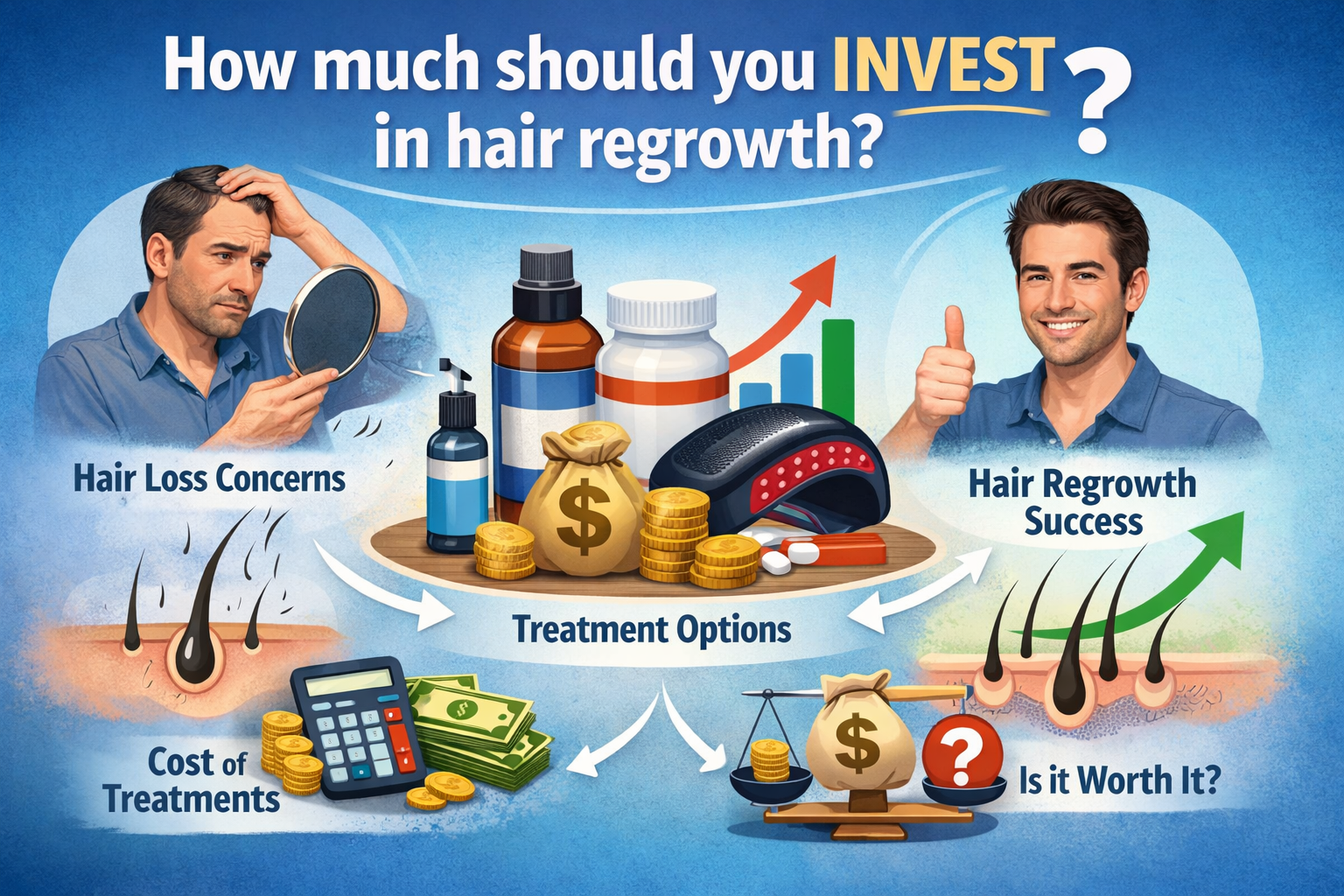
How Much Should You Invest in Hair Regrowth?
A personal reflection on cost, choices, and what really matters
I didn’t notice it all at once.
There was no dramatic moment, no sudden realization under harsh lighting or in front of a mirror. It began quietly—like most things that eventually matter more than we expect. A few extra strands on the pillow. A slightly wider parting line. The way my hand lingered a little longer when brushing my hair, as if I could feel something changing beneath the surface.
At first, I ignored it.
Not because I didn’t care, but because it felt too small to confront. Hair loss, in those early stages, exists in a strange space between denial and awareness. You see it, but you don’t believe it. You tell yourself it’s temporary. Stress, maybe. Seasonal. Something that will fix itself if you just give it time.
But time, I would later learn, is not always a passive ally.
The First Expense: Attention
Before money ever enters the equation, there is a different kind of investment—attention.
I started noticing patterns. When the shedding was worse. How my scalp looked under different lighting. Whether certain days felt “better” than others. It became a quiet habit, almost subconscious, like checking the weather before stepping outside.
And with that attention came questions.
Should I do something about this?
Is it too early?
Or worse—is it already too late?
This is where the idea of “investment” begins to shift. Because investing in hair regrowth isn’t just about money. It’s about deciding that something matters enough to act on.
The Marketplace of Hope
Once you start looking for solutions, you quickly realize how vast—and overwhelming—the options are.
Shampoos promising thicker, fuller hair in weeks.
Serums infused with ingredients you’ve never heard of.
Supplements claiming to “restore from within.”
Clinics offering advanced treatments with impressive before-and-after photos.
Each one comes with a price tag. Some modest. Others… less so.
I remember scrolling late at night, comparing products, reading reviews, trying to make sense of it all. The numbers varied wildly. A $20 bottle here. A $200 treatment there. Monthly subscriptions. One-time procedures. Long-term commitments.
It felt less like shopping and more like navigating a maze.
And at the center of it all was a simple question: How much is enough?
Cheap, Expensive, or Effective?
It’s tempting to assume that more expensive means more effective. That if something costs more, it must work better.
But reality isn’t that straightforward.
I tried starting small. A basic shampoo marketed for “hair strengthening.” It was affordable, easy to incorporate, and felt like a safe first step. For a while, it gave me a sense of control—like I was doing something, even if the results weren’t immediately visible.
Then came the serums. Slightly more expensive, slightly more promising. They required consistency, patience, and a willingness to believe in gradual change.
And that’s when I realized something important: effectiveness isn’t just about the product—it’s about the commitment behind it.
A highly effective treatment won’t work if you use it inconsistently. And a modest product, used regularly and thoughtfully, can sometimes yield surprisingly meaningful results.
The Hidden Cost of Waiting
One of the biggest mistakes I almost made was waiting too long.
There’s a natural hesitation when it comes to spending money on something that feels uncertain. What if it doesn’t work? What if it’s a waste? What if things would have improved on their own?
But here’s what often goes unspoken: delaying action has a cost too.
Hair regrowth, in many cases, is easier in earlier stages. The longer you wait, the more limited your options can become. What could have been addressed with simpler, less expensive methods may eventually require more intensive—and costly—solutions.
I began to see that “saving money” in the short term could actually lead to higher costs later.
And that changed how I thought about investing.
Emotional ROI (Return on Investment)
We often think about return on investment in purely financial terms. Spend X, get Y.
But hair regrowth doesn’t fit neatly into that equation.
The real return is often emotional.
It’s the confidence you feel when you stop worrying about how your hair looks under bright lights.
The relief of not overanalyzing every strand left on your brush.
The quiet comfort of knowing you took action instead of standing still.
I remember the first time I noticed a small improvement—not dramatic, not life-changing, but real. It wasn’t just about the hair. It was about the shift in how I felt.
And suddenly, the money I had spent felt less like an expense and more like an investment in my well-being.
Finding Your Personal Threshold
There’s no universal number when it comes to how much you should invest.
For some, a simple routine with affordable products is enough. For others, professional treatments or consultations feel necessary. The “right” amount depends on a mix of factors:
- How early you start
- The underlying cause of hair loss
- Your consistency and patience
- And, importantly, your personal priorities
I had to ask myself a difficult question: What is this worth to me?
Not in a vague, emotional sense—but in practical terms. What am I comfortable spending monthly? What feels sustainable over time?
Because that’s another truth people don’t always mention—hair regrowth is rarely a one-time cost. It’s an ongoing process.
The Danger of Over-Investing
There’s also a flip side to this journey.
When you care deeply about something, it’s easy to overcorrect. To spend more than you should, chasing faster or better results. To believe that the next product, the next treatment, the next promise will be the one that changes everything.
I came close to this.
At one point, I had a list of products and treatments that, combined, would have cost more than I was comfortable admitting. Each one seemed justifiable on its own. Together, they were overwhelming.
That’s when I realized that investing wisely isn’t about doing everything. It’s about doing the right things consistently.
More isn’t always better. Sometimes, it’s just more.
Simplicity, Consistency, Patience
If there’s one lesson that stayed with me, it’s this: hair regrowth rewards patience more than anything else.
Not instant results. Not dramatic transformations. But slow, steady progress.
I simplified my approach. Focused on a few methods I could realistically maintain. Let go of the constant urge to try something new every week.
And over time, that consistency began to matter more than any single product ever could.
So… How Much Should You Invest?
If you had asked me at the beginning, I would have wanted a number. A clear, definitive answer.
But now, I see it differently.
You should invest enough to:
- Take action early rather than later
- Stay consistent over time
- Feel confident in your choices without financial stress
And perhaps most importantly, enough to feel like you’re not ignoring something that matters to you.
Because in the end, this isn’t just about hair.
It’s about how we respond to change.
How we balance logic and emotion.
How we decide what’s worth investing in—both financially and personally.
I still catch myself checking, sometimes. Old habits don’t disappear overnight.
But now, it feels different.
Less like worry.
More like awareness.
And maybe that’s the real return on investment—not just regrowth, but a better understanding of what it means to take care of something before it’s gone.