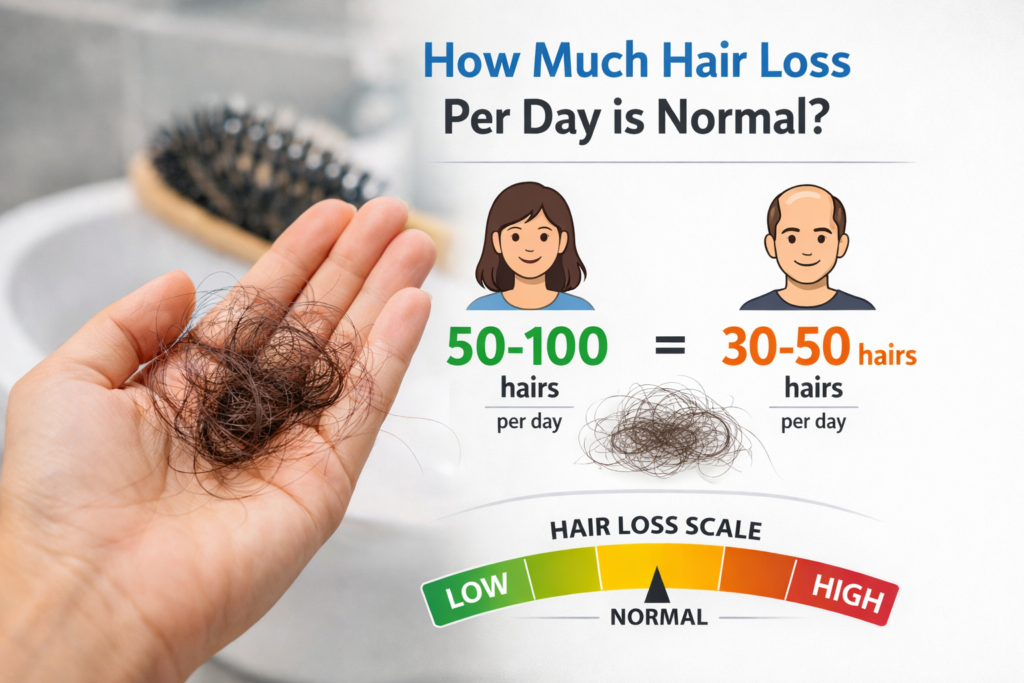
How Much Hair Loss Per Day Is Normal?
I didn’t start by counting.
That would have felt too… intentional. Too obsessive. At least, that’s what I told myself.
But I was noticing.
A few strands on my pillow.
More in the shower.
Even more when I ran my fingers through my hair without thinking.
It wasn’t alarming at first. Just something I became aware of in small, quiet moments. But awareness has a way of growing.
And eventually, that awareness turned into a question I couldn’t ignore anymore:
How much hair loss is actually normal?
The Number Everyone Talks About
At some point, I came across the number.
50 to 100 strands per day.
It’s repeated everywhere. Almost like a rule. A guideline that’s supposed to reassure you.
And at first, it did.
Because it gave structure to something that felt uncertain.
But then came the next thought:
How do I even know if I’m within that range?
The Problem With Counting
I tried, briefly.
Not seriously—but enough to realize how unrealistic it is.
Hair doesn’t fall out in neat, countable ways.
It shows up in moments.
In clusters.
In places where it gathers—your brush, your shower drain, your clothes.
And because of that, it feels like more.
Even if it isn’t.
When Everything Appears at Once
One of the biggest misconceptions I had was thinking that hair loss happens evenly throughout the day.
It doesn’t.
It accumulates.
You might lose some hair while you sleep—but you don’t see it until morning.
More falls out in the shower—but that’s because movement releases what was already loose.
More appears when you brush—but again, that’s just a collection point.
So instead of seeing a steady, gradual process, you see bursts.
And bursts always feel bigger than they are.
Why “Normal” Doesn’t Feel Normal
Even knowing the numbers didn’t fully reassure me.
Because “normal” is abstract.
It’s not personal.
And hair loss feels very personal.
What’s normal for someone else might not feel normal for you.
Because you’re comparing it to what you’re used to.
And that’s the real baseline.
Your Normal vs. The Average
There’s a difference between average and normal.
The average might be 50–100 strands.
But your normal could be less.
Or slightly more.
What matters isn’t just the number—it’s the change.
If you suddenly notice more hair than usual…
If it feels different from your baseline…
That’s when the question becomes more relevant.
The Illusion of “Too Much”
I remember one morning in particular.
After washing my hair, I looked at the drain and paused.
It felt like a lot.
More than usual.
More than I expected.
And immediately, my mind jumped to conclusions.
But later that day, I realized something:
I hadn’t washed my hair in a couple of days.
So what I saw wasn’t just that day’s shedding.
It was multiple days, all at once.
And that changed everything.
Hair Loss Isn’t Always Daily
Another thing I didn’t realize is that hair loss doesn’t always follow a strict daily pattern.
Some days you lose less.
Other days, more.
It fluctuates.
Based on cycles.
Based on timing.
Based on things you don’t always notice.
And that variation can make it feel unpredictable.
Even when it’s not.
When It Becomes Noticeable
There’s a point where hair loss shifts from something you don’t think about…
To something you can’t ignore.
Not because the number suddenly changes dramatically.
But because your awareness does.
You start looking.
Noticing.
Checking.
And once that happens, every strand feels significant.
The Role of the Hair Growth Cycle
Understanding the hair cycle helped me more than any number.
Hair grows, rests, and sheds.
And at any given time, different strands are in different phases.
So shedding isn’t random.
It’s scheduled—just not in a way you can see directly.
And sometimes, more hairs enter the shedding phase at once.
Which creates periods where it feels like you’re losing more.
Even if it’s still within a natural pattern.
When Normal Starts to Feel Abnormal
The tricky part is that normal hair loss doesn’t always feel normal.
Especially when it becomes visible.
Especially when it collects in places you can’t ignore.
Especially when it happens consistently enough to make you think about it.
And that’s where the emotional side comes in.
The Emotional Weight of Numbers
Numbers are supposed to reassure.
But they can also create pressure.
Because once you know the “normal range,” you start comparing.
Trying to estimate.
Trying to measure something that isn’t easy to measure.
And that can make things feel more stressful than they need to be.
What Matters More Than the Number
Over time, I realized that the exact number wasn’t the most important thing.
What mattered more was:
Whether the shedding was increasing over time
Whether my hair felt thinner overall
Whether I was seeing changes beyond just daily loss
Because hair loss isn’t just about quantity.
It’s about pattern.
The Difference Between Shedding and Thinning
You can lose hair daily and still have full, healthy hair.
Because new hair is growing in to replace what’s lost.
But when shedding outpaces regrowth—that’s when thinning happens.
And that’s the distinction that matters most.
When to Pay Closer Attention
There are moments when it’s worth looking a little deeper.
Not with panic.
But with awareness.
If you notice:
Consistently higher shedding over time
Hair feeling less dense
A visible change in volume or thickness
No signs of regrowth
Then it’s not just about daily numbers anymore.
It’s about overall change.
The Danger of Over-Focusing
One thing I had to learn was this:
Paying too much attention can distort your perception.
When you focus on every strand, it feels like more.
When you check constantly, it feels like it’s happening all the time.
And that can create a sense of urgency that isn’t always accurate.
Learning to Step Back
What helped me most was stepping back.
Not ignoring it—but not analyzing every moment either.
Looking at the bigger picture instead of individual strands.
And that shift made everything feel more manageable.
So, How Much Hair Loss Per Day Is Normal?
The general answer is around 50 to 100 strands.
But the more meaningful answer is this:
Whatever is normal for you—until it changes.
Because your baseline matters more than any average.
You’re Not Losing More—You’re Noticing More
That was the thought that stayed with me.
I wasn’t necessarily losing more hair.
I was just noticing it more.
And sometimes, awareness can make something feel bigger than it is.
Final Thought
Hair loss is one of those things that’s easy to overthink.
Because it’s visible.
Because it’s personal.
Because it’s hard to measure precisely.
But the answer isn’t just in the number.
It’s in the pattern.
The consistency.
The changes over time.
So if you’re wondering whether your hair loss is normal, don’t just count strands.
Look at the bigger picture.
Because sometimes, what feels like too much…
Is just something you’re seeing more clearly than before.