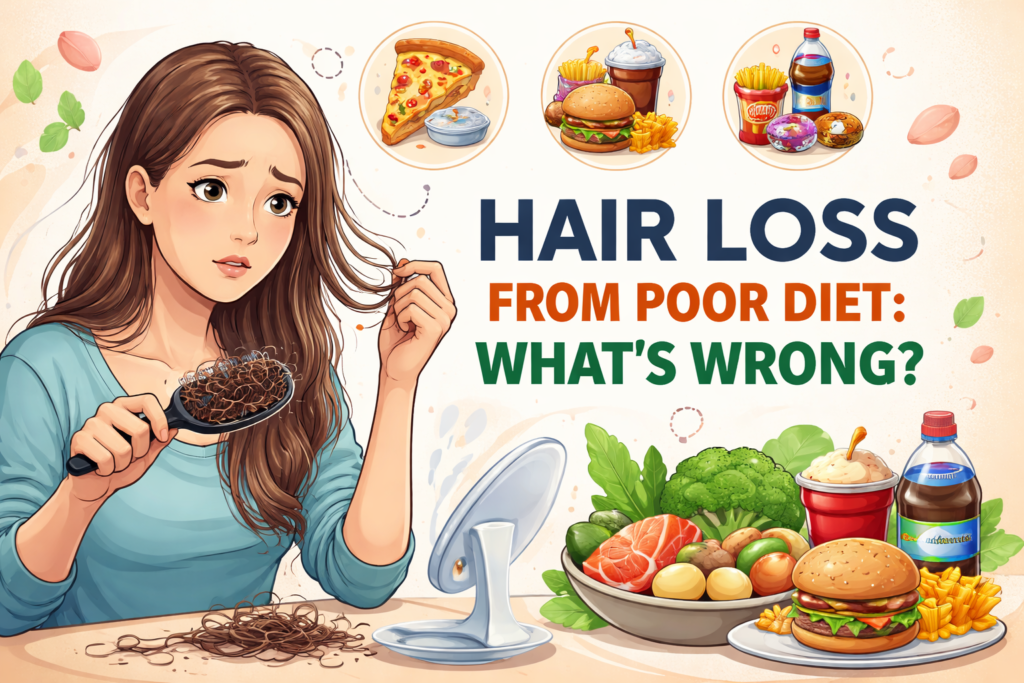
Hair Loss from Poor Diet: What’s Wrong?
I didn’t think my diet had anything to do with my hair.
That was the first assumption.
Because when you think about food, you think about energy. About weight. About how you feel during the day. You don’t immediately think about your hair—something that feels distant, external, almost separate from everything else.
So when my hair started changing, diet wasn’t the first place I looked.
Not even close.
The Disconnect Between What You Eat and What You See
At the time, I felt fine.
Not perfect—but fine.
I wasn’t skipping meals completely. I wasn’t doing anything extreme. I ate when I was hungry. I chose what felt convenient. It didn’t feel like neglect.
It felt normal.
And that’s what made it confusing.
Because if everything felt normal… why was my hair starting to feel different?
The First Signs I Didn’t Connect
It wasn’t just the shedding.
That was the most obvious part—but not the only one.
My hair felt weaker.
Less full.
Less… resilient.
It didn’t bounce back the same way. It didn’t hold its shape. It didn’t feel as strong when I ran my fingers through it.
But I didn’t connect those changes to food.
Because the connection wasn’t immediate.
When “Eating” Isn’t the Same as “Nourishing”
This was the shift that changed everything for me.
I wasn’t lacking food.
But I might have been lacking nutrients.
And those are not the same thing.
You can eat regularly—and still miss what your body actually needs.
And the body doesn’t respond to quantity.
It responds to quality.
Hair as a Low Priority System
One of the hardest things to accept is this:
Hair is not a priority for your body.
If your body has to choose where to send nutrients, it will always prioritize essential functions first.
Organs.
Brain.
Systems that keep you alive.
Hair comes later.
So when something is missing, hair is often one of the first places where that shortage shows up.
The Slow Build of Deficiency
Nothing changed overnight.
That’s what made it difficult to recognize.
It wasn’t like I suddenly stopped eating well.
It was a gradual shift.
More convenience foods.
Less variety.
Less attention to balance.
Small changes that didn’t feel important at the time.
But over weeks… months… they added up.
The Nutrients You Don’t Think About
I started looking into what actually supports hair.
Not in a complicated way.
Just enough to understand.
Protein.
Iron.
Vitamins like D, B-complex.
Minerals like zinc.
Each one plays a role.
Not individually—but together.
And if even one of them is consistently low, it can affect how your hair behaves.
Protein: More Important Than You Realize
Hair is made mostly of protein.
That’s something I had heard before—but never really thought about.
Because protein isn’t just for muscle.
It’s for structure.
For strength.
For growth.
And when intake isn’t consistent, the body adjusts.
Hair growth slows.
Strands become weaker.
Shedding increases.
Not immediately.
But over time.
Iron: The Quiet Impact
Iron was something I never considered.
Because deficiency doesn’t always feel obvious.
You might feel slightly more tired.
Slightly less focused.
But nothing extreme.
And yet, that small imbalance can affect how oxygen is delivered throughout the body—including to hair follicles.
And over time, that affects growth.
The Role of Variety
Another realization was how limited my diet had become.
Not intentionally.
Just through routine.
Eating the same types of food.
Repeating the same patterns.
And while that feels stable, it can lead to gaps.
Because different foods provide different nutrients.
And without variety, those gaps grow.
When Hair Reflects Internal Gaps
Hair doesn’t lie.
It reflects what’s happening inside—even when you’re not aware of it.
And when something is missing, hair shows it.
Not dramatically.
But consistently.
The Frustration of Delayed Effects
What made this even harder was the delay.
The hair loss I was seeing now wasn’t caused by what I ate yesterday.
Or last week.
It was connected to patterns from weeks—or even months—before.
And that delay makes it harder to connect cause and effect.
When You Start Looking Back
I found myself thinking about my habits differently.
Not critically.
Just honestly.
Had I been eating enough protein?
Had I been getting enough nutrients?
Or had I just been getting by?
Because “getting by” works—until it doesn’t.
The Illusion of “Healthy Enough”
I realized I had been operating under a vague assumption:
That I was healthy enough.
But “enough” isn’t always enough for everything.
Hair has its own needs.
And those needs aren’t always met by default.
When Shedding Becomes Noticeable
The more I understood, the more the pattern made sense.
The increased shedding.
The weaker strands.
The slower growth.
It wasn’t random.
It was connected.
Just not in a way I had recognized at first.
The Temptation to Fix Everything Quickly
Once I made the connection, I wanted to fix it immediately.
To change everything at once.
But that approach didn’t last.
Because sudden changes aren’t always sustainable.
And hair doesn’t respond instantly anyway.
The Power of Small, Consistent Changes
What actually helped was something simpler.
Consistency.
Adding more balanced meals.
Paying attention to nutrients.
Not perfectly.
Just more intentionally.
And over time, that made a difference.
The First Signs of Improvement
The change wasn’t dramatic.
But it was real.
Less shedding.
Stronger strands.
Hair that felt slightly more stable.
And those small changes mattered.
Because they showed that the direction was shifting.
You’re Not Just Fixing Hair—You’re Supporting Your Body
That was the realization that stayed with me.
This wasn’t just about hair.
It was about everything.
Energy.
Balance.
Health.
Hair was just one reflection of that.
So, What’s Wrong?
If your hair is falling out due to poor diet, it’s not about one mistake.
It’s about missing pieces.
Gaps that build over time.
Not enough protein.
Not enough iron.
Not enough variety.
Not enough consistency.
And those gaps affect how your body functions—including how your hair grows.
You Don’t Need Perfection
You don’t need a perfect diet.
You don’t need extreme changes.
You just need awareness.
Consistency.
Balance over time.
Because that’s what your body responds to.
Final Thought
Hair loss from poor diet doesn’t happen overnight.
And it doesn’t fix itself overnight either.
It builds slowly.
And it improves the same way.
So if your hair has been changing, and you can’t quite explain why—
It might not be about what you’re doing wrong.
It might be about what you’re not getting enough of.
And once you start filling those gaps, something shifts.
Not immediately.
But steadily.
In the quiet, gradual way that your body always works.