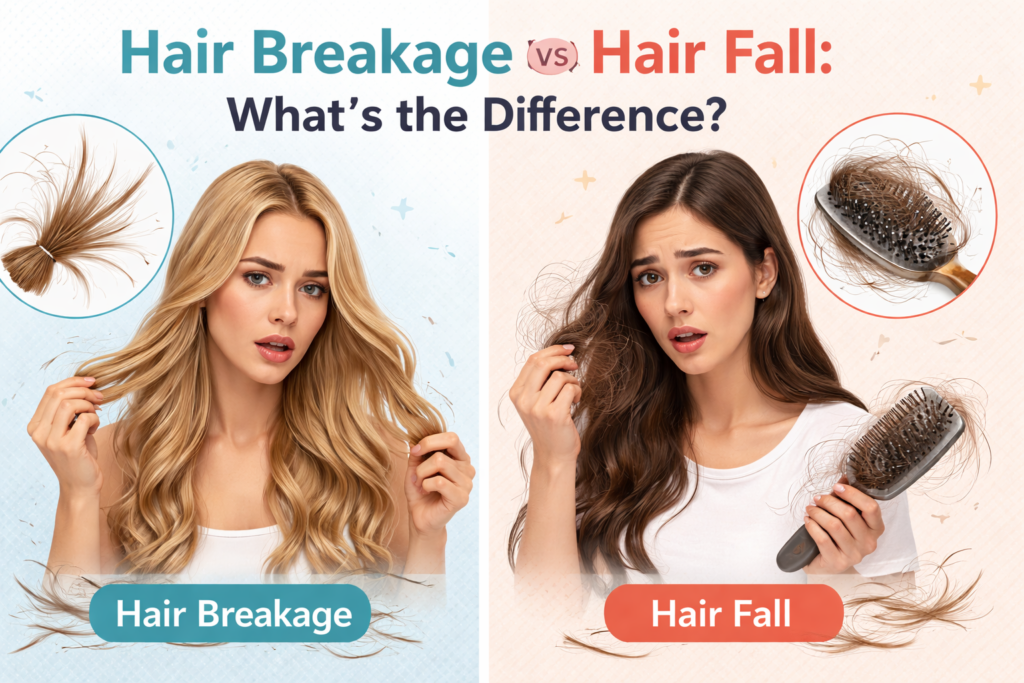
Hair Breakage vs Hair Fall: What’s the Difference?
I didn’t realize there were two different problems.
To me, it was all the same.
Hair coming out meant something was wrong—that was as far as my understanding went. Whether it was in the shower, on my pillow, or caught in my brush, I grouped it all into one category:
Hair loss.
Simple.
Or at least, that’s what I thought.
The Moment That Made Me Question Everything
It started with something small.
I was running my fingers through my hair—absently, the way you do when you’re thinking about something else—and I noticed the strands that came away didn’t look the same.
Some were long.
Full-length strands, with that tiny white bulb at the end.
But others?
They were shorter.
Uneven.
Almost like they had snapped off somewhere in the middle.
That was the first time I paused and thought:
Wait… this isn’t all the same.
When One Problem Looks Like Another
From a distance, hair breakage and hair fall look identical.
Hair is leaving your head.
That’s all you see.
But up close, they tell completely different stories.
One comes from the root.
The other comes from the strand itself.
And understanding that difference changes everything.
Because you can’t fix what you haven’t properly identified.
Hair Fall: Letting Go at the Root
Hair fall—what most people think of as “normal hair loss”—comes from the root.
It’s part of the natural hair cycle.
Hair grows, rests, and eventually sheds to make way for new growth.
When I started paying attention, I noticed that these strands were long, complete, and often had that small bulb at the end.
They looked… finished.
Like they had reached the end of their cycle.
And in many cases, they had.
That kind of hair fall isn’t always a problem.
It becomes one when the amount increases beyond what feels normal.
When shedding becomes more frequent.
More noticeable.
More consistent.
Hair Breakage: A Different Kind of Loss
Breakage, on the other hand, feels different.
Because it’s not part of a cycle.
It’s interruption.
Hair snapping before it’s ready.
Strands that don’t reach their full length because they can’t.
When I looked closer, I saw the signs:
Shorter pieces.
Uneven lengths.
Ends that looked frayed or rough.
Hair that felt weaker between my fingers.
And suddenly, it made sense why my hair didn’t seem to be growing.
It wasn’t that it wasn’t growing.
It was breaking before I could see the progress.
The Illusion of “No Growth”
This was one of the most frustrating parts.
I remember thinking my hair had stopped growing.
It felt stuck.
The same length for months.
No visible change.
But once I understood breakage, everything shifted.
Because the growth was happening.
It just wasn’t staying.
And that’s a very different problem.
How They Feel Different
Over time, I started noticing subtle differences in how each one felt.
Hair fall felt… natural.
Not alarming on its own.
Just part of the routine.
But breakage felt rougher.
More irregular.
More connected to how my hair behaved overall.
Tangling more easily.
Feeling drier.
Snapping with less effort.
It wasn’t just about what I saw—it was about what I felt.
What Causes Hair Fall
Once I understood the difference, I started looking at causes more clearly.
Hair fall often connects to internal factors:
- Stress that lingers longer than you think
- Nutritional imbalances
- Hormonal changes
- Shifts in routine or health
It’s your body adjusting.
Responding.
Sometimes recovering.
And because it comes from the root, it’s often tied to what’s happening beneath the surface.
What Causes Breakage
Breakage, on the other hand, is usually external.
Or at least, more visible in how you handle your hair.
Things like:
- Heat styling
- Tight hairstyles
- Rough brushing
- Lack of moisture
- Overprocessing
It’s physical stress.
Damage over time.
And unlike hair fall, it doesn’t wait for a cycle.
It happens when the strand can’t handle what it’s going through.
When Both Happen at the Same Time
Here’s where it gets complicated.
Sometimes, it’s not one or the other.
It’s both.
And that’s exactly what happened to me.
Some days, I’d see full strands—natural shedding.
Other days, I’d notice shorter pieces—breakage.
And together, they created a bigger problem.
Because now, I wasn’t just losing hair.
I was also losing strength.
The Emotional Confusion
What made this difficult wasn’t just the physical difference.
It was the confusion.
Because when everything looks the same at a glance, you don’t know what you’re dealing with.
And when you don’t know what you’re dealing with, every solution feels uncertain.
You try one thing.
Then another.
Without knowing if it’s the right approach.
And that uncertainty can be exhausting.
Learning to Look Closer
The turning point for me was simple:
I started paying attention.
Not obsessively.
Just intentionally.
Looking at the strands.
Noticing the length.
Observing patterns.
And slowly, I began to understand what my hair was actually going through.
Why This Difference Matters
At first, it might seem like a small detail.
But it’s not.
Because hair fall and breakage require different responses.
If you treat breakage like hair fall, you might focus only on internal factors—while ignoring the damage happening externally.
If you treat hair fall like breakage, you might focus only on products—while missing what your body is trying to tell you.
Understanding the difference isn’t just helpful.
It’s necessary.
The Subtle Signs You Can Look For
Over time, I started recognizing patterns:
If the strands are long and uniform → likely hair fall
If they’re short, uneven, or snapped → likely breakage
If your hair feels weaker, tangles more, and looks dull → breakage may be involved
If shedding increases suddenly across your whole scalp → hair fall may be the main issue
These aren’t strict rules.
But they’re helpful clues.
The Shift From Guessing to Understanding
Before, I was guessing.
Trying things without really knowing why.
After, I was responding.
Adjusting based on what I actually saw.
And that shift made everything feel more manageable.
Less overwhelming.
More grounded.
Recovery Looks Different for Each
Another thing I learned is that recovery doesn’t look the same for both.
Hair fall takes time.
Because it’s tied to the growth cycle.
You have to wait for new hair to grow.
Breakage, on the other hand, can improve more quickly.
Because once you reduce damage, the strands can retain their length better.
But both require patience.
Just in different ways.
You’re Not Just Losing Hair—You’re Learning
Looking back, I realize that what felt like a problem was also a lesson.
Not just about hair.
But about attention.
Awareness.
Understanding the difference between things that seem the same—but aren’t.
So, What’s the Difference?
Hair fall is natural shedding from the root.
Hair breakage is damage along the strand.
One is part of a cycle.
The other is an interruption.
And knowing which one you’re dealing with changes how you respond.
Final Thought
If you’ve been noticing more hair coming out than usual, don’t just ask how much.
Ask what kind.
Because sometimes, the answer isn’t in the quantity.
It’s in the detail.
And once you start looking closely, what once felt confusing begins to make sense.
Not all at once.
But enough to guide you in the right direction.
And sometimes, that’s all you really need.