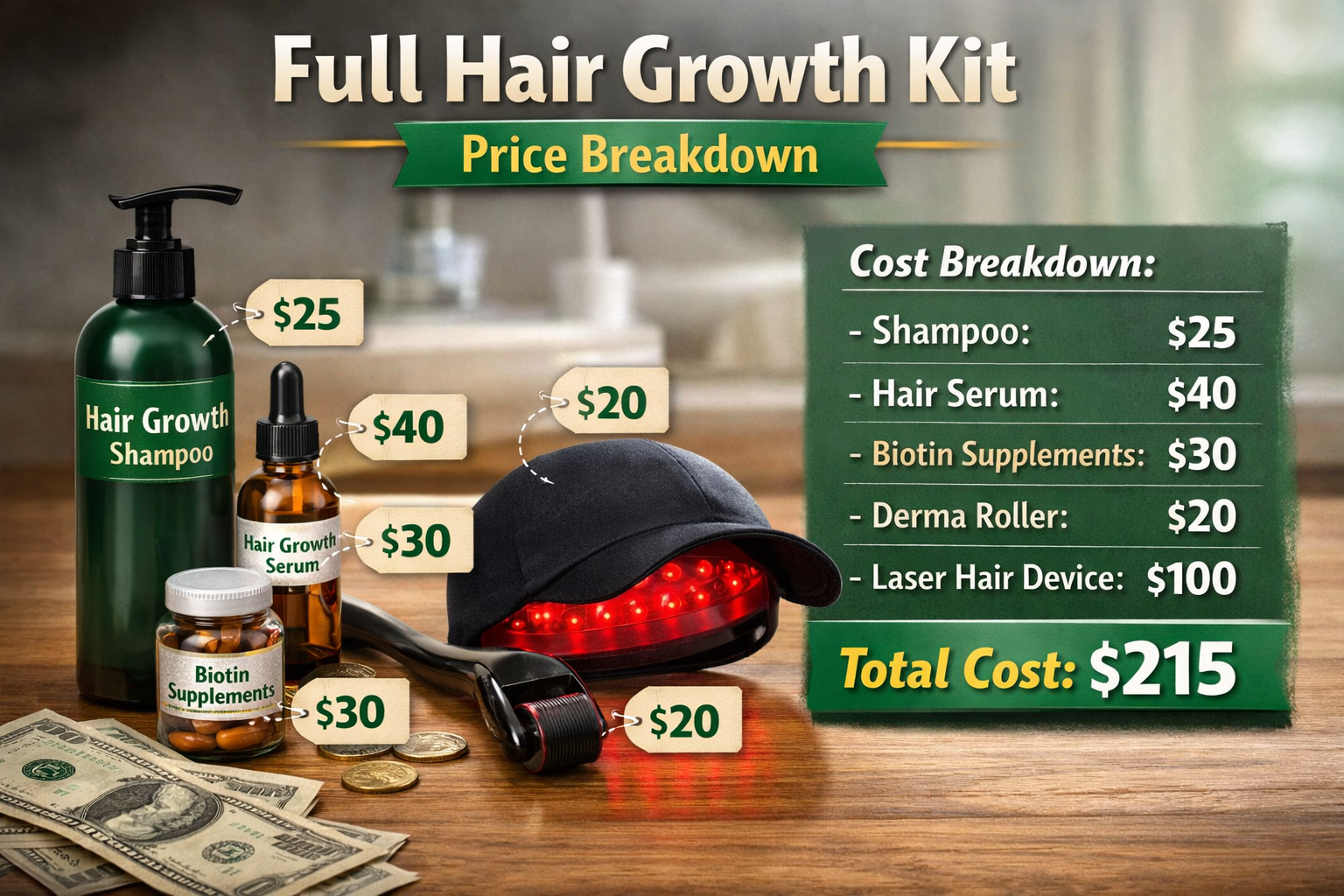
Full Hair Growth Kit Price Breakdown
A personal journey through cost, expectations, and what really matters
I didn’t expect hair care to become a financial story.
At first, it was just curiosity—standing in front of a mirror a little longer than usual, noticing small changes that felt bigger than they probably were. A slightly wider part. A bit more hair left behind on the comb. Nothing dramatic, nothing urgent. But enough to make me wonder: Should I be doing something about this?
That question, simple as it was, led me down a path I hadn’t planned for—one filled with product pages, reviews, recommendations, and eventually, a surprisingly detailed understanding of what a “full hair growth kit” really costs.
The First Purchase: Optimism in a Bottle
I still remember the first product I bought. It wasn’t expensive—just a basic serum that promised stronger, thicker hair with consistent use. The price felt reasonable, almost comforting. It gave me the sense that I was taking control without overcommitting.
But what I didn’t realize then was that this was only the beginning.
Hair growth isn’t a one-time purchase. It’s a system. And like any system, it has layers.
Breaking Down the “Full Kit”
As I started researching more seriously, I kept encountering the same idea: if you want real results, you need a complete routine. Not just one product, but a combination—each targeting a different part of the process.
That’s when the costs began to add up.
1. Shampoo and Conditioner (Foundation Layer)
At the base of every routine is a good shampoo and conditioner—often labeled as “hair growth” or “anti-thinning.”
- Average price per bottle: $15 – $40
- Monthly cost (combined): $30 – $80
At first glance, it doesn’t seem like much. But over time, this becomes a recurring expense. And not all products are equal—some focus on scalp health, others on strengthening strands, and many simply rely on marketing.
I learned quickly that “expensive” doesn’t always mean “effective.” Sometimes, the difference lies more in branding than in actual results.
2. Hair Growth Serums and Treatments (The Core Investment)
This is where most of the attention—and money—goes.
Serums are often marketed as the key to visible change. They promise to stimulate follicles, improve density, and accelerate growth.
- Average price: $25 – $100 per bottle
- Monthly usage: 1–2 bottles
- Monthly cost: $25 – $200
This category is tricky. Some products have well-known active ingredients, while others rely on blends of oils and extracts with less evidence behind them.
I found myself asking a question that didn’t have an easy answer: Am I paying for results, or for hope?
3. Supplements (The Internal Approach)
Then there are supplements—capsules or gummies designed to support hair growth from within.
- Average price: $20 – $60 per month
These often include vitamins like biotin, zinc, and other nutrients. The idea is simple: healthier body, healthier hair.
But here’s where things get complicated. Supplements can help if there’s a deficiency, but they’re not a guaranteed solution. Still, they’re easy to incorporate, which makes them appealing.
I added them to my routine, partly out of curiosity, partly because I didn’t want to miss out on something that might work.
4. Tools and Devices (Optional, but Tempting)
At some point, I started seeing ads for devices—laser caps, scalp massagers, microneedling tools.
They weren’t cheap.
- Scalp massager: $10 – $30 (one-time)
- Microneedling device: $15 – $50 (one-time)
- Laser therapy devices: $200 – $800+
These products promise enhanced results, often by improving blood circulation or stimulating follicles in different ways.
I hesitated here. Not because I didn’t believe in them, but because this was the moment the cost stopped feeling casual and started feeling significant.
The Hidden Cost: Consistency
If there’s one thing I underestimated, it’s this: consistency has a price.
Most products don’t show results overnight. They require weeks, sometimes months, of regular use. And that means ongoing spending.
Let’s break it down:
- Shampoo & conditioner: $50/month
- Serum: $60/month
- Supplements: $30/month
Estimated monthly total: $140
Estimated yearly total: $1,680
And that’s without high-end devices.
Seeing the numbers laid out like this changed something for me. It made the process feel less like a quick fix and more like a long-term commitment.
The Emotional Side of Spending
What surprised me most wasn’t the cost itself—it was how I felt about it.
Some purchases felt empowering, like I was investing in myself. Others felt uncertain, like I was chasing an outcome I couldn’t fully control.
There’s a subtle pressure in the world of hair care. The promise of transformation is always just one product away. And when results take time, it’s easy to wonder if you’re using the wrong thing—or not enough of it.
That’s how routines grow. Not always because they need to, but because we’re afraid of missing something.
Learning to Simplify
At some point, I stepped back.
I looked at everything I was using and asked a simple question: What’s actually making a difference?
The answer wasn’t obvious, but I noticed something important. The more complicated my routine became, the harder it was to stay consistent. And consistency, more than anything, seemed to matter.
So I simplified.
I kept a few key products—ones I trusted, ones I could realistically use every day. I let go of the rest.
And interestingly, nothing got worse. If anything, the process felt more manageable.
Price vs. Value
This is where the idea of a “price breakdown” becomes something deeper.
It’s not just about how much you spend. It’s about what you get in return—not just in results, but in experience.
- Does the routine fit into your daily life?
- Does it feel sustainable?
- Does it reduce stress, or add to it?
A $20 product you use consistently might be more valuable than a $100 product you use occasionally.
The Long-Term Perspective
Hair growth, I’ve learned, is not a race. It’s a slow process, shaped by time, habits, and patience.
The market offers endless options, each with its own promise. But the real challenge isn’t choosing the “best” product—it’s building a routine you can maintain.
And that brings us back to cost.
Because in the end, the most effective routine isn’t necessarily the most expensive one. It’s the one you can sustain—not just financially, but mentally and emotionally.
A Quiet Realization
Looking back, I realize that what started as a concern about hair turned into something broader.
It became a lesson in decision-making, in managing expectations, in understanding the difference between need and want.
The “full hair growth kit” isn’t just a collection of products. It’s a reflection of how we approach change—how much we’re willing to invest, how patient we can be, and how we navigate uncertainty.
And maybe that’s the real takeaway.
Not the exact cost, or the perfect routine, but the awareness that effectiveness—like growth itself—takes time. And that sometimes, the most valuable thing we can do is simplify, stay consistent, and give the process room to work.
If you’re standing where I once stood—scrolling through options, comparing prices, wondering where to start—know this:
You don’t need everything.
You just need something that works for you, and the willingness to stick with it long enough to see what happens next.