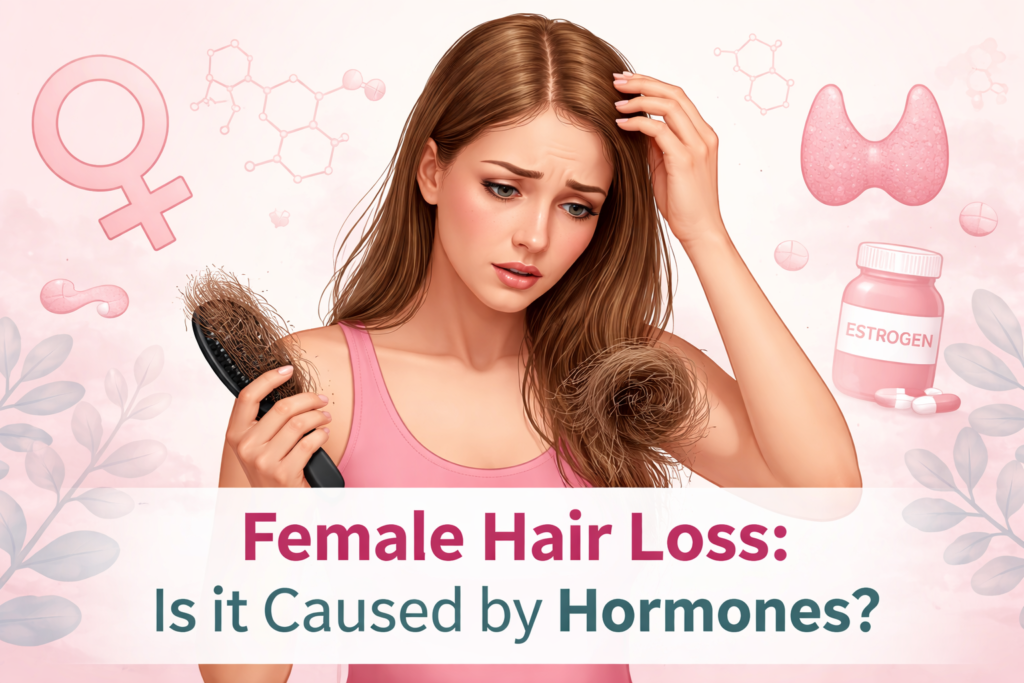
Female Hair Loss: Is It Caused by Hormones?
I didn’t notice it right away.
Not in the way you’d expect, at least.
There was no sudden moment of panic, no dramatic clumps of hair falling into my hands. Instead, it began quietly—so quietly that I almost convinced myself it wasn’t happening at all.
It was in the small things.
The way my part seemed just a little wider under certain lighting. The way my ponytail didn’t feel as thick when I tied it. The way my hair, once full and predictable, started behaving differently—flatter, lighter, harder to style.
At first, I blamed everything else.
The weather.
My shampoo.
Stress.
But the question that kept coming back—soft, persistent—was this:
Could it be hormonal?
The Subtle Nature of Change
Hair loss in women rarely announces itself loudly.
It doesn’t usually begin with obvious bald spots or sharply receding lines. Instead, it’s more like a gradual shift—a soft thinning that spreads across the scalp, often most noticeable along the part or at the crown.
And because it’s so gradual, it’s easy to dismiss.
You tell yourself it’s just a bad hair day.
Then a bad week.
Then somehow, it becomes your new normal—before you’ve even had time to question it properly.
When You Start Looking Closer
I remember the first time I really looked.
Not just a glance in the mirror, but a deliberate pause.
I parted my hair differently, tilted my head under the light, and tried to see what I had been avoiding.
And there it was.
Not dramatic. Not alarming.
But real.
A difference.
And once you see it, you start noticing it everywhere.
Photos.
Reflections.
Even the way your hair falls during the day.
It’s not just physical—it becomes awareness.
Hormones: The Invisible Influence
Hormones are strange.
They don’t ask for attention, but they influence so much—energy, mood, sleep, skin, and yes… hair.
And the difficult part?
You can’t see them.
You can’t feel them shifting in real time.
But their effects show up in ways that are impossible to ignore.
Hair growth is deeply connected to hormonal balance. When that balance shifts—even slightly—it can change how long hair grows, how thick it feels, and when it sheds.
And sometimes, those changes happen without any clear signal.
The Timing That Doesn’t Make Sense
One of the most confusing parts is timing.
You might notice hair loss when everything else feels fine.
No major stress. No obvious health issues. No clear trigger.
And that’s what makes it unsettling.
Because you’re left searching for a cause that isn’t immediately visible.
But hormones don’t always operate on a timeline we can easily follow.
Changes can happen gradually.
Quietly.
And by the time you notice the effect, the cause may already be behind you.
Life Phases and Their Hidden Impact
There are certain periods in life where hormonal shifts are more likely.
Times when the body is adjusting, recalibrating, responding.
And during those times, hair can become part of that adjustment.
It doesn’t mean something is wrong.
It means something is changing.
But that distinction isn’t always comforting when you’re the one experiencing it.
When Hair Becomes a Reflection
What I didn’t expect was how personal it would feel.
Hair isn’t just hair.
It’s part of how you see yourself.
How you present yourself.
How you recognize yourself.
And when it starts to change—even slightly—it can shift something deeper.
You might find yourself paying more attention than you used to.
Adjusting your style.
Avoiding certain angles.
Not because anyone else notices—but because you do.
The Questions That Follow
Once the idea of hormones enters your mind, it opens the door to more questions.
“Is this temporary?”
“Will it get worse?”
“Can it go back to how it was?”
And maybe the hardest one:
“Is this something I can control?”
The answers aren’t always immediate.
And that uncertainty can be one of the most difficult parts.
It’s Not Always Just Hormones
Here’s what I eventually realized:
Hormones can play a role—but they’re not always the only factor.
Hair loss is often layered.
A combination of small influences rather than one clear cause.
Stress.
Nutrition.
Sleep.
Routine.
All of these interact with your hormonal balance in ways that aren’t always obvious.
So when something shifts, it’s rarely just one thing.
It’s a pattern.
The Emotional Loop
There’s a moment where awareness turns into worry.
And worry, in its own way, creates more imbalance.
You start thinking about it more often.
Checking more often.
Trying to figure it out constantly.
And without realizing it, you become part of the cycle.
That was one of the hardest things to step away from.
Not the hair loss itself—but the constant thinking about it.
Learning to Observe, Not Panic
What helped me most wasn’t finding a perfect answer.
It was changing how I responded.
Instead of reacting with fear every time I noticed something, I started observing.
Gently.
Without judgment.
I paid attention to patterns.
To changes over time.
To how my body felt overall—not just my hair.
And slowly, that shifted something.
The Role of Consistency
If hormones thrive on balance, then consistency becomes important.
Not in a strict, overwhelming way.
But in small, steady habits.
Eating regularly.
Resting properly.
Taking care of yourself in ways that don’t feel forced.
It’s not about perfection.
It’s about rhythm.
And over time, that rhythm supports your body in ways you don’t immediately see—but eventually feel.
The Waiting That No One Talks About
One of the most difficult parts is waiting.
Hair doesn’t respond quickly.
Even when things improve internally, it takes time for that change to show externally.
Weeks.
Sometimes months.
And during that time, it’s easy to feel like nothing is happening.
But something is.
It’s just quiet.
Signs That Things Are Shifting
There was a moment—small, but meaningful—when I noticed less hair falling.
Not suddenly.
Just… less.
Then, later, I noticed tiny strands along my hairline.
Soft. New. Growing.
It wasn’t dramatic.
But it was enough.
Enough to remind me that change can go in both directions.
Redefining the Question
At some point, I stopped asking:
“Is this caused by hormones?”
And started asking:
“What is my body trying to adjust to?”
That shift made everything feel less like a problem to solve—and more like a process to understand.
So, Is Female Hair Loss Caused by Hormones?
Sometimes, yes.
But not always in isolation.
Hormones are part of a larger system.
And when that system shifts, hair can reflect it.
But it doesn’t mean something is permanently wrong.
It often means something is temporarily out of balance.
You’re Not Alone in This Experience
If you’ve been noticing changes in your hair, wondering if hormones are the cause—you’re not alone.
This is something many women experience at different points in their lives.
It’s just not always talked about openly.
And because of that, it can feel more isolating than it actually is.
Final Thought
Looking back, I realize that the question I started with—“Is it hormones?”—wasn’t the most important one.
The more important question was:
“Am I paying attention to what my body needs?”
Because hair, in the end, is just one signal.
One reflection of something deeper.
And when you start listening—not with fear, but with curiosity—you begin to understand that your body isn’t working against you.
It’s communicating.
Quietly.
Patiently.
And maybe, all it’s asking for is a little more awareness than before.