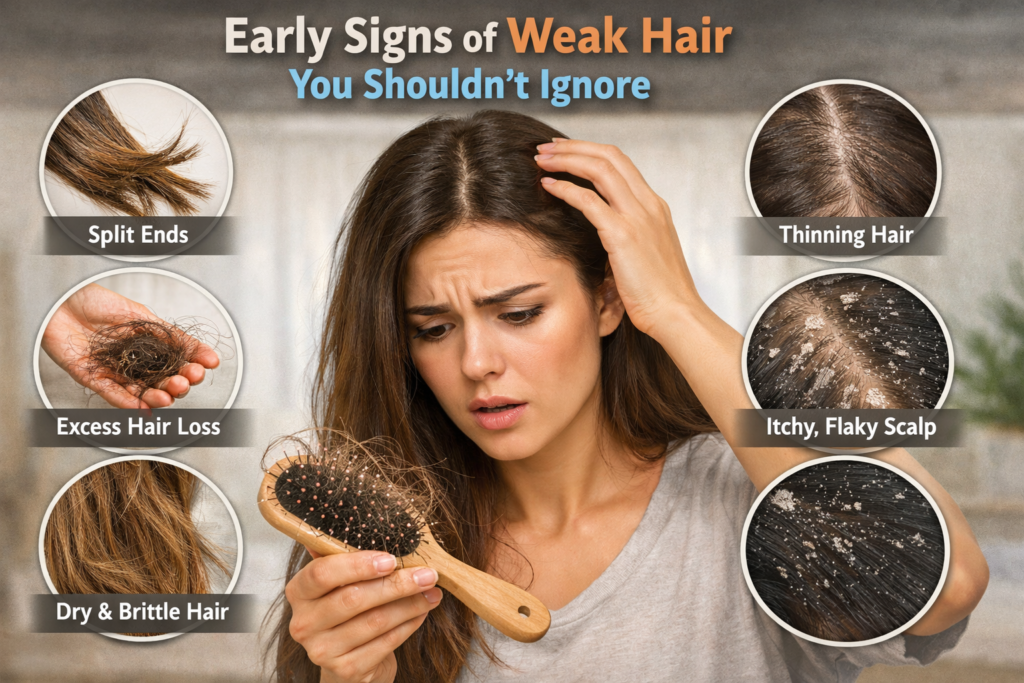
Early Signs of Weak Hair You Shouldn’t Ignore
I didn’t think of my hair as “weak.”
Not at first.
To me, it was just… hair. Something familiar. Something consistent. Something I didn’t have to question too much because it had always behaved the same way.
Until it didn’t.
There wasn’t a single moment where everything changed. No sudden break, no obvious damage. Just a series of small, almost forgettable experiences that slowly began to connect.
A strand snapping more easily than usual.
A little more hair left behind on my brush.
A texture that felt slightly different between my fingers.
Nothing dramatic.
But enough to make me pause.
The First Sign Is Often a Feeling
Before you see weak hair, you often feel it.
That was the part that caught me off guard.
It wasn’t about how my hair looked—it was about how it behaved.
It didn’t glide through my fingers the same way.
It didn’t feel as smooth, as resilient.
There was a kind of fragility to it. Subtle, but present.
And once I noticed it, I couldn’t unnotice it.
When Strength Quietly Fades
Hair doesn’t usually go from strong to weak overnight.
It fades.
Gradually.
A strand that used to stretch slightly before breaking now snaps more quickly.
Hair that once held a style easily starts to fall flat.
Volume becomes harder to maintain.
At first, you adjust without thinking.
Different styling.
Different angles.
But eventually, you realize you’re adapting to something that didn’t used to be there.
Breakage vs. Shedding: The Difference You Miss
One of the things I misunderstood early on was the difference between shedding and breakage.
Shedding comes from the root.
Breakage happens along the strand.
And weak hair?
It tends to break.
Which means you might not see full strands falling out—you might see shorter pieces, uneven ends, hair that never seems to grow past a certain length.
It’s easy to overlook.
But once you recognize it, it explains a lot.
The Ends Tell a Story
I remember looking closely at the ends of my hair one day.
They didn’t look clean.
They didn’t feel smooth.
They looked… worn.
Frayed in a way that suggested more than just dryness.
Like they had been through something.
And maybe they had.
Because weak hair doesn’t just affect how your hair starts—it affects how it ends.
When Growth Slows Without Stopping
Another thing I noticed was that my hair still grew—but not the way it used to.
It felt slower.
Less noticeable.
And sometimes, it felt like it wasn’t growing at all.
But the truth was, it was growing.
It just wasn’t staying.
Because when hair is weak, it breaks before you get to see the length.
So it creates the illusion of no growth.
When in reality, it’s a problem of retention.
The Subtle Loss of Shine
Shine is one of those things you don’t think about until it’s gone.
Healthy hair reflects light.
Weak hair absorbs it.
I didn’t realize how much that mattered until my hair started looking dull, even when it was clean.
Even when I had taken care of it.
It just didn’t have that same natural brightness.
And that dullness?
It wasn’t just cosmetic.
It was a sign.
Tangling More Than Usual
There was also the tangling.
At first, I blamed it on external things.
Wind.
Movement.
Maybe I just hadn’t brushed it properly.
But over time, it became consistent.
Hair that tangles easily is often hair that’s struggling.
Because smooth, strong strands don’t catch onto each other as much.
Weak ones do.
And that friction leads to more breakage.
Which leads to more weakness.
A cycle that builds quietly.
Increased Sensitivity
Another change I noticed was how my hair responded to simple actions.
Brushing felt different.
Tying it back felt different.
Even washing it required more care.
It wasn’t that I was being rough before.
It’s that my hair had become more sensitive.
Less tolerant.
More reactive.
And that sensitivity is easy to dismiss—until it becomes your new normal.
The Role of What You Don’t See
At some point, I realized that weak hair isn’t just about what’s happening on the surface.
It’s about what’s happening underneath.
Nutrition.
Stress.
Routine.
All the things you don’t immediately connect to hair.
But they’re there.
Influencing.
Shaping.
Affecting how strong each strand becomes.
When Weakness Builds Over Time
Weak hair isn’t always the result of one thing.
It’s often the result of accumulation.
Repeated stress.
Inconsistent care.
Small imbalances that don’t seem important in the moment.
But over time, they add up.
And your hair reflects that.
The Mistake of Ignoring Early Signs
Looking back, I realize I didn’t act when I first noticed the signs.
Not because I didn’t care—but because they didn’t feel urgent.
They were easy to ignore.
Easy to explain away.
But early signs matter.
Because they give you time.
Time to understand.
Time to respond before the problem becomes more noticeable.
When Weak Hair Starts Affecting Confidence
It’s not just about appearance.
It’s about how you feel.
There’s a subtle shift that happens when your hair doesn’t behave the way it used to.
You adjust.
You compensate.
You become more aware.
And even if no one else notices, you do.
And that awareness stays with you.
The Turning Point: Paying Attention
For me, the shift happened when I stopped dismissing what I was noticing.
When I started taking it seriously—not in a fearful way, but in an attentive way.
I began to observe patterns.
To notice what made things better.
What made things worse.
And slowly, that awareness turned into understanding.
What Weak Hair Might Be Telling You
Weak hair is rarely random.
It’s often a signal.
That something needs support.
It could be:
- Lack of nutrients
- Too much physical stress (heat, styling, tight hairstyles)
- Ongoing stress or fatigue
- Changes in routine
- Or a combination of small factors over time
It’s not always one cause.
But it’s always communication.
The Power of Small Changes
What helped me wasn’t a drastic transformation.
It was small changes.
Being gentler.
More consistent.
More aware of what my hair needed—and what it didn’t.
And over time, those small changes made a difference.
Not immediately.
But steadily.
The First Signs of Strength Returning
The improvement wasn’t dramatic.
It was subtle.
Less breakage.
Smoother strands.
Hair that felt just a little stronger between my fingers.
And that was enough.
Because it meant something was shifting.
In the right direction.
You Don’t Have to Wait for It to Get Worse
One of the biggest lessons I learned is this:
You don’t have to wait until the problem becomes obvious.
You don’t have to wait until your hair feels completely different.
Early signs are enough.
They’re not something to fear.
They’re something to listen to.
So, What Are the Early Signs of Weak Hair?
Not just one thing—but a combination of small signals:
- Hair that breaks easily
- Ends that look frayed or uneven
- Increased tangling
- Dullness or lack of shine
- Slower visible growth
- A general feeling of fragility
Individually, they might seem minor.
But together, they tell a story.
Final Thought
Weak hair doesn’t appear overnight.
And it doesn’t fix itself overnight either.
It develops slowly.
And it improves the same way.
So if you’ve started to notice these early signs, don’t ignore them.
Not because something is wrong.
But because something is changing.
And change—when you pay attention to it early—is something you can respond to.
Not with panic.
But with care.
Because sometimes, the smallest signs are the ones that matter most.