Common Mistakes When Using Hair Products (And What I Learned the Hard Way)
I still remember the first time I stood in the hair care aisle, completely overwhelmed. Bottles lined the shelves like a colorful army—promising shine, strength, volume, repair, hydration, and things I didn’t even know my hair needed. I grabbed whatever looked convincing, went home, and used everything all at once. The result? My hair felt heavy, greasy at the roots, dry at the ends, and somehow more unmanageable than before.
It took me years—yes, years—of trial, error, and a few regrettable hair days to realize that using hair products isn’t just about buying the “right” ones. It’s about how you use them. Along the way, I made plenty of mistakes. If you’ve ever wondered why your hair doesn’t look like the results on the bottle, you might be making some of the same ones.
Let me walk you through the most common mistakes people make when using hair products—woven with the lessons I learned along the way.
1. Using Too Much Product
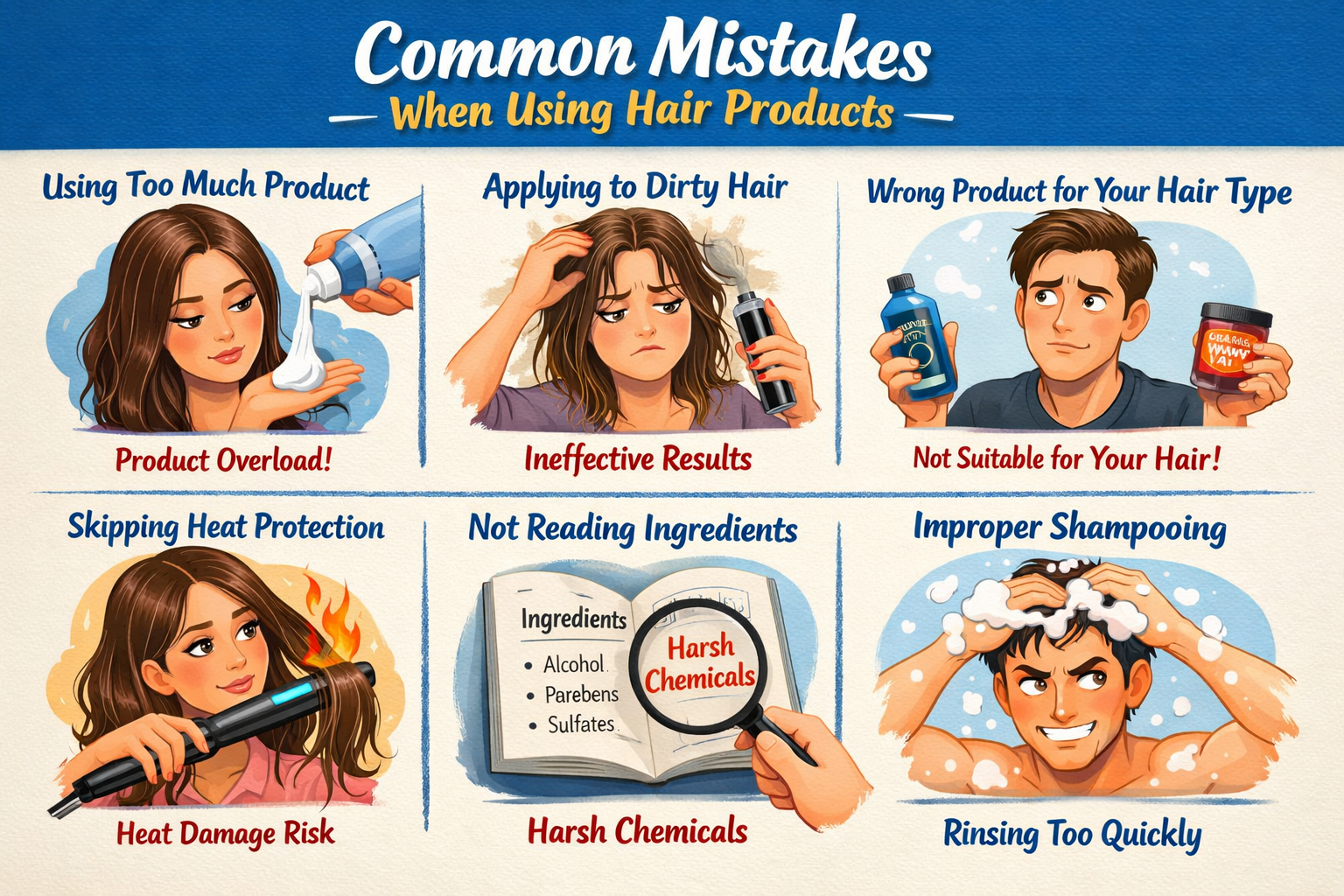
This was my biggest mistake in the beginning. I believed that if a small amount worked, then more would work better. So I layered shampoo, conditioner, leave-in cream, serum, oil—sometimes all in one routine.
Instead of silky hair, I ended up with strands that felt suffocated.
Hair products are designed to work in specific quantities. When you use too much, your hair can become weighed down, greasy, or even dull. Worse, buildup can form on your scalp, making your hair look lifeless no matter what you apply.
I learned to start small—really small. A pea-sized amount of serum, a coin-sized amount of conditioner. You can always add more, but you can’t easily undo excess product once it’s in your hair.
2. Applying Products to the Wrong Areas
For a long time, I treated my hair as one uniform surface. Shampoo went everywhere, conditioner went everywhere, oils went everywhere. It seemed logical—but it wasn’t effective.
Here’s the truth I wish I had known earlier: different parts of your hair have different needs.
- The scalp needs cleansing and balance.
- The mid-lengths need moisture and strength.
- The ends need extra care because they’re the oldest and most fragile.
When I started applying shampoo mainly to my scalp and conditioner only from mid-lengths to ends, everything changed. My roots stayed fresher longer, and my ends finally felt soft instead of coated.
3. Not Understanding Your Hair Type
I used to buy products based on trends or recommendations from friends. If something worked for them, I assumed it would work for me too.
It didn’t.
Hair isn’t one-size-fits-all. Fine hair reacts differently than thick hair. Curly hair has different needs than straight hair. Oily scalps behave differently than dry ones.
Once I took the time to understand my own hair—fine strands, slightly wavy, prone to oil at the roots—I stopped fighting it and started working with it. Lightweight products replaced heavy creams. Volumizing formulas replaced smoothing ones.
The results felt almost immediate.
4. Mixing Too Many Products at Once
There was a phase when I believed my hair needed a “routine” with at least seven steps. Each product had a purpose—or so I thought.
In reality, I was overwhelming my hair.
Different products contain different ingredients, and not all of them work well together. Some combinations can cancel each other out, while others can lead to buildup or dryness.
I simplified my routine. Instead of layering everything, I focused on a few essential products that actually complemented each other. My hair didn’t just look better—it felt healthier.
5. Ignoring Product Instructions
I used to skip labels. I assumed all shampoos, conditioners, and styling products worked the same way.
They don’t.
Some products need time to work. Deep conditioners, for example, often require several minutes to penetrate the hair. Leave-in products are meant to stay in—not be rinsed out. Heat protectants need to be applied before styling, not after.
Once I started actually reading instructions (something I should have done from the start), I noticed a big difference. Products performed the way they were meant to, and I finally got closer to the results advertised.
6. Applying Products on the Wrong Hair Condition
This is something I learned through frustration. I would apply styling products to soaking wet hair one day, completely dry hair the next, and wonder why the results were inconsistent.
The truth is, when you apply a product matters just as much as what you apply.
- Some products work best on damp hair (like leave-in conditioners).
- Others are designed for dry hair (like finishing serums or texturizing sprays).
- Applying products at the wrong time can reduce their effectiveness or make your hair feel off.
Now, I pay attention to timing. It sounds simple, but it changed everything.
7. Overusing Heat Styling Without Protection
There was a time when I straightened or curled my hair almost daily. I didn’t think much about it—I just wanted the look.
What I didn’t realize was how much damage I was causing.
Heat can weaken the hair structure, leading to dryness, breakage, and split ends. For a long time, I skipped heat protectant because it felt like an unnecessary extra step.
It wasn’t.
Once I started using a proper heat protectant, I noticed less breakage and more shine. My hair still endured styling, but it wasn’t silently suffering anymore.
8. Expecting Instant Results
This mistake is easy to make, especially with so many products promising quick transformations.
I used to try something once or twice, not see dramatic results, and immediately switch to something else. My shelf became a graveyard of half-used bottles.
Hair care doesn’t work overnight. Some products need time—weeks, even months—to show real results.
When I finally committed to a consistent routine and gave products time to work, I began to see gradual but lasting improvements.
9. Not Washing Hair Properly
Ironically, even something as basic as washing hair can be done incorrectly.
I used to rush through it—quick shampoo, quick rinse, done. Sometimes I didn’t rinse thoroughly, leaving residue behind.
Proper washing makes a huge difference. Taking the time to massage the scalp, rinse thoroughly, and ensure no product is left behind creates a clean foundation for everything else.
It’s not glamorous, but it’s essential.
10. Forgetting About the Scalp
For a long time, I focused entirely on my hair strands. The scalp? I barely thought about it.
But healthy hair starts at the scalp.
If your scalp is clogged, irritated, or unbalanced, your hair won’t thrive no matter how many products you use. Once I started paying attention—using gentle exfoliating treatments occasionally and choosing products suited to my scalp type—I noticed healthier growth and better overall hair condition.
11. Using Expired or Low-Quality Products
This might sound obvious, but I’ve been guilty of holding onto products far longer than I should have.
Hair products don’t last forever. Over time, their effectiveness can decrease, and in some cases, they can even cause irritation.
I also learned that price doesn’t always equal quality—but extremely cheap products with harsh ingredients can do more harm than good. Finding a balance matters.
12. Comparing Your Hair to Others
This might be the most subtle mistake of all.
I used to compare my hair to people I saw online or even friends around me. If their hair looked smoother, shinier, or fuller, I assumed I was doing something wrong.
But hair is personal. Genetics, environment, diet, and lifestyle all play a role.
The moment I stopped comparing and started focusing on what my hair needed, everything became easier. My routine felt less like a battle and more like a form of care.
Final Thoughts
Looking back, I realize that most of my hair struggles didn’t come from choosing the wrong products—but from using them the wrong way.
Hair care isn’t about perfection. It’s about understanding, patience, and a bit of experimentation. Mistakes are part of the process, and honestly, they’re how you learn what truly works.
If there’s one thing I would tell my younger self standing in that overwhelming aisle, it’s this: keep it simple, stay consistent, and listen to your hair.
Because in the end, your hair doesn’t need everything—it just needs the right things, used the right way.