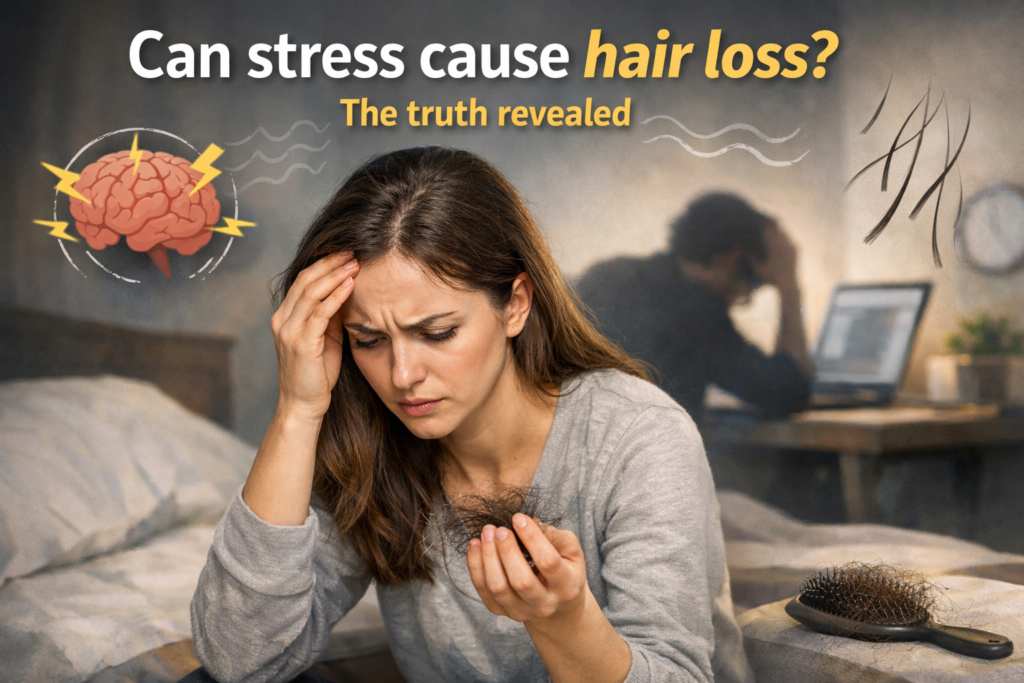
Can Stress Cause Hair Loss? The Truth Revealed
I didn’t connect the dots right away.
If anything, I thought I was handling everything just fine.
Life felt busy, yes—but manageable. There were deadlines, expectations, a constant stream of things to think about… but nothing that seemed overwhelming enough to leave a visible mark.
At least, that’s what I believed.
Until one day, standing in the shower, I noticed it.
More hair than usual.
Not just a strand or two—but enough to make me pause. Enough to make me look twice, as if somehow the second glance would tell a different story.
It didn’t.
And that’s when the question quietly surfaced:
Could this be stress?
The Kind of Stress You Don’t Recognize
When we think of stress, we often imagine something intense.
A major event. A breaking point. A moment where everything feels like too much.
But what I was experiencing didn’t look like that.
It was quieter.
A constant mental noise.
Thinking about what’s next before finishing what’s now.
Sleeping, but not really resting.
Smiling, but still feeling a subtle tension underneath it all.
It didn’t feel like “stress” in the dramatic sense.
But my body seemed to think otherwise.
Hair as a Delayed Reaction
What I didn’t know at the time is that hair doesn’t respond to stress immediately.
There’s a delay.
A gap between what you go through and what your body shows.
So when the hair shedding began, I couldn’t immediately connect it to anything specific.
I remember thinking:
“But things are okay right now… so why is this happening?”
It took time to realize that the body doesn’t always react in real time.
Sometimes, it processes first.
And shows later.
The Science Behind the Silence
Without getting too technical, here’s what I came to understand:
Hair grows in cycles.
There’s a phase where it grows, a phase where it rests, and a phase where it sheds.
Stress can push more hair than usual into that resting phase.
And after a while—weeks, sometimes months—those hairs begin to fall out.
All at once.
Which is why it feels sudden.
Even though the cause was gradual.
When Shedding Feels Personal
There’s something about hair loss that feels… personal.
It’s not painful.
It’s not loud.
But it’s visible.
And that visibility changes how you experience it.
I found myself noticing it everywhere.
On my clothes.
On my desk.
In the brush.
Each strand felt like a question I couldn’t fully answer.
And even though I knew, logically, that some hair loss is normal—it didn’t feel normal anymore.
The Loop Between Stress and Hair Loss
What makes this even more complicated is the loop it creates.
Stress leads to hair loss.
Hair loss leads to more stress.
And before you know it, you’re caught in between the two.
I remember checking my hair more often than I needed to.
Running my fingers through it just to see how much would come out.
Thinking about it at random moments during the day.
Not obsessively—but consistently enough that it stayed in the background of everything.
And that constant awareness?
It added more pressure.
The Things You Try First
At some point, I started looking for solutions.
Small ones, at first.
Changing shampoo.
Washing my hair differently.
Being more careful when brushing.
All of which helped… a little.
But not in the way I had hoped.
Because the root of the issue wasn’t external.
It was internal.
And that’s harder to address.
Understanding That It’s Not Immediate Damage
One of the most reassuring things I learned—though it didn’t feel reassuring at first—is this:
Stress-related hair loss is usually temporary.
That doesn’t mean it disappears overnight.
But it does mean the hair follicles aren’t permanently damaged.
They’re reacting.
Pausing.
Adjusting.
And with time, they can return to their normal cycle.
That idea changed something for me.
It shifted the situation from “something is wrong” to “something is happening.”
The Difficulty of Slowing Down
Of course, knowing that stress is the cause doesn’t automatically remove it.
If it were that simple, none of this would happen in the first place.
I tried to “relax.”
Which, ironically, became another thing to overthink.
How do you relax correctly?
How do you stop thinking about something that keeps reminding you it’s there?
It wasn’t a quick fix.
It was a gradual shift.
Small Changes That Made a Difference
What helped wasn’t one big solution.
It was a series of small ones.
Getting more consistent sleep.
Eating more regularly.
Taking short breaks without filling them with distractions.
Letting my mind rest, even if just for a few minutes.
None of it felt dramatic.
But over time, it created a sense of balance that had been missing.
And slowly, something began to change.
The First Sign of Improvement
It didn’t happen all at once.
There was no clear turning point.
Just a moment where I realized:
There was less hair in the shower.
Less in the brush.
Less on my clothes.
Not none.
But less.
And that “less” meant everything.
Because it meant things were shifting.
Quietly, but steadily.
The Patience You Didn’t Know You Needed
Hair recovery doesn’t match the urgency you feel.
It moves slower.
More gradually.
And that can be frustrating.
But it also teaches something important:
Not everything needs to be fixed immediately.
Some things just need time—and the right conditions.
Redefining What Stress Means
One of the biggest realizations I had was this:
Stress isn’t just about how things look on the outside.
You can seem fine.
Function normally.
Keep up with everything.
And still carry more than your body is comfortable with.
And your body will find a way to show it.
Hair is just one of those ways.
So, Can Stress Cause Hair Loss?
Yes.
But not always in the way you expect.
Not instantly.
Not dramatically.
And not always in direct proportion to how stressed you feel.
It’s more subtle than that.
More delayed.
More connected to the overall state of your body than any single moment.
You’re Not Losing Control
If you’re going through this, it can feel like something is slipping out of your control.
But in reality, your body is responding exactly as it’s designed to.
Protecting itself.
Prioritizing what matters most.
And temporarily letting go of what it doesn’t need to hold onto.
That includes hair.
A Different Way to Look at It
Instead of seeing hair loss as something to fight, I started seeing it as something to understand.
A signal.
Not a failure.
Not damage.
Just information.
And once I approached it that way, it became easier to respond calmly.
More thoughtfully.
More patiently.
Final Thought
If you’ve been asking yourself whether stress is the reason behind your hair loss—the answer might not be immediate, but it’s often closer than you think.
Not in a dramatic, obvious way.
But in the quiet, accumulated weight of everyday life.
And the good news?
That kind of cause can also be eased.
Not instantly.
But gradually.
Just like everything else your body does.
Hair, in the end, is part of a bigger conversation.
And sometimes, all it takes is learning how to listen.