Why Doesn’t Hair Grow Back After Falling Out?
At first, I wasn’t worried about the hair falling out.
Because I believed something simple:
If it falls out, it grows back.
That’s what I had always heard. That’s what made hair loss feel temporary, manageable—almost predictable. Hair sheds, hair regrows. A cycle. A balance.
So when I started noticing more strands than usual, I didn’t panic.
I assumed the second half of the cycle would follow.
It didn’t.
The Waiting That Feels Longer Than It Should
I remember looking closely at my scalp one day, expecting to see something—anything—that suggested regrowth.
Tiny hairs.
Soft strands.
Some sign that the process was continuing.
But there was nothing obvious.
No clear return.
Just the same space that had been there before.
And that’s when the question changed:
Why isn’t it coming back?
When the Cycle Feels Incomplete
We’re taught that hair follows a cycle.
Grow.
Rest.
Shed.
Repeat.
But what no one really explains is that the “repeat” part isn’t always immediate.
Sometimes, the cycle pauses.
Sometimes, it slows.
And sometimes, it changes in ways that aren’t easy to see.
The Difference Between Falling and Returning
Hair falling out is visible.
It happens in real time.
You see it.
You feel it.
But regrowth is different.
It’s quiet.
Slow.
Almost invisible at first.
So there’s a period where it feels like everything is leaving—and nothing is coming back.
Even if something is happening beneath the surface.
The Hidden Delay Beneath the Surface
One of the most important things I learned is this:
Hair doesn’t regrow on your timeline.
It follows its own.
After shedding, hair follicles don’t always immediately return to the growth phase.
They can stay in a resting phase for longer than expected.
And during that time, it looks like nothing is happening.
But “nothing” isn’t always nothing.
It’s often a pause.
When the Follicle Changes
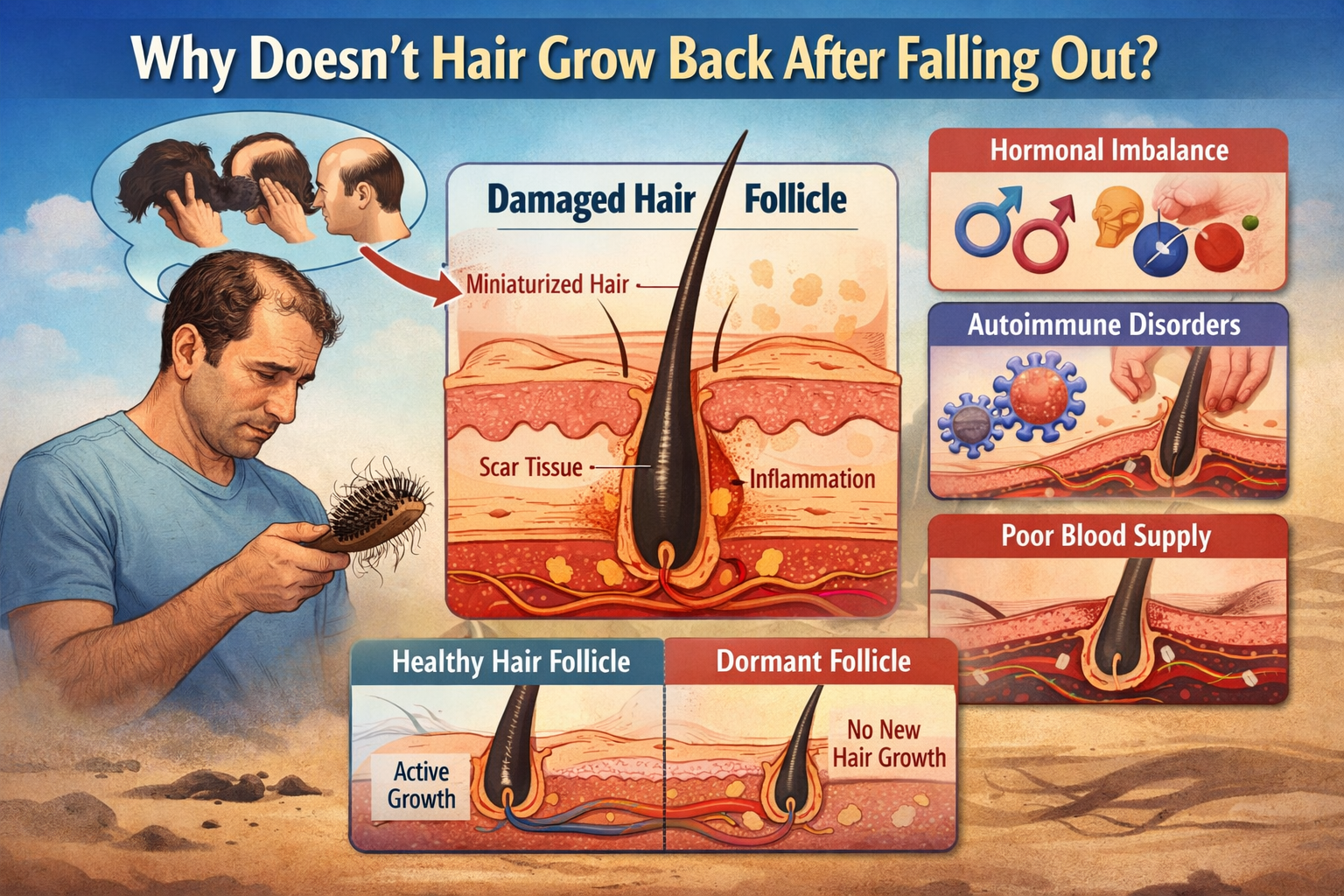
In some cases, the issue isn’t just timing—it’s transformation.
Hair follicles can change over time.
Not disappear.
Not stop completely.
But become less active.
Producing finer, thinner hair.
Or growing more slowly.
Or, in some cases, not producing visible hair at all.
And because this happens gradually, it’s hard to notice in real time.
The Role of What’s Happening Internally
Hair doesn’t operate independently.
It reflects what’s happening inside your body.
Stress.
Nutrition.
Hormonal balance.
All of these influence whether a hair follicle returns to the growth phase—or stays inactive longer.
And sometimes, those internal factors don’t fully reset right away.
When Recovery Takes Longer Than Expected
I kept expecting a clear turning point.
A moment where things would shift back to normal.
But recovery didn’t work like that.
It was gradual.
Subtle.
Almost unnoticeable at first.
And because of that, it felt like it wasn’t happening at all.
The Illusion of “Nothing Is Growing”
There’s a point where it feels like your hair has stopped growing completely.
But often, it hasn’t.
It’s just growing slowly.
Or the new hairs are so fine that they’re hard to see.
Or they’re breaking before they become noticeable.
So what looks like absence may actually be something quieter.
Something less visible.
The Frustration of Not Seeing Progress
What made this difficult wasn’t just the lack of regrowth.
It was the uncertainty.
Not knowing whether it would come back.
Not knowing if what I was seeing was temporary or permanent.
And that uncertainty creates a kind of mental loop.
You check.
You question.
You wait.
When Time Becomes the Only Indicator
Eventually, I realized that time was the only way to understand what was happening.
Not days.
Not weeks.
But months.
Because hair doesn’t change quickly enough to give you immediate answers.
It reveals itself slowly.
Through patterns.
Through consistency—or lack of it.
The Fear of Permanence
At some point, a heavier thought appears:
What if it doesn’t grow back at all?
It’s not always loud.
But it’s there.
Because when something doesn’t return within the time you expect, your mind fills in the gap with worst-case possibilities.
Not All Hair Loss Behaves the Same
One of the most important realizations I had was this:
Not all hair loss is the same.
Some types are temporary.
Others are more gradual.
Some affect the cycle.
Others affect the follicle itself.
And without understanding the type, it’s easy to assume the worst.
When “Not Growing Back” Is Just “Not Yet”
This was the shift that helped me most.
Instead of seeing it as not growing back, I started seeing it as not yet visible.
Because regrowth doesn’t start with full strands.
It starts small.
Soft.
Almost invisible.
And it takes time to become noticeable.
The Conditions for Regrowth
Hair doesn’t just grow back automatically.
It needs the right conditions.
Balance.
Support.
Consistency.
And if those conditions aren’t fully in place, regrowth can be delayed.
Not prevented.
Just delayed.
The Importance of Patience (Again)
Patience is difficult when you’re looking for visible change.
Because it feels passive.
Like waiting without control.
But in reality, it’s part of the process.
Because forcing change doesn’t speed up the cycle.
Supporting it does.
The Subtle Signs You Might Miss
There were moments I almost overlooked:
Tiny hairs near the hairline.
A slight reduction in shedding.
A feeling that my hair was becoming a little stronger.
They weren’t dramatic.
But they were signs.
And signs matter.
You’re Not Always Starting From Zero
Another realization was this:
Hair doesn’t always restart from nothing.
Even when it feels like it’s gone, the follicles are still there.
Still capable.
Still part of the system.
They just need time—and the right conditions—to reactivate.
So, Why Doesn’t Hair Grow Back After Falling Out?
Because the cycle can pause.
Because the follicle can change.
Because internal factors influence timing.
Because regrowth is slower than shedding.
And because what you see isn’t always the full picture.
You’re Not Stuck—You’re in a Phase
That was the thought that changed everything for me.
I wasn’t stuck.
I was in between.
Between shedding and regrowth.
Between imbalance and recovery.
And that space, while uncomfortable, is temporary more often than it feels.
Final Thought
If your hair has fallen out and doesn’t seem to be growing back, it’s easy to assume something is wrong.
But more often than not, it’s not absence.
It’s delay.
A slower cycle.
A quieter process.
One that doesn’t reveal itself immediately.
Hair doesn’t always return the way you expect.
Or when you expect.
But that doesn’t mean it won’t.
Sometimes, it’s already beginning—
In ways you just can’t see yet.