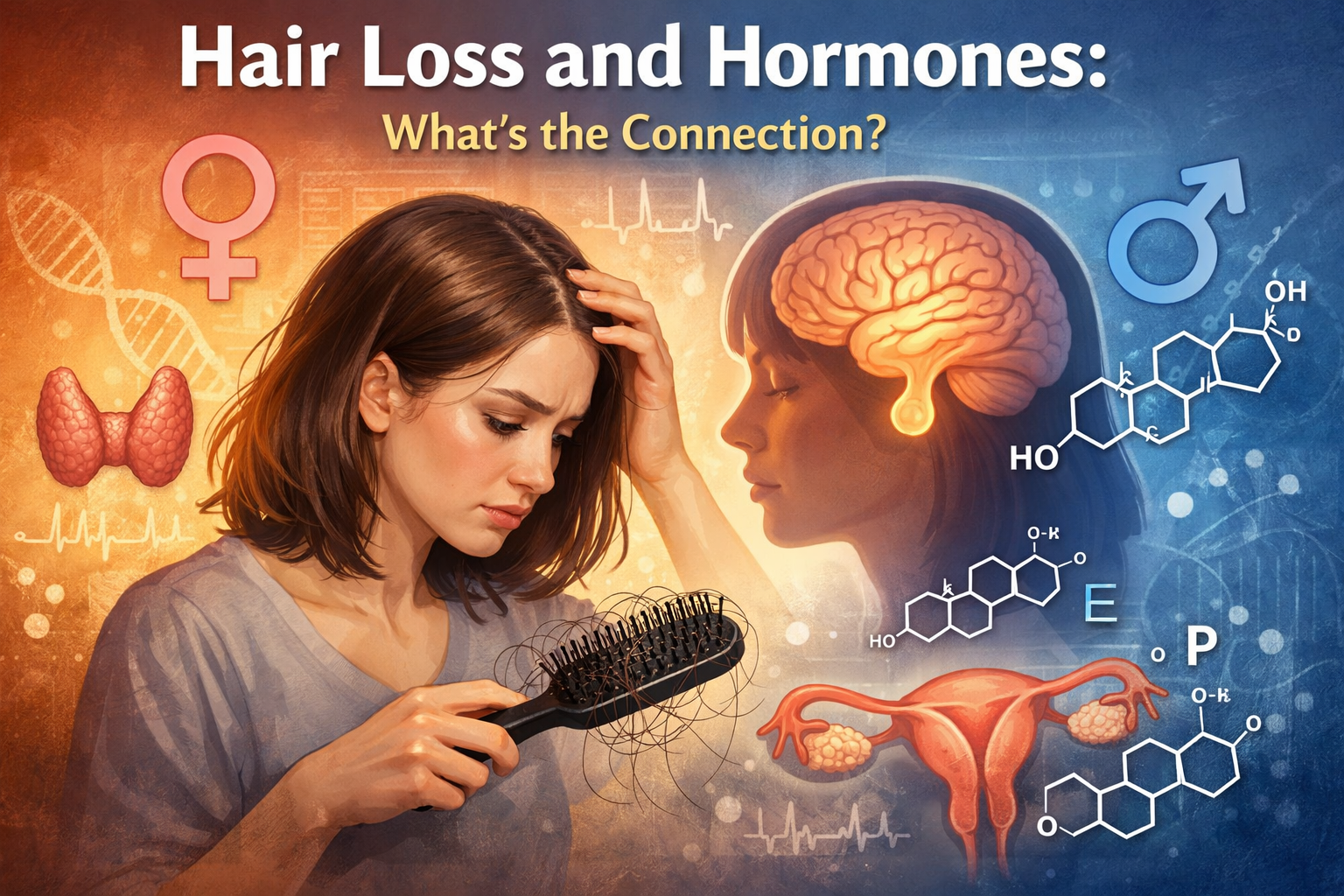
Hair Loss and Hormones: What’s the Connection?
I didn’t think hormones had anything to do with my hair.
At least, not in any way I could see or feel.
Hormones, to me, were something abstract—something you read about, something that affected mood or energy or maybe sleep. But hair? That felt different. More external. More visible. Less… complicated.
Until it wasn’t.
The Change I Couldn’t Explain
It started the same way many things do—quietly.
My hair didn’t fall out in dramatic amounts. It didn’t suddenly look completely different. But something had shifted.
It felt thinner.
Lighter.
Less… present.
And the strange part was, nothing else seemed obviously wrong.
I was eating the same.
Living the same.
Following the same routines.
So the question lingered:
If nothing has changed… why does it feel like something has?
When the Cause Isn’t Visible
That’s the thing about hormones.
They don’t show themselves directly.
You don’t see them changing.
You don’t feel them in a clear, immediate way.
But they influence everything beneath the surface.
And hair, as I eventually learned, is deeply connected to that invisible system.
The System You Don’t Think About
Hormones regulate so many processes in the body that it’s easy to overlook how far their influence extends.
Growth.
Repair.
Balance.
Timing.
Hair doesn’t exist outside of that system—it’s part of it.
And when something shifts within that system, hair can reflect it.
Not instantly.
But eventually.
The Delay That Makes It Confusing
One of the most frustrating parts is the timing.
Hormonal changes don’t always produce immediate effects.
There’s often a delay.
Weeks.
Sometimes months.
So when you notice hair loss, the cause might not feel connected.
You think:
But nothing has changed recently.
And that’s exactly why it feels confusing.
When Hair Becomes the First Clue
Looking back, I realized that my hair was one of the first signs that something internal had shifted.
Not the only sign.
But the most visible one.
Because hair doesn’t hide.
It shows.
Even when the cause is something you can’t see.
The Subtle Role of Balance
Hormones aren’t about extremes.
They’re about balance.
And even small shifts can create noticeable effects.
Not dramatic imbalances.
Just slight changes.
Enough to alter how long hair grows.
How strong it feels.
How quickly it sheds.
And because those changes are subtle, they’re easy to overlook at first.
The Growth Cycle Changes Quietly
Hair grows in cycles.
That part is simple.
But hormones influence those cycles.
They affect how long hair stays in the growth phase.
How quickly it transitions to rest.
How easily it sheds.
So when hormones shift, the cycle shifts with them.
And that shift shows up over time.
When Thinning Feels Gradual
Unlike sudden shedding, hormone-related hair loss often feels gradual.
Diffuse.
Spread out.
Not concentrated in one place.
Which makes it harder to notice—and easier to question.
You don’t see a clear change.
You feel a difference.
And that feeling builds over time.
The Emotional Side of Not Knowing
What made this harder wasn’t just the hair loss.
It was not knowing why.
Because when the cause isn’t obvious, the mind fills in the gaps.
You start guessing.
Questioning.
Looking for answers that don’t feel clear.
And that uncertainty can be more difficult than the change itself.
When You Start Looking for Patterns
At some point, I began to look for patterns.
Not just in my hair.
But in everything.
Energy levels.
Sleep.
Mood.
Subtle shifts that might not seem connected—but could be.
And slowly, it became clear that my body wasn’t unchanged.
It was adjusting.
Hormones Don’t Work Alone
Another realization was this:
Hormones don’t operate in isolation.
They interact with everything else.
Stress.
Nutrition.
Sleep.
Routine.
So when something shifts hormonally, it’s often connected to other factors.
Which makes it more complex—but also more understandable.
The Mistake of Looking for One Cause
I wanted a single answer.
A clear explanation.
But hair loss rarely works that way.
It’s not always one cause.
It’s a combination.
And hormones are often part of that combination—not the whole story.
The Difference Between Sudden and Gradual Change
Understanding this helped me separate two types of experiences:
Sudden shedding → often linked to a specific trigger
Gradual thinning → often linked to ongoing internal shifts
Hormonal changes tend to fall into the second category.
They don’t create immediate change.
They create gradual adjustment.
The Importance of Paying Attention Early
Because hormonal hair loss is gradual, it’s easy to miss early signs.
Until they become more noticeable.
And by then, it feels like it appeared suddenly—even though it didn’t.
That’s why early awareness matters.
Not to react quickly.
But to understand sooner.
The Role of Patience (Again)
If there’s one theme that keeps coming up with hair, it’s this:
Time matters.
Hormonal changes take time to show.
And they take time to stabilize.
So any improvement also takes time.
And that can be frustrating.
But it’s part of the process.
When You Start Seeing Small Shifts
At some point, I noticed something subtle.
Not a full return to how things were—but a shift.
Less shedding.
Slightly stronger strands.
Small signs that things were stabilizing.
And that was enough.
Because it meant my body was adjusting again.
You’re Not Powerless
One of the biggest misconceptions I had was that hormonal hair loss was something I couldn’t influence.
Something that just… happened.
But that’s not entirely true.
You may not control hormones directly.
But you can support the systems they’re part of.
Through consistency.
Through care.
Through balance.
So, What’s the Connection?
Hair and hormones are connected through timing.
Through cycles.
Through balance.
Hormones influence how hair grows, rests, and sheds.
And when that balance shifts, hair reflects it.
Not immediately.
But inevitably.
You’re Not the Only One Experiencing This
If you’ve been noticing changes in your hair that don’t have a clear cause, hormones might be part of the picture.
And if that feels confusing, you’re not alone.
Because it’s one of those things that doesn’t come with obvious answers.
Final Thought
Hair loss linked to hormones isn’t always loud.
It doesn’t always announce itself clearly.
It shows up gradually.
Quietly.
In ways that are easy to question but hard to explain.
But once you understand the connection, it becomes less mysterious.
Less overwhelming.
Because it’s no longer just something happening to you—
It’s something your body is moving through.
And like most things your body does, it’s not random.
It’s part of a system.
A system that, even when it shifts, is still trying to find its balance again.