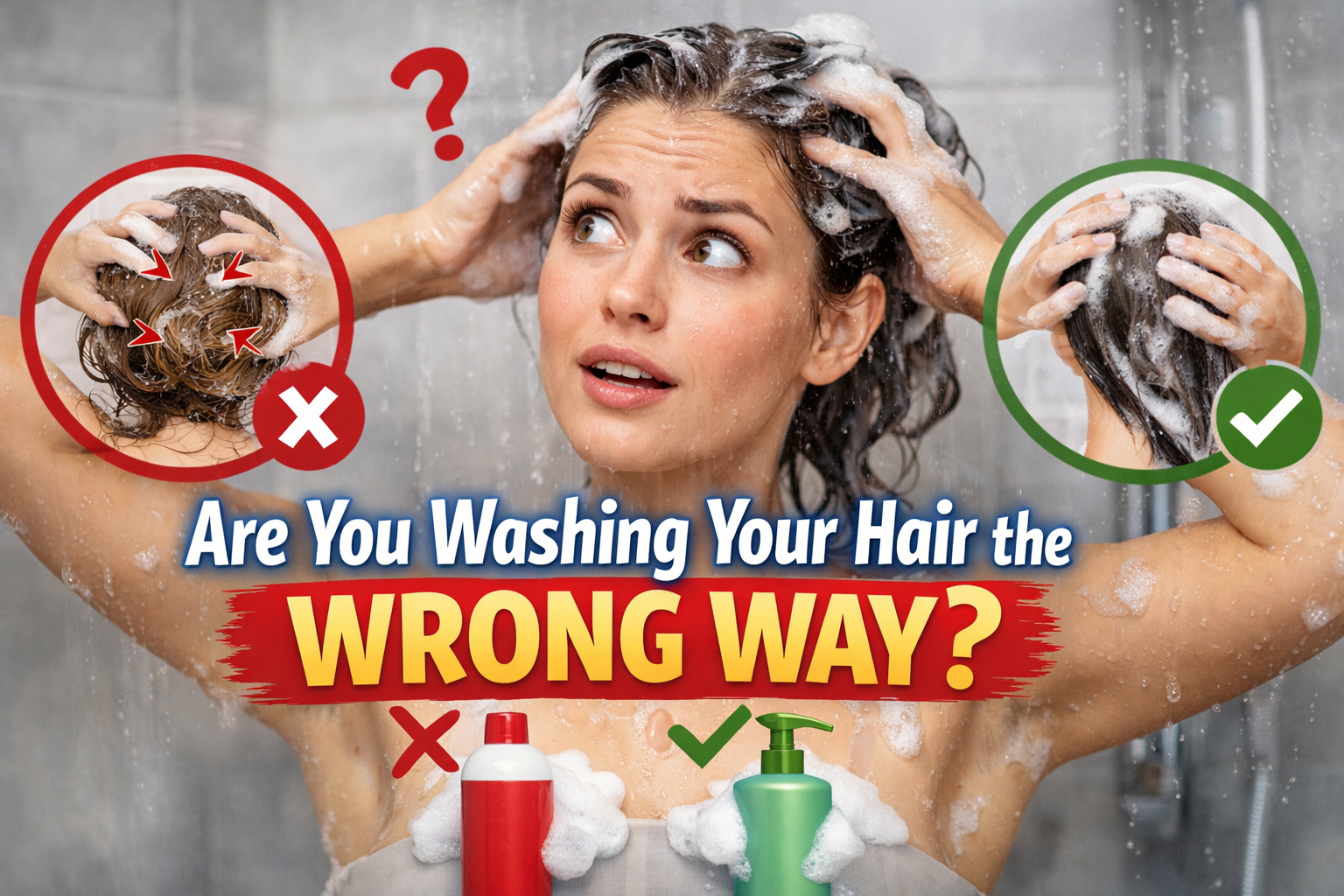
Are You Washing Your Hair the Wrong Way?
I never thought washing my hair could be… wrong.
It was one of those routines so automatic, so familiar, that it never crossed my mind to question it. You step into the shower, wet your hair, apply shampoo, rinse, maybe condition, and that’s it. Done. Clean. Simple.
Or at least, that’s what I believed.
Until one day, something felt off.
Not immediately. Not in a way that made me stop mid-shower. But over time—gradually, quietly—I started to notice small changes.
More hair in the drain.
Hair that felt rougher after drying.
Ends that didn’t feel as smooth as they used to.
And a strange thought began to form:
What if I’m not doing this as correctly as I think?
When Routine Becomes Invisible
There’s something about repetition that makes us stop paying attention.
We do things the same way every day until they become invisible—until we no longer notice the details.
Washing my hair had become one of those things.
I wasn’t thinking about how I did it.
I was just doing it.
And that’s exactly why I never questioned it.
The First Sign Something Might Be Off
It wasn’t the shedding alone that made me pause.
It was how my hair felt afterward.
Clean—but not quite right.
There was a dryness that hadn’t been there before.
A kind of roughness that didn’t match the idea of “freshly washed.”
And that contradiction stayed with me.
Because if something is clean, shouldn’t it also feel… better?
The Way We Think Hair Should Feel
We often assume that washing equals improvement.
That the act of cleaning automatically leads to healthier hair.
But hair doesn’t always respond that way.
Because it’s not just about what you use.
It’s about how you use it.
And that’s where things get more complicated.
The Habit of Rushing
I started noticing how quickly I moved through the process.
Wet. Shampoo. Rinse. Done.
It was efficient.
But maybe too efficient.
Because in that rush, I wasn’t paying attention to how my hair was actually responding.
I was following a sequence.
Not a process.
Applying Shampoo: More Than Just Coverage
I used to focus on getting shampoo everywhere.
Spreading it through the lengths.
Making sure everything felt clean.
But over time, I realized something simple:
Hair doesn’t need to be scrubbed from top to bottom.
The scalp is where cleansing matters most.
The lengths don’t need the same level of attention.
And when I treated everything the same, I was overdoing it—without realizing.
The Pressure You Don’t Notice
Another thing I hadn’t considered was pressure.
How firmly I was rubbing my scalp.
How aggressively I was moving my hands.
It didn’t feel rough in the moment.
But repeated over time, that kind of friction adds up.
Hair isn’t just affected by what you do once.
It’s affected by what you do consistently.
Water Temperature: The Detail I Ignored
I liked hot showers.
Not extreme—but warm enough to feel relaxing.
Comforting.
But I never thought about what that meant for my hair.
Hot water can strip away natural oils more quickly.
Leaving the hair feeling clean—but also more vulnerable.
And that vulnerability doesn’t show immediately.
It builds.
Conditioner: The Step I Rushed Through
If I’m being honest, conditioner was always the quickest step.
Apply. Wait a few seconds. Rinse.
It felt optional.
Secondary.
But over time, I realized that this step wasn’t just an add-on.
It was balance.
A way to restore what washing removes.
And rushing through it meant I wasn’t giving my hair what it needed to recover.
The Way Hair Feels When It’s Wet
There’s a moment in the shower where your hair is at its most fragile.
When it’s wet.
When it stretches more easily.
When it’s more prone to breakage.
And that’s exactly when I used to handle it the most.
Running my fingers through it.
Pulling gently to detangle.
Not roughly—but not carefully either.
And that difference matters.
Towel Drying: The Hidden Damage
After the shower, I used to wrap my hair tightly in a towel.
Rub it to dry faster.
It felt efficient.
Practical.
But hair, especially when wet, doesn’t respond well to friction.
And that rough drying, repeated over time, can weaken the strands.
Even if you don’t notice it immediately.
The Cumulative Effect
None of these things felt like mistakes on their own.
Each one seemed small.
Insignificant.
But together?
They created a pattern.
A pattern that affected how my hair looked, felt, and behaved.
And that’s what made the difference.
Because hair care isn’t about one action.
It’s about accumulation.
When Clean Doesn’t Mean Healthy
This was the biggest shift in understanding for me.
Clean hair isn’t always healthy hair.
You can remove dirt, oil, buildup—and still leave your hair in a weakened state.
Because health isn’t just about removal.
It’s about balance.
The Subtle Signs You Might Be Washing Wrong
Looking back, there were signs I could have noticed earlier:
Hair feeling dry right after washing
Increased breakage
More tangling than usual
A lack of natural shine
Scalp feeling tight or irritated
Individually, they didn’t seem urgent.
But together, they pointed to something.
Slowing Down Changed Everything
The biggest change I made wasn’t dramatic.
It was slowing down.
Paying attention.
Being more intentional with each step.
Not rushing through the process just to finish it.
And that alone made a difference.
Listening to Your Hair Instead of Following a Routine
What worked for me might not be exactly the same for you.
And that’s important.
Because hair isn’t one-size-fits-all.
Different textures.
Different needs.
Different responses.
So instead of following a fixed routine, I started observing.
Adjusting.
Responding.
It’s Not About Perfection
I didn’t suddenly start doing everything perfectly.
And I don’t think that’s necessary.
Because hair doesn’t need perfection.
It needs consistency.
Gentle care.
Awareness.
The First Signs of Change
The improvement wasn’t immediate.
But it was noticeable.
Hair felt softer.
Less tangled.
More manageable.
And over time, stronger.
Not dramatically—but enough to feel the difference.
So, Are You Washing Your Hair the Wrong Way?
Maybe.
But not in an obvious way.
Not in a way that feels like a mistake.
More in the small habits you don’t question.
The steps you rush through.
The details you overlook.
You Don’t Need to Start Over
If something in your routine isn’t working, it doesn’t mean everything is wrong.
It just means there’s room to adjust.
To refine.
To understand what your hair actually needs.
Final Thought
Washing your hair seems simple.
And in many ways, it is.
But simplicity doesn’t mean it’s insignificant.
Because how you do something repeatedly matters more than you think.
So if your hair hasn’t been feeling the way it used to—
It might not be about what you’re using.
It might be about how you’re using it.
And sometimes, the smallest changes in how you care for something…
Make the biggest difference over time.