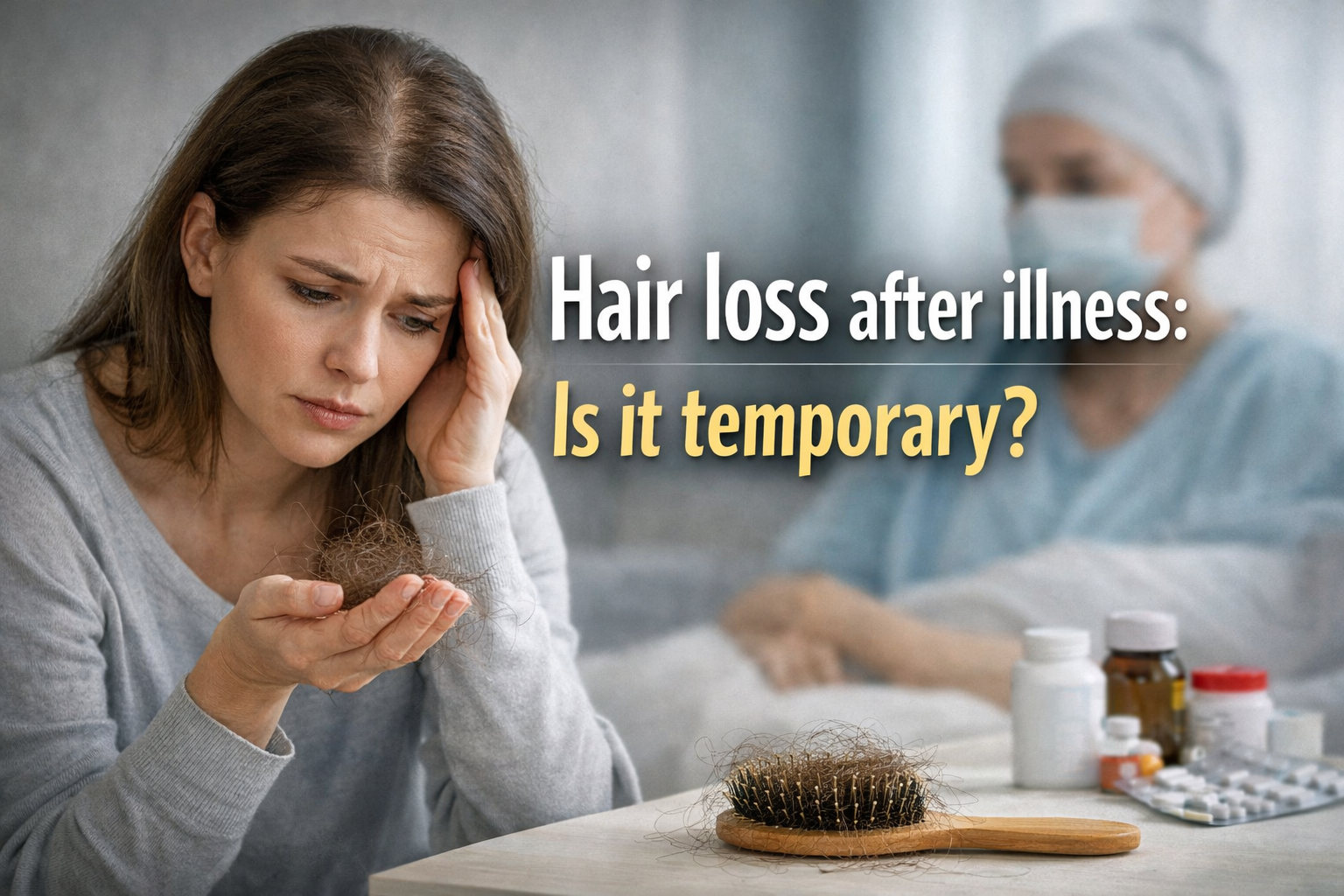
Hair Loss After Illness: Is It Temporary?
It didn’t happen while I was sick.
That’s what made it so confusing.
When I was actually unwell, my focus was somewhere else entirely—resting, recovering, just trying to feel normal again. Hair was the last thing on my mind. It felt distant, irrelevant, almost trivial compared to everything else my body was dealing with.
But then, weeks later—when I thought I was finally “fine”—I noticed it.
Hair.
More than usual.
At first, just a little extra in the shower. Then more on my pillow. Then more caught in my hands when I ran my fingers through it without thinking.
And suddenly, a new question replaced the relief I had just started to feel:
Why now?
The Delay No One Warns You About
If hair had started falling out while I was sick, maybe it would have made sense.
But it didn’t.
It waited.
And that delay is what makes post-illness hair loss so unsettling.
Because by the time it begins, the illness feels like it’s already over.
You’ve moved on.
Your body, apparently, hasn’t.
When Recovery Isn’t Complete
We tend to think of recovery as a clear moment.
You’re sick.
Then you’re not.
But the body doesn’t work in such clean lines.
Even after symptoms fade, the internal recovery continues.
Quietly.
Gradually.
And sometimes, hair becomes part of that delayed response.
The Body’s Way of Prioritizing
During illness, your body shifts its focus.
Energy goes toward healing.
Toward protecting vital systems.
Toward getting you back to a stable state.
And in that process, certain functions are temporarily deprioritized.
Hair growth is one of them.
Not because it’s unimportant.
But because it’s not essential for survival.
So while your body is recovering, hair quietly moves into a resting phase.
And weeks later—that’s when the shedding begins.
The Moment It Feels Like Something New
I remember thinking this was a new problem.
Something separate from what I had already gone through.
Because the timing didn’t match.
The illness was over.
So why was something else starting?
It took time to understand that this wasn’t new.
It was delayed.
A continuation of something my body had already experienced.
When Shedding Feels Out of Place
There’s something particularly frustrating about hair loss that appears after you’ve already gone through something difficult.
Because it feels like an extension of something you thought you had finished.
You’ve already been through the discomfort.
The fatigue.
The disruption.
And now, just when things are supposed to return to normal, something else shows up.
Quietly.
Persistently.
The Pattern That Slowly Becomes Clear
At first, it felt random.
But over time, I started to notice patterns.
The shedding wasn’t constant—it had a rhythm.
Some days more.
Some days less.
But overall, it was more than what I was used to.
And that consistency made it harder to ignore.
Because now, it wasn’t just a moment.
It was a phase.
The Fear of It Lasting Too Long
Once the shedding continued for a while, the question changed again:
Is this temporary?
And maybe more honestly:
Will it stop?
Because when something begins unexpectedly, it creates uncertainty.
And uncertainty always leads to imagining outcomes you can’t yet see.
Understanding What’s Actually Happening
What helped me most was understanding the process.
Not in a complicated way.
Just enough to make sense of it.
After illness, many hair follicles shift into a resting phase.
They pause.
Then, after some time, they shed.
Not because something is wrong.
But because the cycle was interrupted.
And now, it’s resetting.
That idea changed how I saw everything.
It’s Not Loss—It’s Transition
Instead of seeing it as hair loss, I started seeing it as a transition.
A phase where old strands are released so new ones can begin.
That doesn’t make the experience easier in the moment.
But it makes it less alarming.
Because it reframes what’s happening.
The Difficulty of Waiting (Again)
Even with that understanding, the waiting is still hard.
Because shedding is visible.
But regrowth is slow.
Subtle.
Almost invisible at first.
So there’s a period where it feels like everything is going out—and nothing is coming back.
And that imbalance creates doubt.
The Small Signs You Almost Miss
Then, gradually, something shifts.
Not dramatically.
Just slightly.
Less hair falling out.
Short, fine strands appearing along the hairline.
Tiny signs of regrowth that are easy to overlook.
But they matter.
Because they signal that the cycle is moving forward again.
When Temporary Feels Long
One of the hardest things to accept is that “temporary” doesn’t always mean short.
It can last weeks.
Sometimes months.
And during that time, it doesn’t feel temporary at all.
It feels ongoing.
But temporary is about direction—not duration.
It means it’s moving toward resolution.
Even if that movement is slow.
The Importance of Not Overreacting
There’s a temptation to fix it quickly.
To try everything at once.
To stop the shedding immediately.
But this kind of hair loss doesn’t respond to urgency.
It responds to time.
To balance.
To allowing the body to complete what it started.
Supporting the Process Instead of Fighting It
What helped me most wasn’t trying to control it.
It was supporting it.
Rest.
Nutrition.
Gentle care.
Consistency.
Not dramatic changes.
Just steady ones.
Because recovery isn’t about forcing results.
It’s about creating the conditions for them.
When It Might Need More Attention
Most of the time, hair loss after illness is temporary.
But there are moments when it’s worth paying closer attention.
If the shedding continues for a long time without slowing…
If there’s no sign of regrowth…
If your hair becomes noticeably thinner overall…
Then it might be time to look deeper.
Not out of fear.
But out of awareness.
You’re Not Starting Over
One thought that stayed with me was this:
I wasn’t starting over.
My body was still in the process of finishing what it had already been through.
And hair loss was part of that process—not a separate problem.
So, Is It Temporary?
In most cases, yes.
But not immediately.
Not in a way that feels quick or obvious.
It’s temporary in the sense that the cycle continues.
That regrowth happens.
That balance returns.
But it requires patience.
You’re Not Alone in This Experience
If you’ve gone through illness and are now noticing hair loss, it can feel like an unexpected extension of something you thought was over.
But it’s a common experience.
It just isn’t always talked about in detail.
So when it happens, it feels more personal than it actually is.
Final Thought
Hair loss after illness can feel like a delayed reaction.
Because it is.
Not a new problem—but a continuation of your body’s recovery.
And while it may feel discouraging, it’s also a sign that your body is still adjusting.
Still recalibrating.
Still moving toward balance.
So if you’re in that phase right now, wondering whether it will stop—
It likely will.
Not instantly.
Not dramatically.
But gradually.
In the same quiet way it began.
And sometimes, that’s how healing works—
Not all at once, but in small, steady steps you only fully understand when you look back.