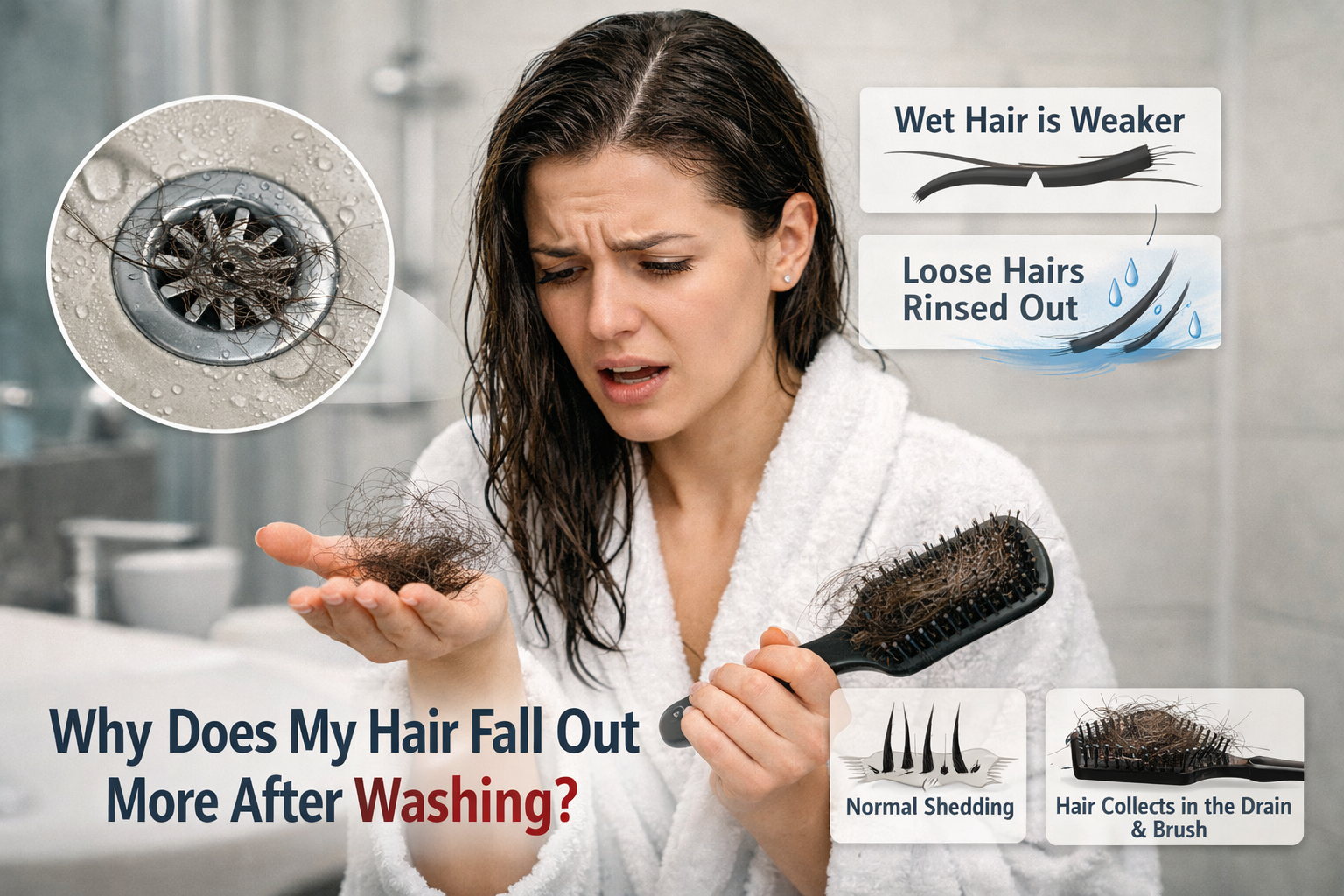
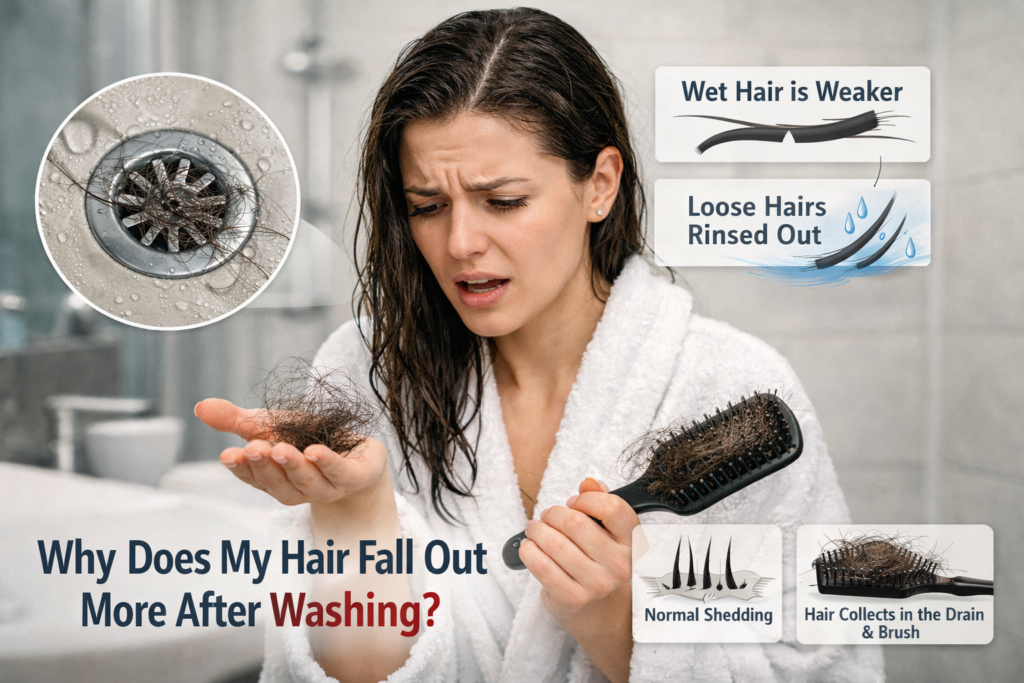
Why Does My Hair Fall Out More After Washing?
A quiet, personal exploration of something we all notice—but rarely talk about
I didn’t notice it at first.
Or maybe I did, but I brushed it off the way we often do with small, inconvenient truths. A few strands on my fingers while rinsing shampoo. A couple more tangled in the drain. Nothing dramatic, nothing alarming—just enough to make me pause for a second before convincing myself it was normal.
But then one day, it wasn’t just a few strands anymore.
It was a small clump.
I remember standing there under the warm stream of water, my hand frozen mid-motion, staring at what I had just gathered from my hair. It felt heavier than it should have, like it carried a quiet question I wasn’t ready to answer: Is this normal?
The Moment We Start Paying Attention
Hair, in many ways, is something we take for granted—until we begin to lose it.
Before that moment, washing my hair was automatic. Shampoo, rinse, conditioner, done. I never paid attention to how many strands slipped away because I never had a reason to. But once I noticed it, I couldn’t unsee it.
Every wash became an observation.
Every strand became a signal.
And with that awareness came a strange mix of curiosity and concern. I started wondering if I had changed something—my routine, my products, my diet. Or maybe something else had changed without me realizing it.
What I eventually learned is that hair shedding during washing is not only common—it’s often misunderstood.
The Illusion of “More Hair Loss”
One of the first things I discovered is that it’s not necessarily that we lose more hair when we wash it. It just appears that way.
On a typical day, we naturally shed hair—often dozens of strands—without even noticing. They fall out gradually, silently, throughout the day. Some get caught in our clothes, some drift away unnoticed, and some remain loosely attached until something dislodges them.
Washing your hair simply gathers all of those “already-shed” strands into one moment.
It’s like collecting days’ worth of unnoticed shedding and presenting it all at once, right there in your hands. No wonder it feels alarming.
I remember realizing this and feeling a small wave of relief. Maybe nothing had suddenly gone wrong. Maybe I was just seeing what had always been happening—only now, it was visible.
The Role of Timing
Another detail that quietly influences this experience is how often we wash our hair.
There was a period when I started washing my hair less frequently, thinking it might be healthier. Every two or three days instead of daily. It seemed like a small, reasonable change.
But when I did wash it, the amount of hair I saw falling out seemed to double.
At first, I thought I had made things worse.
But then it clicked: if you’re shedding a similar number of hairs each day, and you go longer between washes, those loose strands simply accumulate. When you finally wash your hair, they all come out together.
It’s not increased loss—it’s delayed release.
Understanding that changed how I interpreted what I was seeing. The same event that once felt alarming now made sense within a broader pattern.
The Gentle vs. The Rough
Still, not all hair shedding during washing is just an illusion. Sometimes, the way we treat our hair in that moment matters more than we think.
I began to notice how I handled my hair in the shower.
On rushed days, I was less careful—scrubbing more aggressively, pulling my fingers through tangles without much patience. On slower days, I was gentler, more deliberate.
The difference was subtle, but real.
Hair is at its most vulnerable when it’s wet. The strands stretch more easily, and the roots can be more sensitive to tension. What feels like a normal motion can sometimes be a bit too rough.
This doesn’t mean we need to treat our hair like something fragile to the point of anxiety. But it does suggest that small adjustments—like detangling gently, using enough conditioner, or avoiding unnecessary pulling—can make a difference over time.
Stress You Don’t See—But Your Hair Does
There was another layer to this that I didn’t immediately connect: stress.
Not the kind that announces itself loudly, but the quiet, persistent kind. Deadlines, expectations, overthinking—things that settle into the background of daily life.
I went through a period where everything felt slightly heavier than usual. Nothing extreme, just enough to keep my mind constantly occupied.
A few weeks later, I noticed more shedding.
At first, I didn’t connect the two. But then I started reading, observing, reflecting—and it became harder to ignore the possibility that what I was experiencing internally was showing up externally.
Hair has a way of responding to what the body goes through, even if the connection isn’t immediate. There can be a delay—a kind of echo of past stress that appears weeks or even months later.
Realizing this didn’t give me instant control over the situation. But it did shift my perspective. Instead of seeing hair shedding as a random problem, I began to see it as a signal—subtle, but meaningful.
The Products We Trust
Then there’s the question of products.
At some point, I started wondering if the shampoo or conditioner I was using played a role. We often trust these products without question, assuming that if they’re on the shelf, they must be safe and effective.
But not every product works the same for everyone.
I tried switching to something gentler, something that felt less harsh on my scalp. I paid attention to how my hair felt during and after washing—not just in terms of shedding, but overall texture and comfort.
The changes weren’t dramatic, but they were noticeable.
It reminded me that hair care isn’t one-size-fits-all. What works perfectly for one person might not suit another at all. And sometimes, the only way to find what works is through quiet experimentation.
The Emotional Side of It
What surprised me the most wasn’t the physical aspect of hair shedding—it was the emotional reaction to it.
There’s something deeply personal about hair. It’s tied to identity, confidence, and how we present ourselves to the world. So when we notice changes, even small ones, it can feel more significant than we expect.
I found myself thinking about it more than I wanted to admit.
Counting strands. Comparing days. Looking for patterns.
And then, at some point, I realized that this constant monitoring was doing more harm than good. Not physically—but mentally.
So I made a small decision: to step back.
Not to ignore the issue, but to stop obsessing over every detail. To trust that some level of shedding is normal. To focus on overall patterns rather than isolated moments.
That shift didn’t solve everything—but it made the experience feel less overwhelming.
What I’ve Come to Understand
If there’s one thing I’ve learned through all of this, it’s that seeing more hair fall out during washing doesn’t automatically mean something is wrong.
Often, it’s a combination of:
- Natural daily shedding becoming visible all at once
- The frequency of washing
- How we handle our hair in that moment
- Subtle changes in stress, routine, or environment
It’s rarely just one factor. More often, it’s a quiet intersection of many.
And perhaps most importantly, it’s something most people experience at some point—even if they don’t talk about it.
A Different Way of Looking at It
Now, when I wash my hair, I still notice the strands that come away. But I don’t react the same way.
I don’t freeze or overanalyze.
I observe, acknowledge, and move on.
Because I’ve come to understand that not every visible change is a sign of something going wrong. Sometimes, it’s just a part of how the body works—something that feels dramatic in the moment but is actually quite ordinary when seen in context.
And maybe that’s the real shift.
Not in how much hair falls out—but in how we interpret what we see.
If you’ve ever stood in the shower, holding a few strands of hair and wondering what it means, you’re not alone.
Sometimes, the answer isn’t as alarming as it feels.
Sometimes, it’s just time—quietly doing what it has always done.