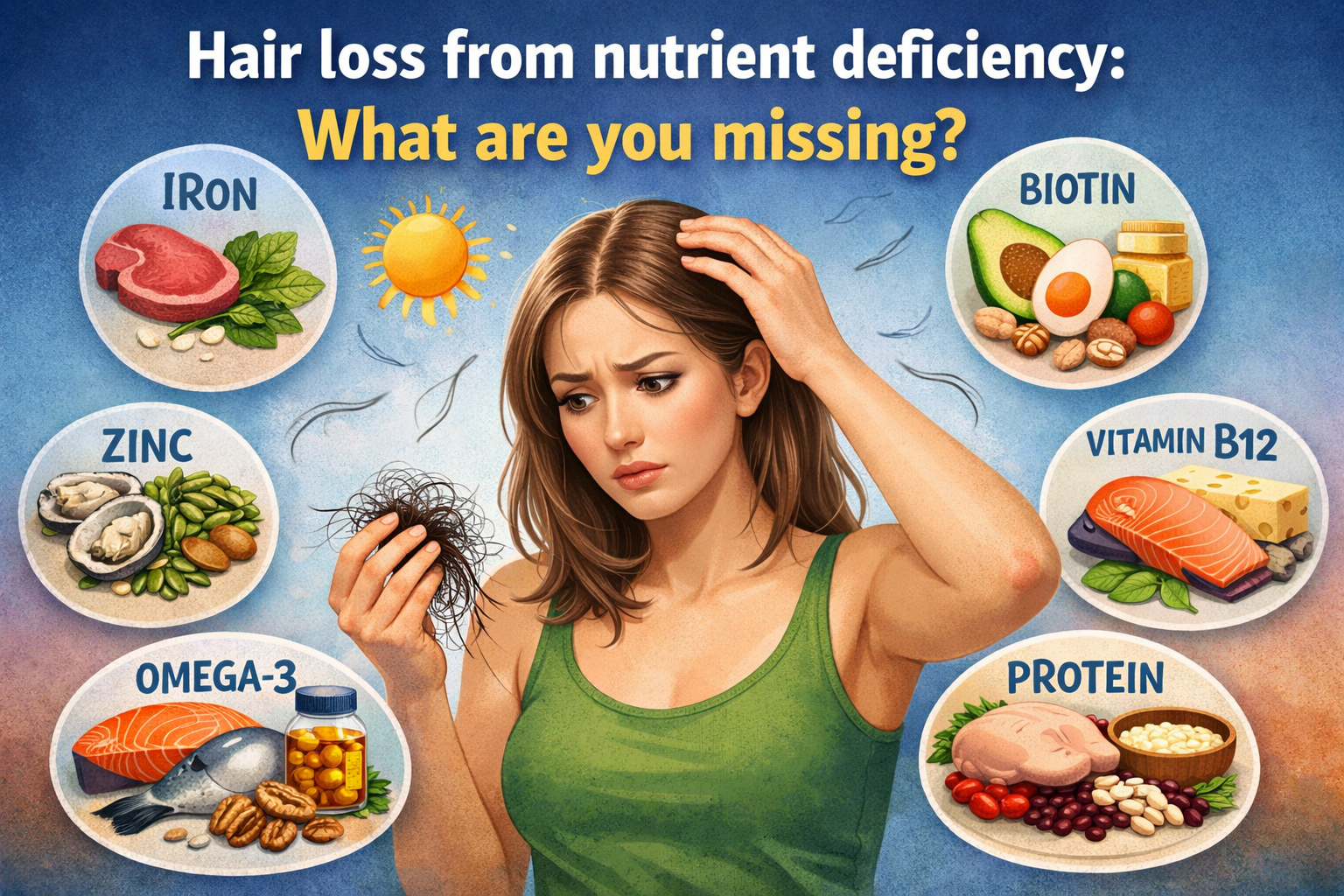
Hair Loss from Nutrient Deficiency: What Are You Missing?
It didn’t feel like something was missing at first.
If anything, everything seemed… normal.
I was eating regularly. Maybe not perfectly, but enough. Meals happened. Snacks happened. There was no obvious sign that my body was lacking anything essential.
And yet, something felt off.
Not dramatically. Not in a way that stopped me in my tracks. Just a quiet shift—subtle enough to ignore, but persistent enough to return.
It showed up in the shower first.
A few more strands than usual.
Then in my brush.
Then on my clothes, my desk, my hands when I ran them through my hair without thinking.
And slowly, that quiet thought began to form:
Am I missing something?
When “Enough” Isn’t Actually Enough
We often assume that eating regularly means we’re getting what we need.
But the body doesn’t measure intake the way we do.
It doesn’t count meals.
It counts nutrients.
And those two things aren’t always the same.
I started thinking back—not in a strict, critical way, but in an honest one.
What was I actually eating?
Was it balanced?
Was it consistent?
Or was I just… getting by?
Because “getting by” can feel fine in the moment.
But over time, the body starts to notice the gaps.
Hair: The First Place to Let Go
One of the things that surprised me most is how quickly hair becomes a signal.
Not because it’s fragile—but because it’s not essential.
If your body has to choose where to direct its energy, it prioritizes survival.
Vital organs.
Core systems.
Things that keep you functioning.
Hair?
That comes later.
So when something is missing—iron, protein, vitamins—hair is often one of the first places where that shortage becomes visible.
Not immediately.
But gradually.
The Slow Build of Deficiency
Nutrient deficiencies don’t always happen suddenly.
They build over time.
Small imbalances.
Missed nutrients.
Inconsistent habits.
None of it feels urgent.
Until it adds up.
And by the time your hair starts to change, the deficiency has often been there longer than you realize.
Which makes it harder to trace.
Harder to connect cause and effect.
The Subtle Signs You Overlook
Looking back, I realized there were signs I hadn’t paid attention to.
Not just in my hair.
But in my body.
Low energy on certain days.
A kind of fatigue that didn’t feel like lack of sleep—but something else.
Moments where I felt slightly off, without knowing why.
None of it was extreme.
But it was consistent.
And consistency matters.
Protein: The Building Block You Might Be Skipping
Hair is made mostly of protein.
That’s something I knew—but didn’t fully think about.
Because protein isn’t just about how much you eat.
It’s about how consistently you get it.
And whether your body has enough to support everything it needs to do.
If protein intake drops—even slightly—your body adjusts.
And one of those adjustments can be slower hair growth.
Weaker strands.
More shedding.
Not overnight.
But over time.
Iron: The Quiet Deficiency
Iron is one of those nutrients that often goes unnoticed.
Until it doesn’t.
It plays a role in carrying oxygen throughout the body—including to hair follicles.
And when levels are low, the effects can be subtle at first.
Fatigue.
Reduced concentration.
And eventually… hair shedding.
The challenge is that iron deficiency doesn’t always feel obvious.
It can exist quietly.
Just enough to affect your body—but not enough to trigger immediate concern.
Vitamins You Don’t Think About Daily
There are so many vitamins connected to hair health that it’s easy to overlook them.
Vitamin D.
Biotin.
Zinc.
Each one plays a role.
Not individually—but collectively.
And when even one of them is slightly off, it can influence the overall balance.
What makes this tricky is that deficiencies aren’t always extreme.
They can be mild.
Just enough to shift things.
Not enough to feel urgent.
The Illusion of “Healthy Enough”
I realized at some point that I had been operating under an assumption:
That I was healthy enough.
That what I was doing was good enough.
And maybe it was—for a while.
But “enough” doesn’t always stay enough.
Needs change.
Routines shift.
And what worked before might not support you in the same way now.
When Hair Reflects Internal Priorities
Hair doesn’t demand attention.
It reflects it.
It shows how your body is allocating resources.
And when resources are limited, hair becomes less of a priority.
That’s not a flaw.
It’s a function.
A way for your body to protect what matters most.
Even if it means letting go of something visible.
The Frustration of Not Seeing Immediate Change
Once I started paying attention to my nutrition, I expected something to shift quickly.
But it didn’t.
Not at first.
And that was frustrating.
Because effort usually leads to visible results.
But with hair, the timeline is different.
Slower.
Less obvious.
What you change today might not show up for weeks—or months.
And during that time, it’s easy to feel like nothing is working.
The Role of Consistency (Again)
What made the difference wasn’t perfection.
It was consistency.
Eating more balanced meals.
Making sure I wasn’t skipping nutrients without realizing it.
Not in a rigid way—but in a steady one.
And slowly, something changed.
Not dramatically.
But enough to notice.
The First Signs of Return
It started with less shedding.
Then, gradually, I noticed small hairs—short, soft, easy to miss.
But they were there.
And they hadn’t been there before.
That’s when it became real.
That something had shifted.
Not instantly.
But meaningfully.
The Connection You Don’t Expect
One of the most surprising things about this experience was how connected everything felt.
Hair wasn’t separate.
It wasn’t just an external issue.
It was tied to how I was eating.
How I was living.
How I was taking care of myself in ways I hadn’t fully considered before.
And once I saw that connection, it became harder to ignore.
So, What Might You Be Missing?
It’s not always one thing.
It could be:
- Not enough protein over time
- Low iron levels
- Insufficient vitamins like D, B-complex, or zinc
- Inconsistent eating patterns
- Or a combination of small gaps that add up
That’s what makes it complex.
But also what makes it fixable.
You Don’t Need to Overcorrect
There’s a temptation to fix everything at once.
To change your entire routine overnight.
But that’s not necessary.
And often, it’s not sustainable.
Small, consistent changes matter more.
Because they last.
Listening Without Overreacting
Hair loss from nutrient deficiency isn’t something to panic about.
But it is something to pay attention to.
Because it’s your body signaling that something is missing.
Not dramatically.
Not urgently.
But clearly enough that, once you notice it, you can’t really ignore it anymore.
Final Thought
If your hair has been falling out more than usual, and you can’t quite explain why—it might not be about what you’re doing wrong.
It might be about what you’re not getting enough of.
And that’s an important distinction.
Because it shifts the focus.
From fixing a problem…
To filling a gap.
Hair, in the end, is just one reflection of how your body is functioning.
And sometimes, when it starts to change, it’s not asking for more attention.
It’s asking for more support.
Quietly.
Consistently.
In ways that take time—but make all the difference.