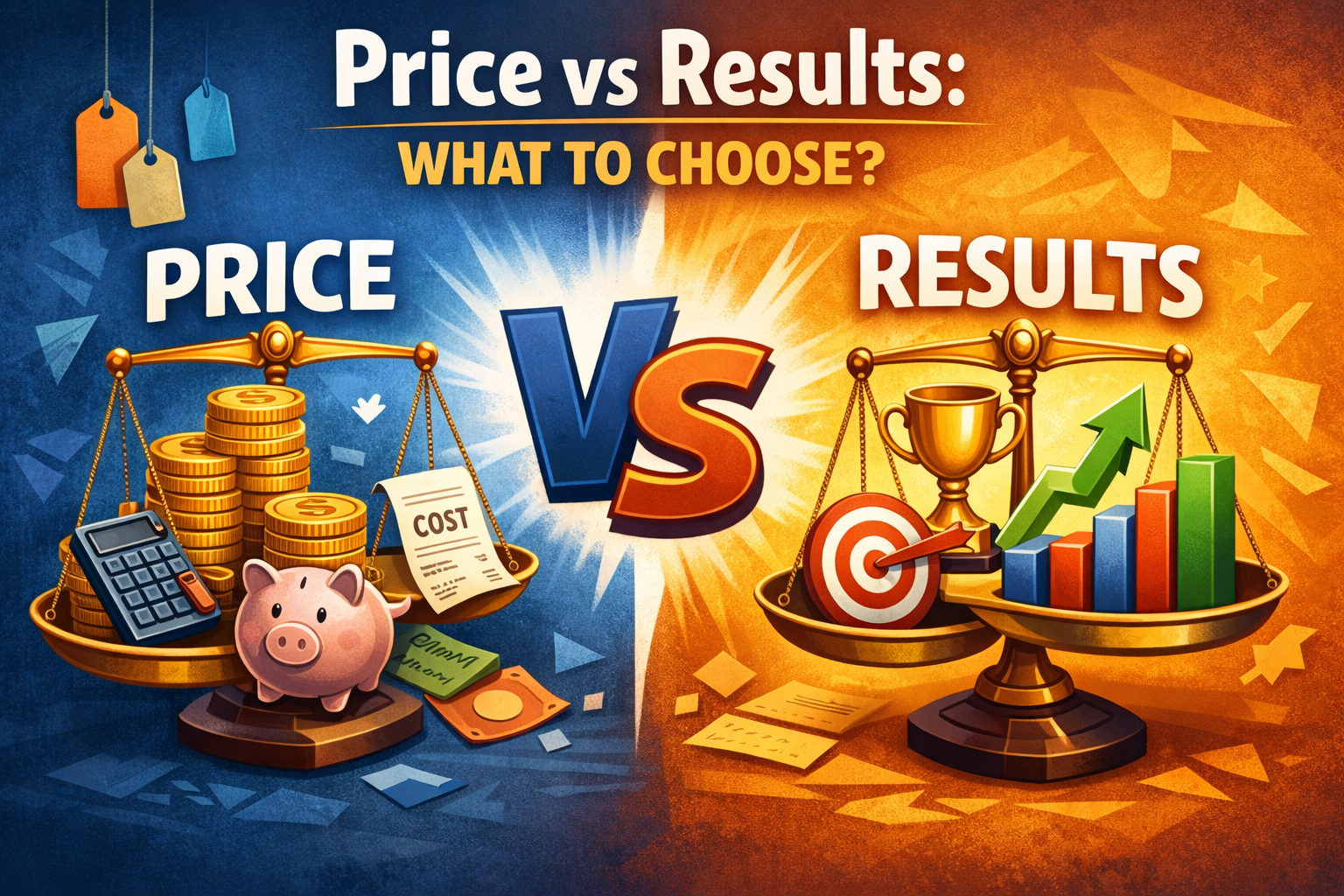
Price vs. Results: What to Choose?
A reflective, narrative-style exploration
I still remember standing in the middle of a brightly lit store, holding two versions of the same thing in my hands.
One was cheaper—noticeably so. The packaging was simple, almost unremarkable, and it did what it claimed, at least on paper. The other was more expensive. It looked better, felt more “complete,” and promised results that seemed just a little more convincing.
At that moment, the decision felt small. Almost trivial.
But it wasn’t.
Because what I was really choosing between wasn’t just two products—it was two different ways of thinking: price versus results.
And over time, I’ve realized that this quiet dilemma shows up everywhere—in what we buy, how we learn, how we work, and even in the goals we set for ourselves.
The Comfort of Saving
There’s a certain satisfaction in choosing the cheaper option. It feels responsible, controlled, even smart. You tell yourself you’re avoiding unnecessary spending, that you’re being practical.
I used to lean heavily in that direction.
Whenever I had a choice, I would instinctively look for the lower price. Not because I didn’t care about quality, but because saving money felt like a clear, measurable win. You could see it instantly—money not spent, budget preserved.
And sometimes, that decision worked out perfectly fine.
But other times, something subtle would happen.
The cheaper option would do its job—but only partially. It might take longer, feel less reliable, or require extra effort to get the same result. Nothing dramatic, nothing catastrophic—just a quiet accumulation of inconvenience.
At first, I ignored it.
Until I couldn’t.
When Cheap Becomes Expensive
The turning point didn’t come from a single bad purchase. It came from a pattern.
I began to notice that some of the things I bought to “save money” ended up costing me more in the long run—not always in cash, but in time, energy, and frustration.
A tool that broke sooner than expected. A service that needed constant fixing. A shortcut that led to more steps later.
Each time, the difference seemed small. But together, they formed a clear picture: choosing based on price alone often meant paying in other ways.
That’s when I started asking a different question.
Not “How much does this cost?”
But “What result will this actually give me?”
The Weight of Results
Results are harder to measure than price.
Price is immediate, visible, and precise. Results are delayed, sometimes uncertain, and often subjective.
And yet, results are what we actually care about.
I remember investing in something that felt expensive at the time—something I hesitated over, something I almost walked away from. It wasn’t the cheapest option, not even close.
But it delivered.
Not instantly, not perfectly—but meaningfully.
It saved me time. It reduced stress. It worked consistently. And over time, the value it provided far outweighed the initial cost.
That experience shifted something in me.
I began to see that price is what you pay, but results are what you live with.
The Trap of Overpaying
But there’s another side to this story—one that’s just as important.
Not everything expensive is worth it.
At one point, I swung too far in the other direction. Convinced that higher price meant better results, I started choosing premium options more often, assuming they would automatically deliver more value.
Sometimes they did.
But sometimes, they didn’t.
I paid extra for features I didn’t use. For quality I didn’t fully need. For improvements that were so small they barely made a difference in my actual experience.
And that’s when I realized something equally important:
Higher price does not guarantee better results.
Just as cheap can be misleading, so can expensive.
Learning to Evaluate Value
So if price can mislead, and results are hard to measure, how do we decide?
For me, the answer came slowly, through trial and reflection.
I started paying attention not just to what something costs, but to what it changes.
Does it save time?
Does it reduce effort?
Does it improve consistency?
Does it solve the problem completely—or just partially?
These questions began to matter more than the number on the price tag.
Because value isn’t about spending more or less—it’s about aligning what you pay with what you actually gain.
Time as a Hidden Cost
One of the biggest shifts in my thinking came when I started considering time as part of the equation.
We often focus so much on money that we forget how valuable time is.
A cheaper option that takes twice as long isn’t necessarily cheaper. A solution that requires constant attention isn’t really efficient. A product that needs frequent replacement quietly consumes more of your life than you realize.
I learned this the hard way.
There were moments when I chose the budget option, only to spend hours fixing, adjusting, or compensating for its limitations. At the end of the day, I hadn’t saved anything—I had simply traded money for time.
And not always willingly.
That realization changed how I approached decisions.
Because time, unlike money, is not something you can earn back in the same way.
Emotional Impact of Decisions
What surprised me most was how much these choices affected not just my productivity, but my mindset.
The wrong choice—whether too cheap or unnecessarily expensive—often came with a subtle emotional cost.
Frustration when something didn’t work as expected.
Regret when I felt I had overspent.
Doubt when I questioned whether I had made the right decision.
On the other hand, the right choice—regardless of price—brought a sense of ease. Things worked. Problems stayed solved. There was less second-guessing.
And that emotional clarity, I realized, was part of the “result” too.
Context Changes Everything
One of the most important lessons I’ve learned is that there is no universal answer to “price vs. results.”
The right choice depends on context.
Sometimes, the cheaper option is exactly what you need—especially when the stakes are low, or when the difference in results is minimal.
Other times, investing more makes sense—particularly when the outcome has a significant impact on your time, your work, or your well-being.
I began to think of decisions in terms of importance.
For things that truly matter, results should lead the decision.
For things that don’t, price can take priority.
This simple shift made decisions clearer, and often easier.
The Long-Term Perspective
Perhaps the most valuable change in my thinking came when I started looking beyond the immediate moment.
Instead of asking, “What’s the best choice right now?” I began asking, “What will this choice mean later?”
Will I still be satisfied with this decision in a week? A month? A year?
That perspective often revealed things that weren’t obvious at first glance.
A slightly higher upfront cost that leads to consistent, reliable results often becomes the better choice over time.
A lower price that leads to repeated issues often becomes more expensive than it seemed.
Time, once again, becomes the ultimate judge.
A Personal Balance
Today, I don’t see price and results as opposing forces anymore.
I see them as parts of the same equation.
Price matters. It always will. But it’s only one side of the story.
Results matter more—but only when they truly deliver value.
The goal isn’t to always choose the cheapest or the most expensive option. It’s to choose the one that makes sense for the situation you’re in, the outcome you want, and the resources you have.
And that balance isn’t fixed.
It evolves.
Closing Reflection
If I think back to that moment in the store—the two options in my hands—I realize now that the real decision wasn’t about which product to buy.
It was about how I define value.
And that definition has changed over time.
I’ve learned to look beyond the price tag, but also to question the promise of results. I’ve learned to consider time, effort, and emotional impact—not just cost.
And most importantly, I’ve learned that the best choice isn’t always obvious in the moment.
Sometimes, you only understand it later—when you live with the results of what you chose.
Because in the end, price is what you pay once.
But results are what you experience again and again.
And that difference, subtle as it may seem, is what makes all the difference.