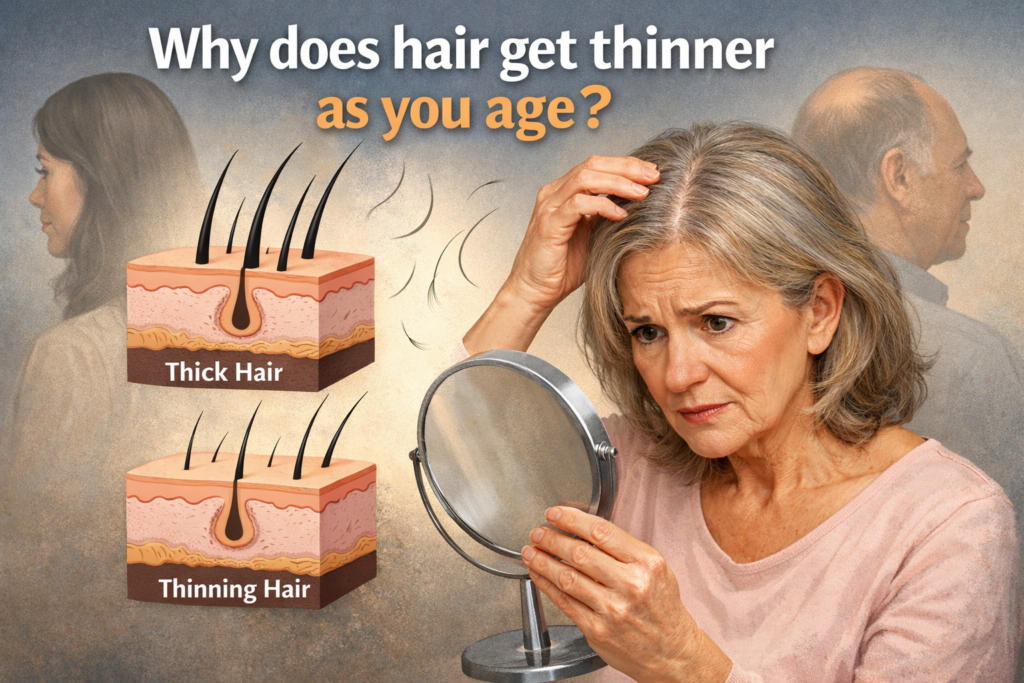
Why Does Hair Get Thinner as You Age?
I didn’t notice the change the way you’d expect.
There was no sudden shift. No moment where I woke up and thought, something is wrong. It was quieter than that—so quiet, in fact, that for a long time, I didn’t even realize it was happening.
It started in the way my hair felt.
Not how it looked, at least not immediately—but how it moved. It seemed lighter somehow. Less dense between my fingers. When I ran my hand through it, there was less resistance, less of that familiar fullness I had always taken for granted.
At first, I told myself it was just a phase.
Maybe stress.
Maybe the weather.
Maybe I was imagining it.
But time has a way of revealing patterns we try to ignore.
And slowly, almost imperceptibly, the question began to form:
Is this just what happens as you get older?
The Kind of Change You Can’t Date
One of the most confusing things about age-related hair thinning is that you can’t pinpoint when it begins.
There’s no clear starting line.
No single moment where everything changes.
Instead, it unfolds gradually—so gradually that you adapt to it as it happens.
A slightly looser ponytail.
A part that looks a little wider under certain light.
Hair that doesn’t hold volume the way it used to.
Each change is small.
But over time, they accumulate into something noticeable.
Something real.
When “Normal” Starts to Shift
What I struggled with most wasn’t the thinning itself—it was redefining what “normal” meant.
Because for so long, my hair had been consistent.
Predictable.
Something I didn’t have to think about.
And then, without warning, it became something I did think about.
Not constantly.
But often enough.
Enough to notice.
Enough to question.
And maybe most of all, enough to compare—to how it used to be.
Aging Doesn’t Announce Itself
We tend to think of aging as something obvious.
Visible.
Measurable.
But in reality, it happens in subtle layers.
Quiet shifts.
Small adjustments that don’t demand attention—but still change everything over time.
Hair is one of those layers.
It reflects changes happening beneath the surface—changes that don’t always have clear boundaries or timelines.
The Biology Behind the Change
At some point, curiosity replaced confusion.
I wanted to understand—not just what was happening, but why.
And what I found was both simple and complex at the same time.
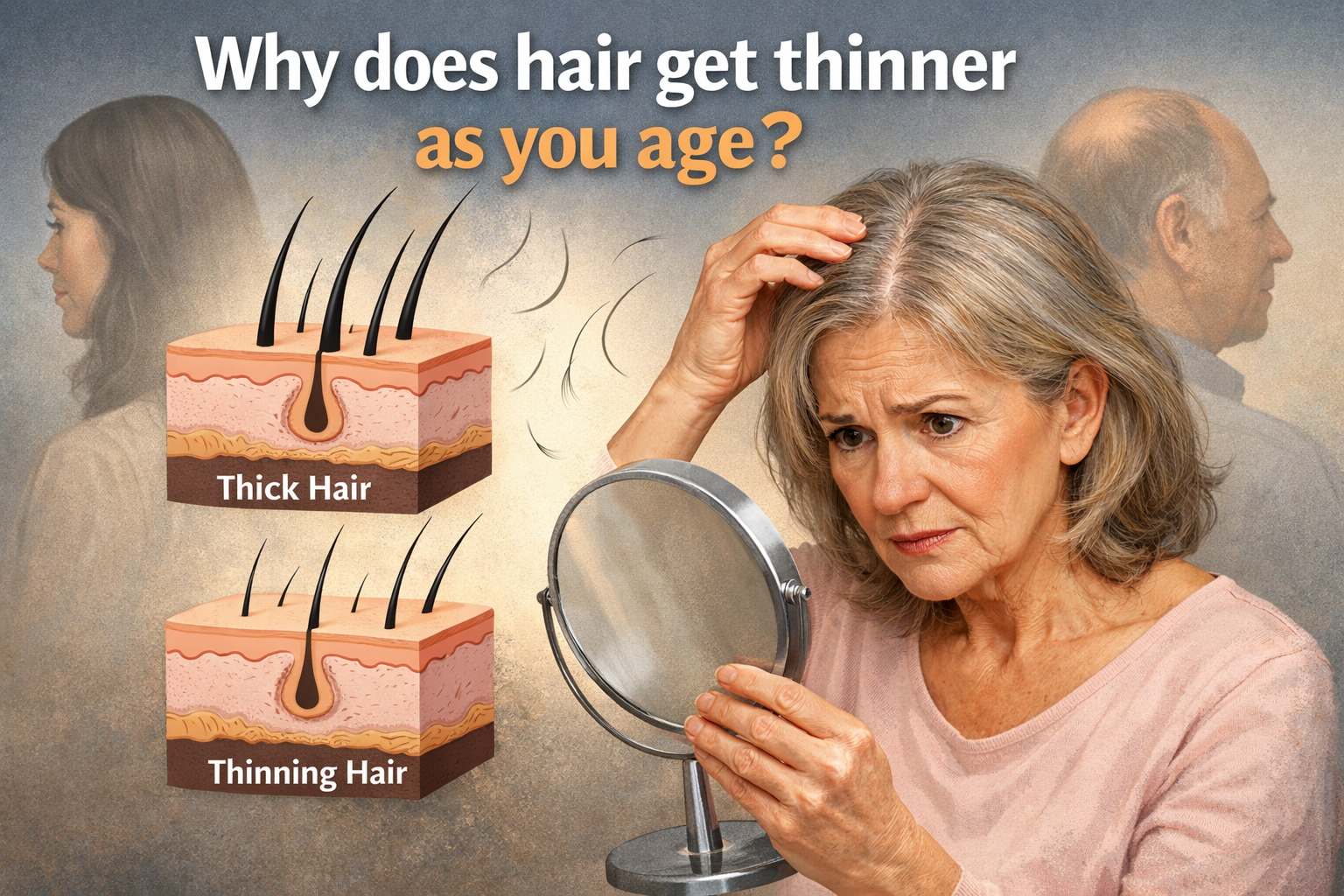
Hair grows in cycles.
There’s a phase where it actively grows, a phase where it rests, and a phase where it sheds.
As we age, that cycle begins to change.
The growth phase can become shorter.
The resting phase can become longer.
And over time, the hair that grows back may be finer, thinner, less pigmented.
It’s not that hair suddenly stops growing.
It’s that it grows differently.
The Gradual Miniaturization
There’s a term I came across that stayed with me: miniaturization.
It describes how hair follicles gradually produce thinner and weaker strands over time.
Not all at once.
Not dramatically.
But slowly.
A thick strand becomes slightly finer.
Then finer still.
Until eventually, it’s barely noticeable.
That process isn’t something you see happening.
It’s something you realize has happened.
Hormones: The Quiet Influence
Then there are hormones.
Always present.
Always working behind the scenes.
As the body ages, hormonal balance shifts.
Not abruptly, but gradually.
And those shifts can influence how hair grows, how long it stays, and how strong it feels.
What makes this challenging is that you don’t always feel these changes.
You just see their effects.
And hair is often one of the first places those effects become visible.
Time and Accumulated Impact
Another thing I began to understand is that aging isn’t just about the present—it’s about accumulation.
Years of stress.
Years of habits.
Years of small imbalances that didn’t seem important at the time.
All of it adds up.
And hair, in its own way, reflects that accumulation.
Not as a punishment.
Not as a failure.
But as a record.
The Role of Scalp and Environment
It’s easy to focus on the hair itself, but the environment it grows in matters just as much.
As we age, changes in scalp health—circulation, oil production, overall balance—can influence how hair behaves.
It’s not always something you notice directly.
But it affects the foundation.
And when the foundation changes, the result changes too.
The Emotional Layer
What I didn’t expect was how emotional the experience would feel.
Not overwhelmingly so.
But quietly.
Subtly.
Hair, for many of us, is tied to identity in ways we don’t fully recognize until it begins to change.
It’s part of how we see ourselves.
How we present ourselves.
How we recognize ourselves in the mirror.
And when it shifts, even slightly, it creates a kind of internal adjustment.
The Temptation to Compare
There’s a moment where comparison becomes almost automatic.
You look at old photos.
You remember how your hair used to feel.
And you measure the present against the past.
But that comparison can be misleading.
Because it assumes that nothing should change.
When in reality, change is part of the process.
Not a deviation from it.
Trying to Hold On
I’ll admit—there was a point where I wanted to hold on to what my hair used to be.
To find a way to reverse it.
To bring it back to something familiar.
But over time, I realized that approach wasn’t helping.
Because it was rooted in resistance.
And resistance made everything feel heavier.
A Shift in Perspective
What helped was changing the question.
Instead of asking:
“How do I stop this?”
I started asking:
“How do I support what’s happening?”
That shift didn’t mean giving up.
It meant working with my body, not against it.
Understanding that aging isn’t a problem to fix.
It’s a process to navigate.
What Thinner Hair Actually Means
Thinner hair doesn’t mean your body is failing.
It doesn’t mean something is wrong.
It often means your body is adapting.
Changing its priorities.
Responding to time in the way it naturally does.
And while that change can feel uncomfortable, it’s also… normal.
The Balance Between Acceptance and Care
Acceptance doesn’t mean doing nothing.
And care doesn’t mean trying to control everything.
There’s a balance between the two.
You can take care of your hair.
Support your body.
Maintain healthy habits.
While also accepting that some changes are part of a larger process.
The Slow Nature of Change (and Recovery)
Just as thinning happens slowly, any improvement also takes time.
There’s no immediate reversal.
No instant transformation.
Only gradual shifts.
Small improvements.
Subtle changes that build over time.
And recognizing that helps manage expectations.
You’re Not Alone in This
One of the most comforting realizations is this:
You’re not the only one experiencing it.
Hair thinning with age is incredibly common.
It just isn’t always talked about openly.
So it feels more personal than it actually is.
More isolating than it needs to be.
So, Why Does Hair Get Thinner as You Age?
Because the body changes.
Because cycles shift.
Because time influences everything—including the way hair grows, rests, and renews.
It’s not one cause.
It’s a combination.
Of biology.
Of environment.
Of experience.
A Final Thought
Looking back, I realize that the thinning wasn’t something that suddenly happened to me.
It was something that happened with me.
Alongside everything else that changed over time.
And maybe that’s the most important thing to understand.
Hair isn’t separate from the rest of you.
It’s part of a bigger story.
A story that continues to evolve—quietly, gradually, and sometimes in ways you don’t immediately notice.
So if your hair feels thinner than it used to, it doesn’t mean you’re losing something.
It might just mean you’re moving through a new phase.
And like every phase before it—
It takes time to understand.