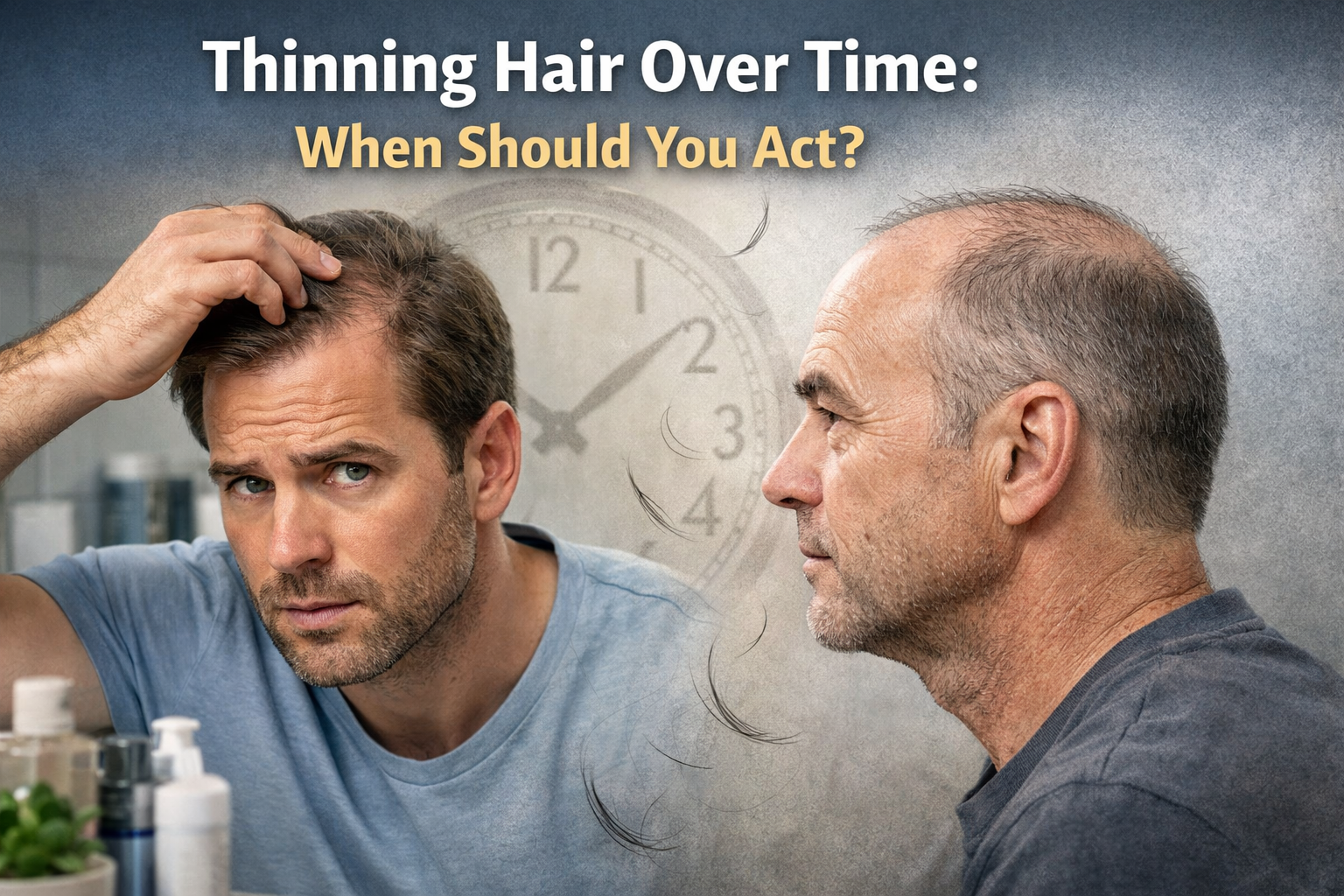
Thinning Hair Over Time: When Should You Act?
It didn’t feel urgent at first.
That’s the strange thing about gradual change—it rarely asks for your attention right away. It happens quietly, in the background of your daily life, blending into routines so seamlessly that you almost don’t question it.
Almost.
For me, it started with a feeling more than a visible sign.
My hair didn’t sit the same way anymore. It didn’t have the same weight, the same presence. When I tied it back, it felt… lighter. Not dramatically so—but enough for me to notice, and then wonder.
I told myself it was nothing.
A phase.
A trick of the light.
But time has a way of revealing what we try to ignore.
The Slow Shift You Can’t Pinpoint
Unlike sudden hair loss, thinning over time doesn’t give you a clear starting point.
There’s no “before” moment you can easily compare to.
Instead, it’s a gradual shift.
A little less volume this month.
A slightly wider part the next.
A ponytail that feels just a bit smaller than it used to.
Each change, on its own, is easy to dismiss.
But together, they form something harder to ignore.
When You Start Looking Back
I remember trying to figure out when it began.
Scrolling through old photos.
Looking for differences.
Searching for that one moment where everything changed.
But there wasn’t one.
Just a series of small transitions that I hadn’t fully noticed at the time.
And maybe that’s what makes it unsettling—
Not the change itself, but the realization that it’s been happening longer than you thought.
The Question That Lingers
At some point, a quiet question takes shape:
Should I do something about this?
Not out of panic.
Not even out of fear.
Just a sense that maybe this isn’t something to keep ignoring.
But knowing when to act isn’t always obvious.
Because thinning hair doesn’t follow a clear timeline.
It doesn’t announce when it crosses from “normal” to “something more.”
It just… continues.
What Thinning Really Looks Like
Before this, I thought hair thinning would be obvious.
But it’s not always dramatic.
It’s subtle.
Diffuse.
Spread out.
You don’t lose hair in patches—you lose density.
And that’s harder to see.
Because nothing looks drastically different.
Until one day, it does.
The Role of Time
Time changes how you see things.
At first, you notice.
Then you question.
Then you adjust.
And eventually, you start to accept.
But acceptance can be misleading.
Because sometimes, what feels like acceptance is just delay.
Putting off a decision you’re not ready to make.
When “Normal” Starts to Shift
One of the hardest parts is defining what’s normal.
Hair changes over time—that’s expected.
But how much change is too much?
There’s no exact number.
No clear threshold.
Instead, it’s about patterns.
If your hair feels consistently thinner than it used to…
If the change continues over months without stabilizing…
If you notice it not just occasionally, but regularly…
Those are signs worth paying attention to.
The Emotional Weight of Waiting
Waiting sounds passive.
But it’s not.
It’s active in its own way.
You’re constantly observing.
Noticing.
Thinking.
Deciding whether to act—or not.
And that decision carries weight.
Because acting too early can feel unnecessary.
But waiting too long can feel like regret.
The Fear of Overreacting
There’s always that voice:
“Maybe it’s not that bad.”
“Maybe I’m just overthinking it.”
“Maybe it will fix itself.”
And sometimes, that’s true.
Hair can stabilize.
Recover.
Return to balance.
But not always.
And that uncertainty makes the decision harder.
The Turning Point
For me, the turning point wasn’t dramatic.
It wasn’t one moment.
It was a realization.
That the thinning wasn’t stopping.
It wasn’t getting worse quickly—but it wasn’t improving either.
It had settled into a pattern.
And that pattern told me something:
This wasn’t just temporary.
Acting Doesn’t Mean Panicking
When we think about “taking action,” it’s easy to imagine drastic steps.
But it doesn’t have to be that way.
Acting can be quiet.
Thoughtful.
Measured.
It can start with understanding.
With paying closer attention to your habits, your health, your routine.
With noticing what might be contributing to the change.
It’s not about fixing everything at once.
It’s about responding intentionally.
The Balance Between Waiting and Acting
There’s a space between doing nothing and doing everything.
And that’s where most people need to be.
Not ignoring the problem.
But not reacting impulsively either.
Just… engaging with it.
Learning from it.
Understanding it.
What Your Hair Might Be Telling You
Thinning hair is rarely just about hair.
It can reflect:
- Long-term stress
- Nutritional imbalances
- Hormonal shifts
- Changes in routine or lifestyle
- Or natural aging processes
And sometimes, it’s a combination.
Not one clear cause—but a layered one.
The Subtle Signs It’s Time to Act
Looking back, I realized there were signs I could have noticed earlier.
Not obvious ones.
But consistent ones.
If your hair:
- Feels noticeably thinner over time
- Doesn’t return to its previous fullness
- Continues changing without stabilizing
- Affects how you style or manage it daily
Then it might be time to move from observation to action.
Not urgently.
But intentionally.
The Myth of Immediate Results
One thing I had to let go of was the expectation of quick change.
Hair doesn’t respond immediately.
Even when you take the right steps, it takes time to see results.
And during that time, it’s easy to doubt whether anything is working.
But change is happening.
Just slowly.
The Importance of Consistency
If there’s one thing that matters more than anything else, it’s consistency.
Not perfection.
Not intensity.
Just steady, ongoing care.
Because hair responds to patterns.
And consistency creates the kind of environment where improvement becomes possible.
Letting Go of Control (In a Different Way)
At some point, I realized I couldn’t control everything.
I couldn’t force my hair to return to what it was overnight.
But I could influence the conditions.
Support my body.
Reduce unnecessary stress.
Stay consistent in how I cared for myself.
And that was enough.
The Shift From Reaction to Understanding
What began as a question—“When should I act?”—turned into something else.
A deeper awareness.
A better understanding of how my body responds to change.
And a realization that acting isn’t about fixing a problem.
It’s about responding to a signal.
So, When Should You Act?
Not at the first sign.
Not at the point of panic.
But somewhere in between.
When the change becomes consistent.
When it no longer feels temporary.
When you’ve given it time—and it hasn’t shifted back.
That’s when action makes sense.
You’re Not Too Late
One thought that often comes with thinning hair is:
“Did I wait too long?”
But in most cases, you’re not too late.
Hair changes slowly.
And that means it can often respond—slowly as well.
The key is not how early you noticed.
But how thoughtfully you respond.
Final Thought
Thinning hair over time doesn’t demand immediate action.
But it does ask for awareness.
For attention.
For a willingness to look beyond the surface and understand what’s changing—and why.
Because the question isn’t just “When should you act?”
It’s also:
“Are you paying attention to the right moment?”
And sometimes, that moment isn’t loud.
It’s quiet.
Gradual.
Easy to overlook—until you finally decide not to.