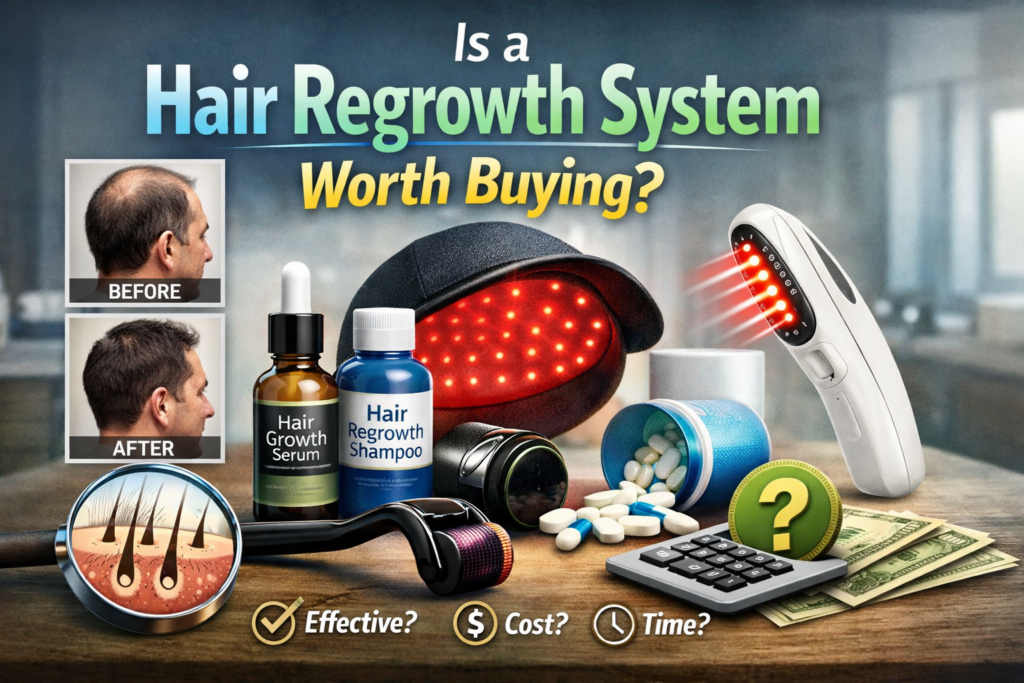
Is a Hair Regrowth System Worth Buying?
A personal, reflective narrative
I didn’t notice it all at once.
It started subtly—like most changes that matter do. A few extra strands on my pillow. A slightly wider part when I looked in the mirror. At first, I brushed it off. “It’s normal,” I told myself. “Everyone sheds hair.” And that was true. But there’s a quiet difference between normal shedding and that creeping awareness that something is changing—and not in your favor.
The real moment it hit me wasn’t dramatic. No sudden clumps of hair falling out. No shocking transformation overnight. It was just a photograph. Someone had taken it casually, in good lighting, and when I saw it later, I paused. My hairline looked… different. Not drastically, but enough that I couldn’t unsee it.
That was the beginning.
The Search Begins
Like most people, I turned to the internet.
At first, it felt empowering. There were countless solutions: oils, shampoos, supplements, laser devices, and of course, the more “serious” treatments that promised clinical results. Every product seemed backed by testimonials, before-and-after photos, and confident claims.
“Regrow your hair in 90 days.”
“Clinically proven results.”
“Thousands of satisfied customers.”
It was overwhelming, but also strangely hopeful.
I remember opening multiple tabs, comparing products, reading reviews deep into the night. There was a sense that somewhere in that sea of options, there had to be the one—the system that would reverse everything and bring my hair back to what it used to be.
But as the days went on, something else crept in: doubt.
What Is a “Hair Regrowth System,” Really?
Before I could decide whether it was worth buying, I had to understand what I was actually being sold.
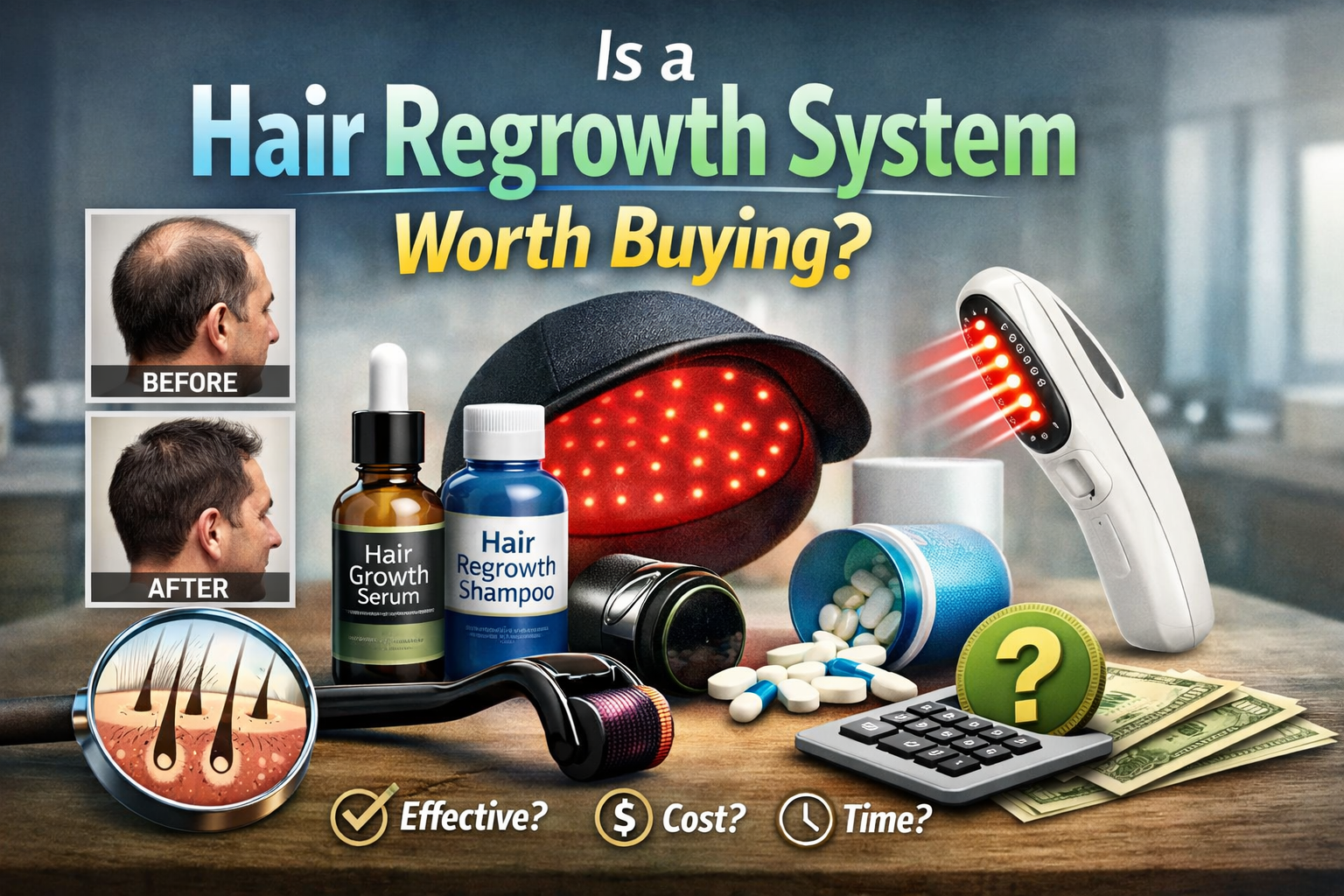
A “hair regrowth system” isn’t just one product. It’s usually a combination—a curated set of treatments designed to work together. This might include:
- A topical solution applied daily
- A specialized shampoo or conditioner
- Dietary supplements
- Sometimes a device, like a laser comb or helmet
On the surface, it makes sense. Hair loss is complex, so a multi-angle approach feels logical. But I started to wonder: was this truly about effectiveness, or about packaging multiple products together to justify a higher price?
That question stayed with me as I continued researching.
The Emotional Side No One Talks About
What surprised me most wasn’t the science or the cost—it was the emotional weight of the decision.
Hair is deeply tied to identity. It’s not just about appearance; it’s about how we see ourselves and how we believe others see us. Losing it, even gradually, can feel like losing a part of your confidence.
I found myself thinking about it more than I expected. Not obsessively, but persistently. Every mirror became a checkpoint. Every bad hair day felt slightly worse.
And that’s where hair regrowth systems become particularly compelling. They don’t just sell a product—they sell a sense of control. The idea that you can do something instead of just watching the change happen.
But that raises an important question: are you buying results, or are you buying hope?
The Reality of Results
Eventually, I decided to look past the marketing and focus on what actually works.
The truth is, not all hair regrowth systems are created equal. Some are built around ingredients that have scientific backing. Others rely more on branding than evidence.
What I learned—sometimes the hard way—is this:
- Results are rarely instant
- Consistency matters more than the product itself
- Not everyone responds the same way
There’s no universal solution. What works for one person might do very little for another. And that can be frustrating, especially when you’ve invested time, money, and expectation into a system.
I remember trying one system that came highly recommended. For the first few weeks, I was optimistic. I followed the routine carefully, applied everything as instructed, and waited.
Weeks turned into months.
There were small changes—maybe less shedding, maybe slightly thicker texture—but nothing dramatic. Certainly not the kind of transformation shown in advertisements.
And that’s when I had to confront a difficult truth: progress, if it comes at all, is often slow and subtle.
The Cost Factor
Hair regrowth systems aren’t cheap.
At first, the price might seem manageable. But when you factor in the need for long-term use, it adds up quickly. Months turn into years, and what started as a one-time purchase becomes an ongoing commitment.
I had to ask myself: Is this sustainable?
Because effectiveness isn’t just about results—it’s also about whether you can realistically stick with the process.
There’s no point in starting something you can’t maintain. Hair regrowth, in most cases, requires consistency over time. Stopping often means losing whatever progress you’ve made.
That realization changed how I viewed the decision. It wasn’t just “Is it worth buying?” but “Is it worth continuing?”
Expectations vs. Reality
One of the biggest gaps I noticed was between expectation and reality.
Marketing tends to highlight the best-case scenarios. Full regrowth. Dramatic improvements. Life-changing results.
But real life is more nuanced.
For many people, success doesn’t mean restoring a full head of hair. It might mean slowing down hair loss. It might mean slightly thicker strands. It might mean feeling just a bit more confident.
And that’s not insignificant.
I had to adjust my own expectations. Instead of chasing a complete reversal, I started looking for improvement—however small.
That shift made a difference. It turned the experience from a constant disappointment into something more balanced.
The Routine Itself
Another thing I didn’t anticipate was how much the routine would affect my daily life.
Some systems require multiple steps, applied at specific times. Missing a step can feel like undoing progress. Traveling becomes more complicated. Even simple things like staying overnight somewhere require planning.
At first, I was committed. Motivated. But over time, the routine started to feel like a burden.
That’s when I realized: effectiveness isn’t just about what works in theory—it’s about what fits into your life.
A slightly less effective system that you can stick with consistently might be more valuable than a “perfect” system you abandon after a few months.
So… Is It Worth It?
This is the question I kept coming back to.
And the answer, frustratingly, isn’t simple.
A hair regrowth system can be worth buying—but only under certain conditions:
- If you understand what it can realistically achieve
- If you’re willing to commit to the process
- If the cost fits your long-term budget
- If you choose a system with credible ingredients or evidence
But if you’re expecting a quick fix or a guaranteed transformation, you’ll likely be disappointed.
For me, the value wasn’t just in the results. It was in the sense of taking action. Of not ignoring the change, but engaging with it.
At the same time, I learned not to tie my self-worth to the outcome.
A More Balanced Perspective
Over time, my perspective shifted.
I still care about my hair. I still notice changes. But it no longer feels like something that defines me.
The experience taught me something broader about how we approach problems like this. We often look for external solutions to restore something we feel we’ve lost. And sometimes, those solutions help.
But they’re rarely complete answers.
A hair regrowth system can be a tool—not a miracle.
And maybe that’s the most honest way to look at it.
Final Thoughts
If you’re considering buying a hair regrowth system, take your time.
Research carefully. Set realistic expectations. Think about the long-term commitment—not just the initial purchase.
And most importantly, ask yourself why you’re considering it.
Is it about confidence? Control? Appearance?
There’s no wrong reason—but understanding your motivation can help you make a decision that feels right, not just in the moment, but over time.
Because in the end, the question isn’t just whether it’s worth buying.
It’s whether it’s worth it—for you.