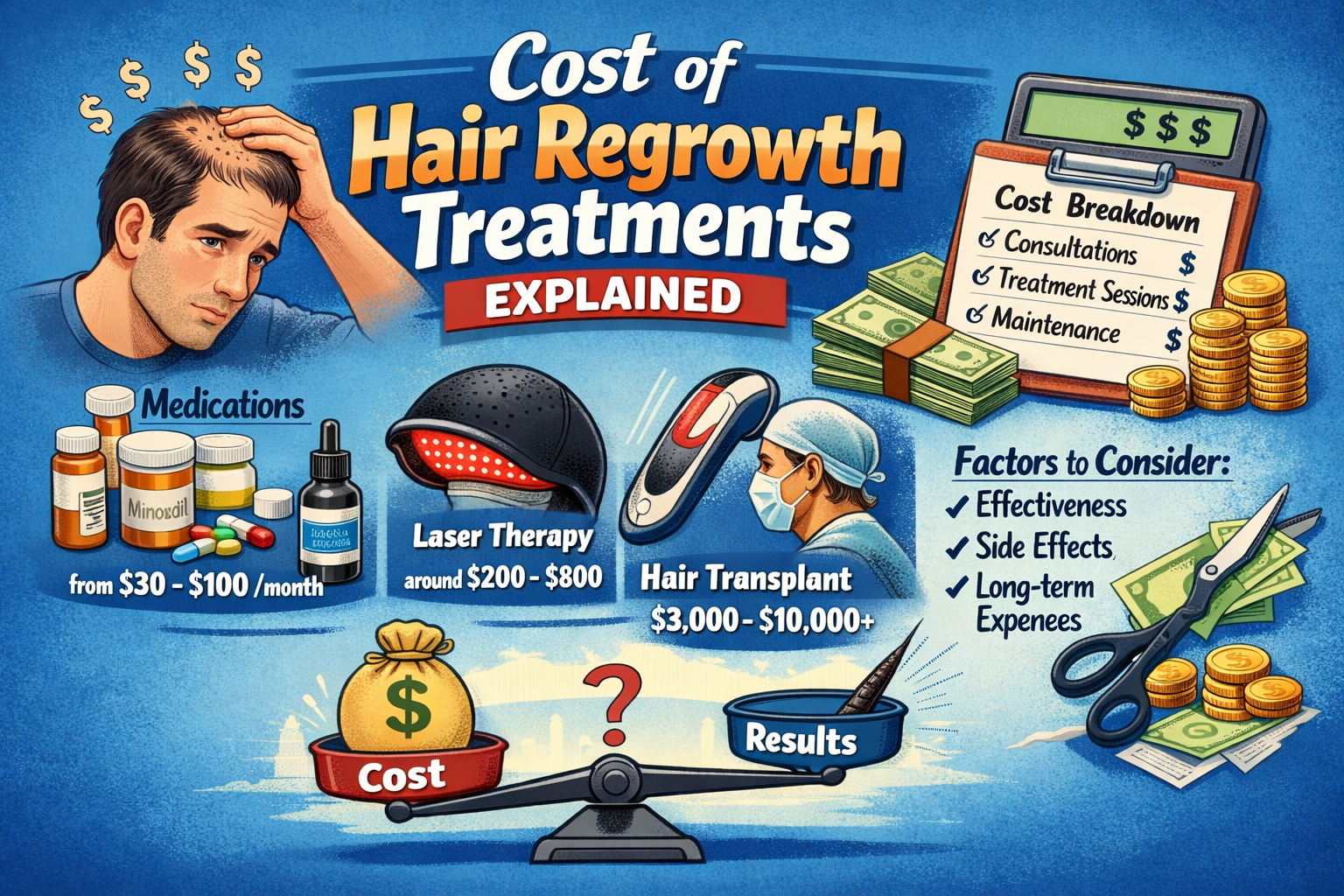
Cost of Hair Regrowth Treatments Explained
A personal, reflective journey through choices, expectations, and reality
I didn’t notice it all at once.
At first, it was just a little more hair left behind on my pillow. Then it was the subtle widening of my hair part in photos I didn’t remember posing for. Eventually, it became something I couldn’t ignore—something that quietly followed me into mirrors, into conversations, into moments where confidence used to exist without effort.
Hair loss has a way of creeping into your awareness slowly, and by the time you fully recognize it, you’re already searching for solutions.
That’s how I found myself, late one evening, scrolling through endless articles, forums, and before-and-after photos, trying to answer a simple question that turned out not to be simple at all:
How much does it really cost to regrow hair?
What I discovered wasn’t just a list of prices. It was a landscape—one filled with hope, skepticism, marketing promises, and very real financial decisions.
The First Encounter: Cheap Solutions That Feel Expensive Later
Like most people, I started with the most accessible options.
Over-the-counter treatments seemed like the logical first step. They were affordable, easy to find, and didn’t require any major commitment. A bottle here, a serum there—nothing that felt too risky.
At first glance, the cost looked manageable. Spending a small amount each month didn’t seem like a big deal. But what I didn’t realize was how quickly “small amounts” add up over time.
Month after month, the expenses continued. And because these treatments often require long-term use to maintain results, stopping wasn’t really an option once you started. It wasn’t just a purchase—it was a subscription to hope.
That’s when I began to understand something important:
The true cost of hair regrowth isn’t measured in a single payment. It’s measured in consistency.
The Middle Ground: Treatments That Promise More
As time went on, I found myself drawn toward treatments that promised faster or more noticeable results.
These options often came with a higher price tag—clinics, specialized therapies, and professional consultations. Walking into a clinic for the first time felt different. It was more serious, more clinical, and somehow more reassuring.
There’s a certain comfort in having someone examine your situation and offer a tailored plan. It feels less like guesswork and more like strategy.
But that reassurance comes at a cost.
Consultations, follow-up sessions, and ongoing treatments can quickly escalate financially. What starts as a single visit often turns into a series of appointments, each adding to the total.
And yet, the emotional cost of doing nothing often feels higher.
That’s the paradox: you’re not just paying for treatment—you’re paying for the possibility of change.
The High-End Route: When Cost Meets Commitment
Eventually, I began looking into more advanced solutions.
These were the treatments people spoke about in hushed, almost reverent tones—the ones that seemed to offer the most dramatic results. But they also came with the highest costs.
At this level, the decision feels different. It’s no longer a casual experiment. It’s a commitment, both financially and mentally.
What struck me most during this stage wasn’t just the price itself, but the way it forced me to evaluate my priorities.
Was this something I truly needed, or something I felt pressured to pursue? Was I investing in myself, or reacting to insecurity?
These questions didn’t have easy answers.
But they were necessary.
Because when costs reach a certain level, the decision stops being purely practical. It becomes deeply personal.
The Hidden Costs No One Talks About
What surprised me most during this journey were the costs that aren’t listed anywhere.
Time, for one.
Researching options, attending consultations, maintaining routines—it all takes time. And not just physical time, but mental energy. The constant evaluation, the hope, the doubt—it can be exhausting.
Then there’s the emotional investment.
Every treatment comes with expectations. You start to imagine outcomes, to picture a version of yourself that feels just a little more confident, a little more like the person you remember.
When results are slow—or uncertain—it’s not just disappointing. It’s personal.
And then, of course, there’s the cost of comparison.
Seeing others’ results, reading success stories, wondering why something worked for someone else but not for you—it adds another layer to the experience.
These hidden costs don’t show up on receipts, but they’re just as real.
What “Worth It” Really Means
At some point, the question shifted.
It was no longer just “How much does it cost?” but rather:
“Is it worth it?”
And that’s a much harder question to answer.
Because “worth” isn’t universal. It’s shaped by your goals, your expectations, and your relationship with yourself.
For some people, even small improvements are enough to justify the cost. For others, anything less than dramatic change feels like a loss.
I realized that defining success early on is crucial. Without it, it’s easy to keep spending, keep trying, and never feel satisfied.
Lessons I Wish I Knew Earlier
Looking back, there are a few things I wish someone had told me before I started:
First, there’s no one-size-fits-all solution. What works for one person might not work for another, regardless of cost.
Second, more expensive doesn’t always mean more effective. Price can reflect many things—technology, branding, convenience—but not always results.
Third, consistency matters more than intensity. A moderately effective treatment used consistently often outperforms a more advanced option used sporadically.
And finally, your expectations need to match reality. Hair regrowth is rarely instant, and often subtle. Understanding that can save both money and frustration.
A Different Perspective on Investment
Over time, I began to see these costs differently.
Instead of viewing them purely as expenses, I started to think of them as investments—not just in appearance, but in how I felt about myself.
But like any investment, it requires clarity.
You need to know what you’re investing in, what return you expect, and how much risk you’re willing to take.
Without that clarity, it’s easy to get lost in the process.
Where I Stand Now
Today, my approach is more measured.
I still care about my hair, of course. That hasn’t changed. But my perspective has.
I no longer chase every new treatment or promise. I focus on what fits my lifestyle, my budget, and my expectations.
And perhaps most importantly, I’ve learned that confidence isn’t something you can buy outright.
Treatments can help. They can improve, enhance, and support.
But they don’t define you.
Final Thoughts
If you’re at the beginning of this journey, wondering about the cost of hair regrowth treatments, here’s what I would say:
Take your time.
Understand your options.
Be honest with yourself about what you want—and why you want it.
Because the real cost isn’t just financial.
It’s the combination of time, effort, emotion, and expectation.
And when you understand all of that, you’re not just making a decision about hair.
You’re making a decision about how you choose to invest in yourself.
In the end, that’s what this journey taught me.
Not just what things cost—but what they’re truly worth.