Hair Transplant vs. Serum: Pros and Cons — A Personal Journey Through Hair Loss and Hope
I still remember the first time I noticed it.
It wasn’t dramatic. No clumps of hair on the pillow, no sudden bald patches. Just a slightly wider part, a little more scalp peeking through under harsh bathroom lighting. At first, I told myself it was nothing—just stress, maybe a bad haircut. But weeks turned into months, and that quiet suspicion turned into something harder to ignore.
Hair loss has a strange way of creeping into your life. It doesn’t just sit on your scalp—it slips into your confidence, your routines, even the way you look at yourself in photos. And once you notice it, it’s almost impossible to unsee.
That’s when the question begins: What do I do about it?
For me, like many others, it came down to two main options—hair serums or a hair transplant. One promised gradual, non-invasive improvement. The other offered a more permanent, surgical solution. Both seemed appealing in their own way, and both came with their own uncertainties.
So I did what most of us do: I researched, I hesitated, I tried things, and I learned. A lot.
The Allure of Hair Serums: A Gentle Beginning
I started with serums. It felt like the safer choice—no surgery, no drastic commitment, just a bottle and a routine.
At first, it was almost comforting. Applying a serum became part of my daily ritual. Morning and night, a few drops massaged into my scalp, a quiet promise to myself that I was doing something about the problem.
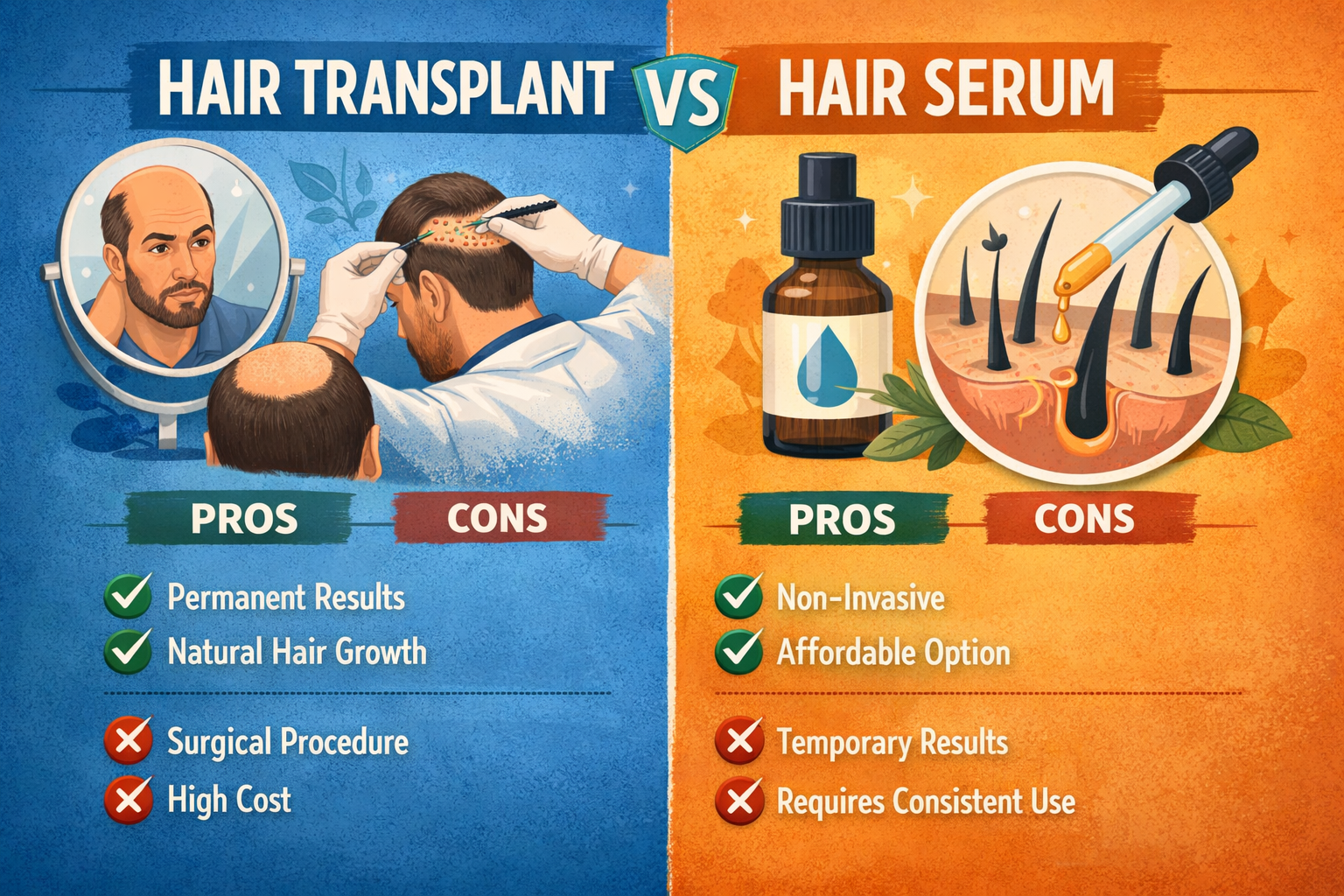
Pros of Hair Serums
1. Non-invasive and easy to use
There’s something reassuring about a solution that doesn’t involve needles or clinics. Hair serums are simple—you apply them at home, often in less than a minute. No recovery time, no disruption to your life.
2. Accessible and relatively affordable
Compared to surgical procedures, serums are far more budget-friendly upfront. You don’t need to save for months or take out a loan. You can start almost immediately.
3. Can improve hair health overall
Some serums aren’t just about regrowth—they nourish the scalp, strengthen existing hair, and reduce breakage. Even if regrowth is slow, your hair might still look healthier.
4. Good for early-stage hair loss
If you catch hair thinning early, serums can sometimes slow down or even partially reverse the process. For mild cases, they can be surprisingly effective.
Cons of Hair Serums
But as weeks turned into months, I started noticing the other side of the story.
1. Results are slow—and sometimes invisible
Patience is essential. Hair doesn’t grow overnight, and serums often take months to show any noticeable change. Even then, results can be subtle.
There were days I stared at my reflection, wondering, Is it working? Or am I just hoping it is?
2. Not always effective for advanced hair loss
If hair follicles are already inactive or gone, serums can’t bring them back. They work best when there’s still something to save.
3. Requires consistency (and discipline)
Skipping applications can reduce effectiveness. It’s a long-term commitment, and honestly, there were nights I just forgot—or didn’t feel like it.
4. Ongoing cost adds up
While cheaper than surgery initially, the cost of continuous use over years can become significant. It’s not a one-time fix; it’s a subscription to maintenance.
The Turning Point: Considering a Hair Transplant
After nearly a year of using serums, I had to face a difficult truth: while my hair felt healthier, the thinning areas hadn’t dramatically improved.
That’s when I started seriously considering a hair transplant.
At first, the idea intimidated me. Surgery—even a minor one—felt like a big step. But at the same time, the promise of a more permanent solution was hard to ignore.
Hair Transplant: A Bold Step Toward Change
Walking into a consultation for the first time felt surreal. It made everything real in a way that serums never did.
The doctor explained the process calmly—how hair follicles are taken from one part of the scalp and implanted into thinning areas. It sounded almost too simple.
But of course, it wasn’t just about simplicity. It was about commitment.
Pros of Hair Transplant
1. Long-lasting results
This is the biggest advantage. Transplanted hair is typically permanent. Once it grows, it behaves like normal hair—you can cut it, style it, and treat it as your own.
2. Noticeable transformation
Unlike serums, which often produce gradual and subtle changes, a transplant can create a visible difference. It’s not instant, but when results appear, they’re hard to miss.
3. Boost in confidence
This is something people don’t always talk about enough. Feeling like you’ve regained control over your appearance can have a real emotional impact.
It’s not just about looking better—it’s about feeling more like yourself again.
4. Less daily maintenance (after recovery)
Once the procedure is done and the hair has grown, you don’t need to rely on daily treatments. The routine becomes simpler again.
Cons of Hair Transplant
But it’s not all smooth sailing.
1. High upfront cost
Hair transplants can be expensive. Depending on the clinic and the extent of hair loss, it can cost thousands. For many people, that’s a major barrier.
2. It’s still a medical procedure
Even though techniques have improved, it’s still surgery. There’s recovery time, possible discomfort, and the need to follow post-procedure care carefully.
3. Results take time
Ironically, even though it’s a more “dramatic” solution, you still need patience. Hair growth after a transplant can take several months to become noticeable.
4. Not always a one-time fix
In some cases, additional sessions may be needed, especially if hair loss continues in untreated areas.
The Emotional Side of the Decision
What surprised me most wasn’t the technical differences between serums and transplants—it was the emotional weight of choosing between them.
Serums felt like hope in a bottle. They allowed me to believe I could fix things quietly, gradually, without anyone noticing.
A transplant, on the other hand, felt like a declaration. It meant acknowledging the problem openly and taking a bold step to address it.
Neither choice is inherently better—it depends on where you are, both physically and mentally.
So… Which One Is Better?
If you’re hoping for a simple answer, I wish I could give you one. But the truth is, it depends.
If your hair loss is mild and recent, serums might be enough. They’re low-risk, easy to start, and can genuinely help in early stages.
If your hair loss is more advanced, or if you’re looking for a more definitive solution, a transplant might be worth considering.
In many cases, it’s not even an either-or situation. Some people use both—serums to maintain existing hair and a transplant to restore lost areas.
What I Learned Along the Way
Looking back, I realize that this journey wasn’t just about hair.
It was about patience. About managing expectations. About understanding that some changes take time, and some decisions require courage.
I also learned that there’s no shame in caring about how you look. Wanting to feel confident is human. The key is making informed choices—ones that align with your situation, your budget, and your comfort level.
Final Thoughts
Hair loss can feel deeply personal, but you’re not alone in it. Millions of people go through the same questions, the same doubts, the same search for solutions.
Whether you choose a serum, a transplant, or decide to embrace your hair as it is, what matters most is that the choice feels right for you.
Because at the end of the day, it’s not just about hair.
It’s about how you see yourself when you look in the mirror—and how you choose to move forward from there.