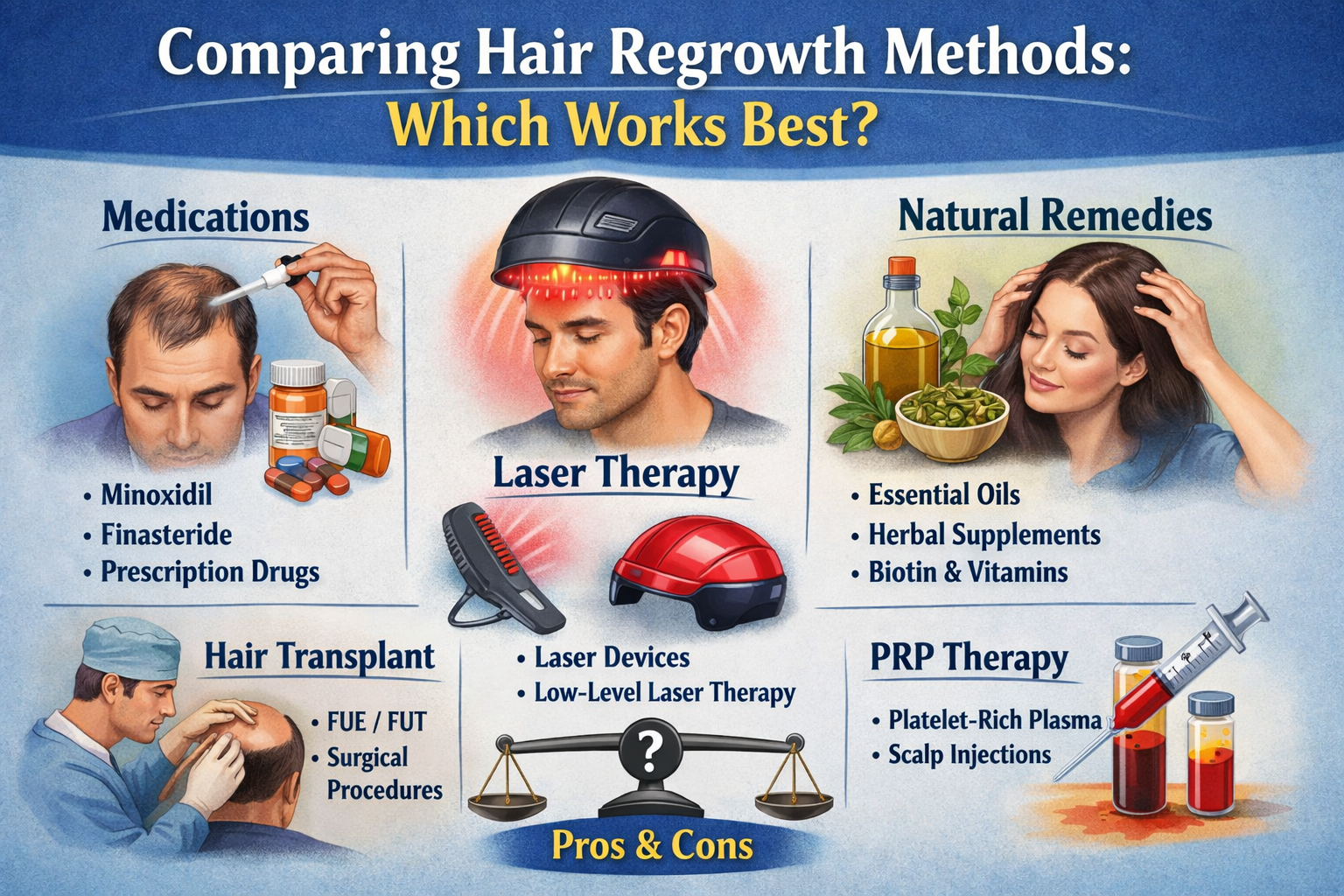
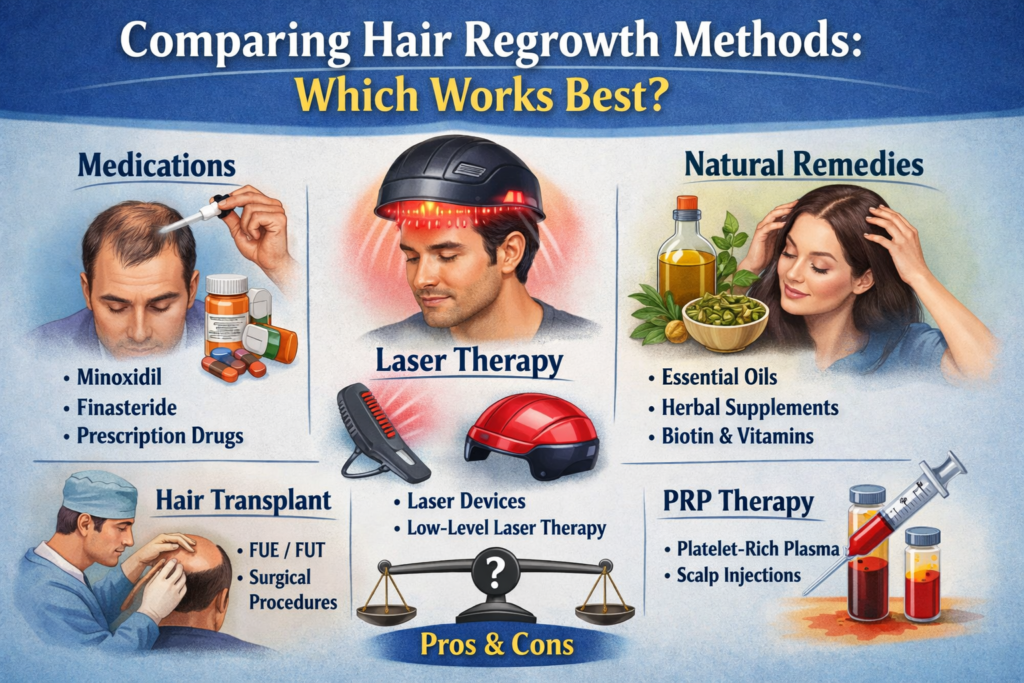
Comparing Hair Regrowth Methods: Which Works Best? (Continued)
I didn’t notice the first strand fall.
That’s the strange thing about hair loss—it rarely announces itself in dramatic fashion. No warning signs, no grand moment in front of the mirror where everything changes. Instead, it creeps in quietly. A few extra hairs on the pillow. A slightly wider part. A little more scalp catching the light than before. At first, you brush it off—literally and figuratively. Stress, maybe. Weather. Shampoo.
Until one day, you realize it’s not stopping.
That’s where my journey began. And if you’re reading this, chances are, you’ve either started your own—or you’re standing right at the edge of it.
So I went searching. Not just for solutions, but for answers. What actually works? What’s just marketing? And why does every method seem to promise miracles?
Let me walk you through what I discovered—not as a scientist in a lab, but as someone standing in front of a mirror, trying to feel like themselves again.
1. The First Stop: Over-the-Counter Treatments
The first thing most people try is what’s easiest to access.
For me, that was Minoxidil.
You’ve probably heard of it—it’s everywhere. Foam, liquid, sprays. It sits quietly on pharmacy shelves, promising regrowth with consistency.
At first, I was skeptical. But it felt like a “safe” starting point. No prescriptions, no complicated routines. Just apply twice a day and wait.
And that’s the keyword: wait.
Weeks passed. Then months.
At first, things got worse. More shedding. That moment alone almost made me quit. But I learned something important: shedding at the beginning is actually part of the process. Old hairs fall out to make way for new ones.
Around the three-month mark, I noticed something different. Not dramatic. Not cinematic. But real. Tiny, soft hairs—almost invisible—starting to appear along my hairline.
Was it working? Slowly, yes.
But here’s the truth: Minoxidil is not a miracle cure. It’s a commitment. The moment you stop, the progress usually fades. It’s like watering a plant—you can’t just do it once and expect it to thrive forever.
Verdict:
Effective for many people, especially in early stages. But requires patience, discipline, and long-term use.
2. Prescription Medications: Stronger, But With Questions
After some progress with Minoxidil, I wanted to understand what else was out there.
That’s when I came across Finasteride.
Unlike Minoxidil, this isn’t something you casually pick up. It works internally, targeting a hormone called DHT, which is closely linked to hair loss—especially in men.
The idea sounded promising: stop the root cause, not just treat the symptom.
But this is where things got complicated.
I read stories—some positive, some cautious. People talked about thicker hair, regained confidence… but also about side effects that made them hesitate.
So I did what many people do: I sat on the decision for a long time.
Eventually, I realized something important. Every treatment comes with trade-offs. The key is understanding them, not ignoring them.
For many, Finasteride works well. It can slow down hair loss significantly and even help regrow hair in some cases.
But it’s not a casual choice. It’s something to discuss with a professional, to understand your own body and risks.
Verdict:
Potentially one of the most effective options, especially for preventing further loss. But requires careful consideration and medical guidance.
3. Natural Remedies: Hope, Tradition, and Reality
At some point, I found myself going down a different path.
I started looking into natural remedies.
Oils, herbs, scalp massages—methods that felt older, gentler, almost comforting in their simplicity. Coconut oil, castor oil, rosemary oil… each one came with stories, traditions, and passionate believers.
There’s something appealing about these methods. They feel less clinical. More human.
So I tried them.
Massaging oil into my scalp at night became almost therapeutic. It wasn’t just about hair—it was about slowing down, taking care of myself in a small, consistent way.
Did it regrow my hair dramatically?
Not really.
But did it improve scalp health? Possibly. Did it reduce stress? Definitely.
And that matters more than we often admit.
Some natural treatments, like rosemary oil, have shown mild evidence of effectiveness—especially when used consistently over time. But they rarely match the results of medical treatments.
Still, they have a place.
Verdict:
Best as a supportive method rather than a primary solution. Helpful for scalp health and routine, but unlikely to reverse significant hair loss on their own.
4. High-Tech Solutions: When Science Steps In
At some point, curiosity pulled me toward more advanced options.
That’s when I discovered Low-Level Laser Therapy (LLLT).
It sounded futuristic—lasers stimulating hair growth. Helmets, caps, combs that emit light directly into your scalp.
I remember thinking, Does this actually work, or is it just clever branding?
The science behind it is interesting. The light is supposed to stimulate hair follicles, improving blood flow and encouraging growth.
But here’s the catch: results vary widely.
Some users report thicker hair and less shedding. Others notice little to no difference.
And then there’s the cost.
These devices aren’t cheap. And like most treatments, they require consistency—multiple sessions per week, over months.
I tried it briefly. It felt… fine. Not uncomfortable, not inconvenient. But also not transformative—at least not in the short term.
Verdict:
Promising, but inconsistent results. Best used alongside other treatments rather than alone.
5. PRP Therapy: The “Natural Science” Hybrid
Then came one of the more intriguing options: Platelet-Rich Plasma (PRP) therapy.
This one felt different.
Instead of chemicals or devices, it uses your own blood. A small sample is taken, processed, and then injected back into your scalp to stimulate hair growth.
It sounds intense—and it is, a little.
But the idea behind it is fascinating: using your body’s own healing properties to awaken dormant hair follicles.
I’ll be honest—the first session made me nervous.
But it wasn’t as bad as I expected. Slight discomfort, yes. But manageable.
The results?
Subtle, but noticeable over time. Less shedding. Slightly fuller appearance. Not a miracle, but definitely not nothing.
The downside?
Cost and maintenance. PRP isn’t a one-time fix. It requires multiple sessions and occasional follow-ups.
Verdict:
A solid option for those willing to invest time and money. Works best when combined with other treatments.
6. Hair Transplants: The Big Decision
Eventually, I found myself facing the option many people both consider and fear:
Hair transplant surgery.
This is where things become real.
Unlike other methods, a transplant offers something tangible. It moves healthy hair follicles from one part of your scalp to another.
Permanent results. Visible change.
But also: cost, recovery, and commitment.
I spent weeks researching. Before-and-after photos. Clinics. Techniques like FUE and FUT.
What struck me most wasn’t just the results—it was the emotional impact. People didn’t just look different. They felt different.
More confident. More like themselves.
But here’s the truth: a transplant doesn’t stop future hair loss. It redistributes what you already have. That means maintenance treatments are still important.
Verdict:
The most dramatic and long-lasting solution, but also the most serious decision. Best for advanced hair loss and realistic expectations.
So… Which Method Works Best?
After all this, I realized something I didn’t expect:
There is no single “best” method.
There’s only what works best for you.
Hair loss isn’t one-size-fits-all. It depends on genetics, age, lifestyle, and even how early you start treating it.
If I had to summarize everything I learned, it would look something like this:
- Early stages: Minoxidil + lifestyle improvements
- Preventing progression: Consider Finasteride (with guidance)
- Supportive care: Natural oils, scalp health, stress management
- Boosting results: LLLT or PRP
- Advanced cases: Hair transplant, combined with ongoing treatment
But beyond all of that, there’s something more important.
The Part No One Talks About
Hair loss isn’t just physical.
It’s emotional.
It changes how you see yourself, often in ways that are hard to explain to others. It can affect confidence, social interactions, even the way you carry yourself.
And that’s why the journey matters just as much as the result.
For me, it wasn’t about going back to who I was.
It was about understanding that change is inevitable—but how I respond to it is my choice.
I still use treatments. I still pay attention. But I’m no longer chasing perfection.
Just progress.
Final Thoughts
If you’re starting this journey, here’s what I’d tell you:
Don’t rush into everything at once. Start simple. Stay consistent. Learn as you go.
And most importantly—be patient.
Hair doesn’t change overnight. But with time, the right approach, and realistic expectations, it can improve.
Not perfectly. Not magically.
But meaningfully.
And sometimes, that’s more than enough.