At-Home Hair Regrowth System: A Personal Journey from Doubt to Confidence
I still remember the first time I noticed it.
It wasn’t dramatic. No clumps of hair falling out in the shower, no sudden bald patches staring back at me in the mirror. It was subtle—almost unnoticeable if I hadn’t been paying attention. A little more scalp showing under harsh lighting. A slightly wider part line. A feeling, more than anything, that something was changing.
At first, I brushed it off. “It’s just stress,” I told myself. Or maybe it was the new shampoo I had tried, or the weather, or even just my imagination playing tricks on me. But over time, those small signs started adding up. The mirror doesn’t lie forever.
That’s when I began my journey into the world of at-home hair regrowth systems—a journey filled with skepticism, trial and error, late-night research, and eventually, something I didn’t expect: hope.
The Emotional Side of Hair Loss
Before diving into the solutions, I think it’s important to talk about something people often skip—the emotional impact.
Hair is deeply personal. It’s tied to identity, confidence, and how we present ourselves to the world. Losing it, even gradually, can feel like losing control over a part of who you are.
I didn’t talk about it at first. It felt trivial compared to “real problems.” But the truth is, it affected how I felt every day. I avoided certain hairstyles. I checked my reflection more often than I’d like to admit. I even changed how I stood in photos.
What surprised me most was how common this experience is. Once I started opening up—even just a little—I realized so many people were going through the same thing, quietly.
And that’s what led me to explore solutions I could manage from home.
Why At-Home Systems?
Let’s be honest—professional treatments can be intimidating.
They’re expensive, time-consuming, and sometimes overwhelming with technical terms and promises that feel too good to be true. Clinics often present polished results, but it’s hard to know what’s realistic.
At-home systems, on the other hand, offer something different: control.
You can go at your own pace. You can experiment without pressure. You can build a routine that fits your lifestyle instead of rearranging your life around treatments.
But with that freedom comes a challenge—figuring out what actually works.
The Overwhelm of Options
When I first started researching, I felt like I had opened a door to an endless maze.
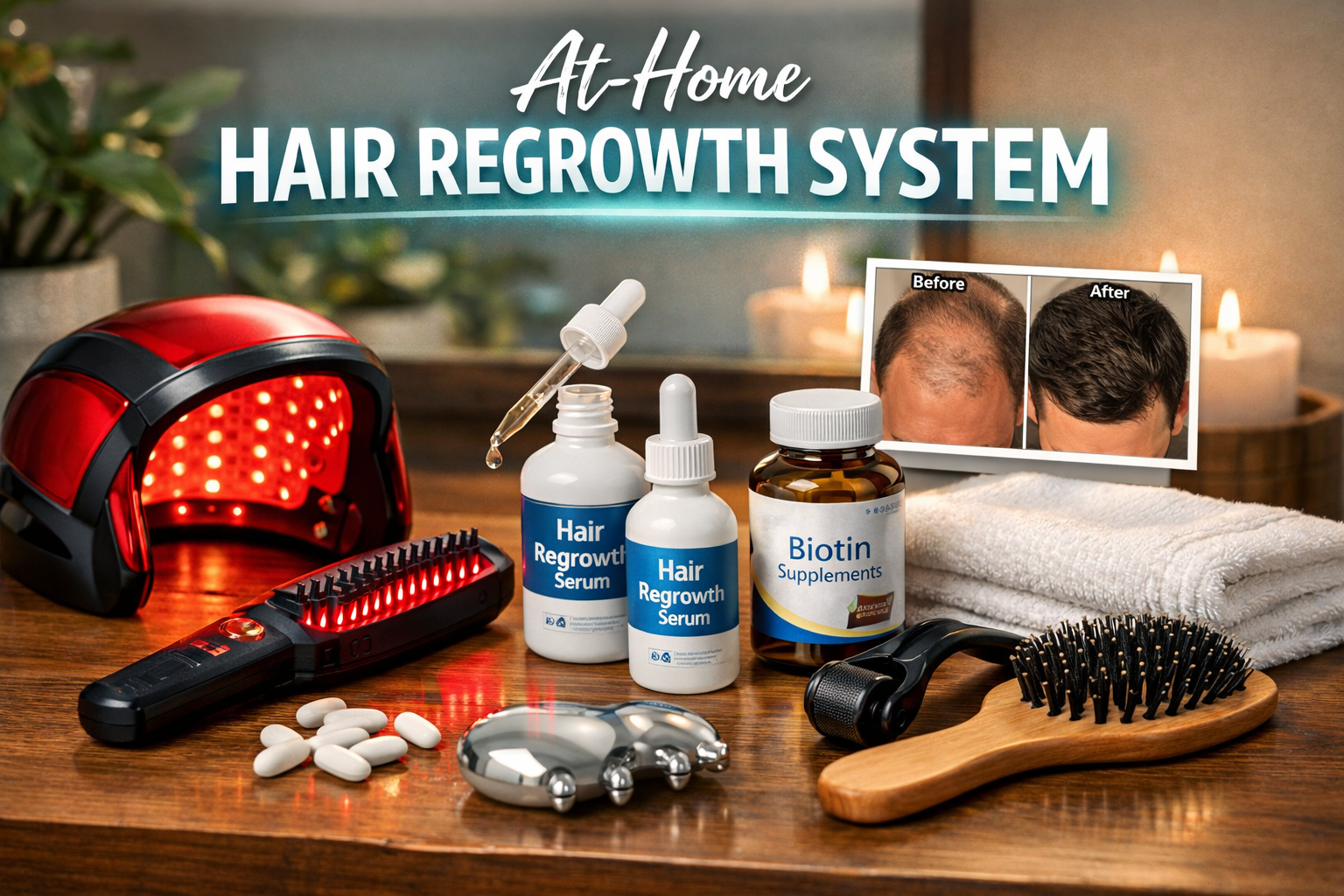
Serums, oils, supplements, laser devices, scalp massagers, derma rollers—the list went on and on. Each product claimed to be “the one,” backed by testimonials that seemed almost too perfect.
At one point, I had so many tabs open on my browser that I didn’t even know where to start.
That’s when I realized something important: no single product is a miracle solution.
Hair regrowth, especially at home, isn’t about one magical item. It’s about building a system—a combination of habits, tools, and consistency.
Building My At-Home Hair Regrowth System
Instead of chasing quick fixes, I decided to create a routine. Something simple enough to stick to, but effective enough to make a difference over time.
Here’s how it came together.
1. Understanding My Scalp
This might sound obvious, but I had never really thought about my scalp before.
I focused on my hair—how it looked, how it felt—but not the environment it grows from. Once I shifted my attention, everything changed.
I started paying attention to:
- Oil levels
- Dryness or flakiness
- Sensitivity
- Product buildup
I realized my scalp wasn’t in the best condition. It was either too dry or too oily, depending on the day, and definitely not balanced.
So I began with the basics: gentle cleansing and occasional exfoliation.
Not aggressive scrubbing. Not harsh treatments. Just consistent, mindful care.
2. Scalp Massage: The Simplest Habit
If there’s one thing I underestimated, it’s this.
Scalp massage felt almost too simple to matter. But over time, it became one of the most important parts of my routine.
A few minutes each day—sometimes with oil, sometimes without—helped me relax and reconnect with the process.
It wasn’t just about potential physical benefits. It became a moment of pause in my day. A small ritual that reminded me I was doing something for myself.
3. Choosing the Right Products (Not the Most Popular Ones)
I made a mistake early on: I chased trends.
If something was viral, I wanted to try it. If influencers praised it, I assumed it would work for me.
It didn’t.
What I learned is that hair regrowth is deeply individual. What works for one person might not work for another.
So I started simplifying:
- Fewer products
- Clearer ingredients
- More consistency
Instead of constantly switching, I gave products time to work. Not days, but weeks—sometimes months.
That shift in mindset made a huge difference.
4. Consistency Over Perfection
This was probably the hardest lesson.
I wanted fast results. I wanted visible change in weeks. But hair doesn’t work like that.
There were days I skipped my routine. Days I felt like nothing was happening. Days I considered giving up entirely.
But I kept coming back to one idea: consistency matters more than perfection.
Even small efforts, repeated over time, start to build something.
And slowly—very slowly—I began to notice changes.
The First Signs of Progress
It didn’t happen overnight.
In fact, if I hadn’t been paying close attention, I might have missed it entirely.
Tiny baby hairs along my hairline. Slightly more volume in areas that used to look flat. Less hair shedding than before.
These weren’t dramatic transformations. But they were real.
And more importantly, they were mine.
The Role of Patience
If there’s one thing I wish someone had told me earlier, it’s this:
Hair regrowth is a long game.
We live in a world that celebrates quick results. Before-and-after photos. Instant transformations. Overnight success stories.
But real change—sustainable change—takes time.
There were moments when I felt stuck, when progress seemed to plateau. But looking back, those moments were part of the process.
Growth isn’t always visible day by day. Sometimes you only notice it when you compare where you are now to where you started.
What Didn’t Work for Me
I think it’s just as important to talk about what didn’t work.
Not everything I tried was helpful. Some things were simply unnecessary. Others were too complicated to maintain.
I tried:
- Overloading my routine with too many steps
- Switching products too frequently
- Expecting immediate results
Each of these taught me something valuable.
Sometimes, doing less—but doing it consistently—is more effective than doing everything at once.
The Mental Shift
At some point, something changed—not just in my hair, but in how I approached the journey.
I stopped obsessing over every strand.
I stopped checking the mirror multiple times a day.
I stopped comparing myself to others.
Instead, I focused on the process.
Taking care of my hair became less about fixing a problem and more about building a habit of self-care.
And ironically, that’s when I started seeing the most progress.
Creating Your Own System
If there’s one takeaway from my experience, it’s this:
There is no one-size-fits-all solution.
But you can build a system that works for you.
Start simple:
- Understand your scalp
- Choose a few reliable products
- Stay consistent
- Be patient
You don’t need to try everything. You don’t need the most expensive tools. You just need a routine you can stick with.
A Note on Expectations
It’s important to stay realistic.
At-home systems can support hair health and regrowth, but they’re not magic. Results vary. Some people see significant improvement, while others notice more subtle changes.
And that’s okay.
Progress isn’t always about dramatic transformation. Sometimes it’s about slowing down loss, improving texture, or simply feeling more confident in your routine.
Where I Am Now
If you asked me today how I feel about my hair, I’d say this:
I’m not chasing perfection anymore.
I still have days where I notice imperfections. That hasn’t changed. But what has changed is how I respond to them.
I feel more in control. More informed. More patient.
And most importantly, I no longer feel like I’m fighting a losing battle.
Final Thoughts
Starting an at-home hair regrowth journey can feel overwhelming. There’s so much information, so many products, and so many expectations.
But at its core, it’s a simple idea:
Take care of your scalp. Be consistent. Give it time.
You don’t need to have everything figured out from the start. You just need to begin.
Because sometimes, the smallest steps—done daily—lead to the biggest changes over time.
And if you’re standing where I once stood, staring at the mirror and wondering what’s happening, just know this:
You’re not alone.
And there is a way forward—one step, one routine, one day at a time.