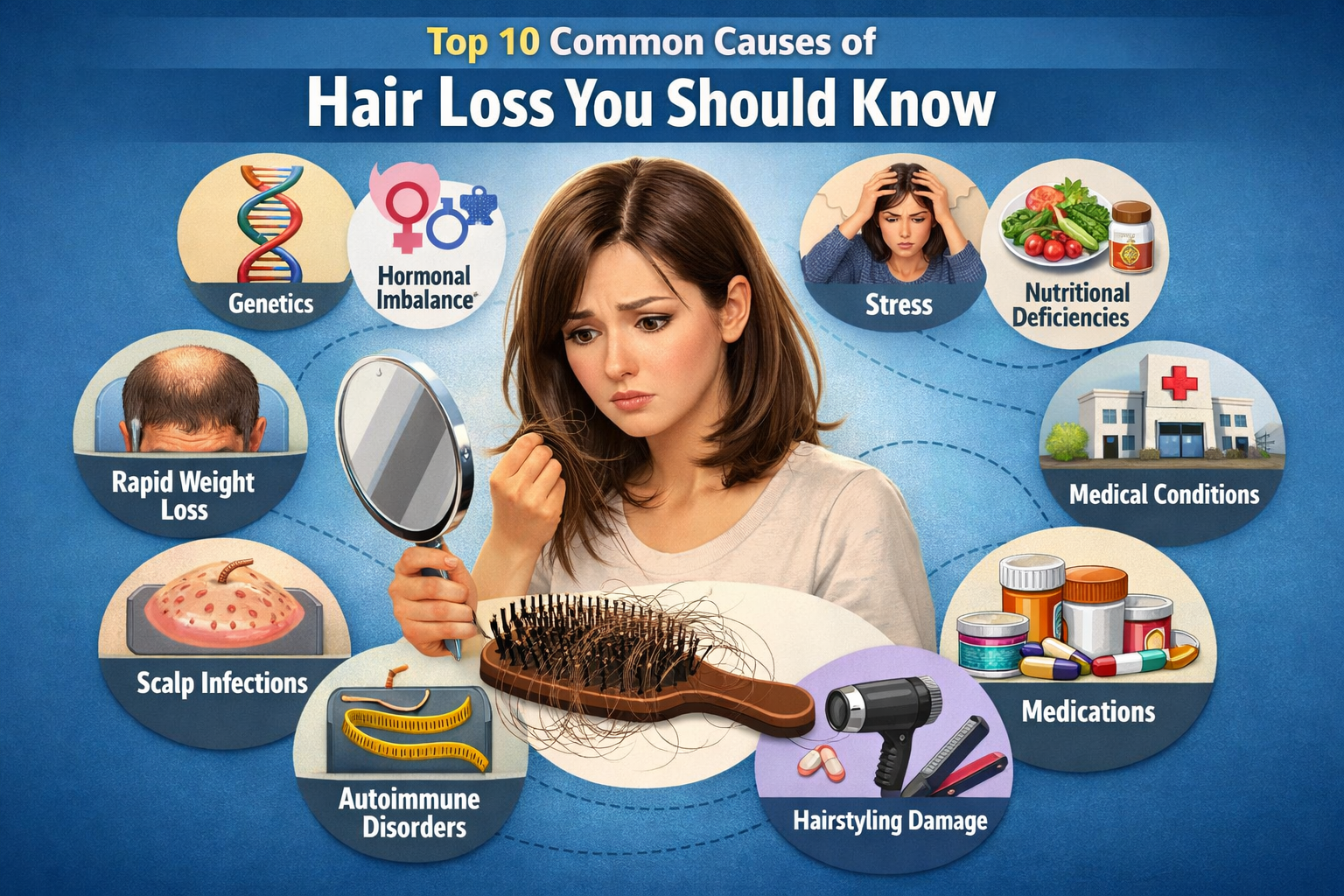
Top 10 Common Causes of Hair Loss You Should Know
I didn’t set out to learn about hair loss.
Honestly, it wasn’t even something I thought about—until it became something I couldn’t ignore.
It started quietly, the way these things often do. A little more hair in my brush. A few extra strands on my pillow. Nothing alarming, just enough to make me pause for a second longer than usual.
At first, I told myself it was normal.
Then I told myself it would pass.
But eventually, I found myself standing in front of the mirror, asking a question I hadn’t expected to ask so soon:
Why is this happening?
And that question led me down a path I didn’t expect—one filled not just with answers, but with a deeper understanding of how connected everything in the body really is.
Because hair loss, as it turns out, is rarely just about hair.
It’s about what’s happening underneath.
1. Stress That Doesn’t Always Feel Like Stress
If there’s one cause that surprised me the most, it’s this.
Not because stress is uncommon—but because it doesn’t always look the way we expect it to.
I always thought stress had to be obvious. Something dramatic. Something you could point to and say, “That’s the reason.”
But sometimes, it’s quieter.
It’s the constant thinking. The lack of real rest. The pressure to keep going even when you’re tired.
And your body notices, even when you try not to.
Hair has this way of responding to stress after the fact. Weeks, sometimes months later. So when the shedding begins, it can feel disconnected from the cause.
You think you’re fine.
But your body is still catching up.
2. Nutritional Gaps You Don’t Realize You Have
There was a point when I started paying attention to what I was eating—not in a strict way, but in an honest one.
Was I getting enough protein?
Was I skipping meals without thinking?
Was I actually nourishing my body, or just getting by?
Hair relies on nutrients—iron, zinc, vitamins, protein. And when those are missing, even slightly, your body starts to prioritize.
Hair becomes less important.
And over time, that shows.
What makes this tricky is that it doesn’t require extreme deficiency. Just small, consistent gaps.
The kind you don’t notice until your body does.
3. Hormonal Shifts Beneath the Surface
Hormones are subtle.
They don’t always announce themselves loudly, but they influence so much—energy, mood, sleep, and yes, hair.
Changes in hormones can affect how long hair grows, how strong it is, and when it falls out.
And the frustrating part?
You might not feel anything different.
No clear sign. No obvious shift.
Just a gradual change that becomes visible in ways you didn’t expect.
4. Genetics: The Quiet Background Story
This is one of those causes that feels… unfair.
Because it’s not about what you did or didn’t do.
It’s just there.
A pattern, passed down quietly, waiting to show up at its own time.
For some people, hair loss runs in the family. It might appear gradually, following a familiar pattern.
And even though you can’t change your genetics, understanding it helps.
It turns confusion into context.
And sometimes, that alone makes it easier to face.
5. Overstyling and Physical Stress on Hair
This was something I didn’t expect to matter as much as it does.
Tight hairstyles. Constant pulling. Heat styling without much thought.
It doesn’t seem like a big deal in the moment.
But over time, that physical stress adds up.
Hair follicles can become strained, weakened.
And eventually, the hair starts to let go.
Not all at once.
But enough to notice.
6. Sudden Changes in Routine
There’s something about sudden shifts that the body doesn’t always handle smoothly.
A change in sleep.
A new schedule.
Travel. Illness. Disruption.
Even if it’s temporary, your body has to adjust.
And sometimes, hair becomes part of that adjustment.
It’s not immediate.
It shows up later.
Which makes it harder to connect the dots.
7. Scalp Health (Often Overlooked)
I used to think hair care was just about the hair itself.
Shampoo. Conditioner. Maybe a mask.
But the scalp?
I didn’t pay much attention to it.
Until I realized that healthy hair starts there.
Issues like buildup, irritation, or imbalance can affect how hair grows and how strong it feels.
And if the environment isn’t right, the hair reflects that.
It’s not always obvious.
But it matters.
8. Medical Conditions and Underlying Changes
Sometimes, hair loss is a sign of something happening internally.
Not always serious—but worth paying attention to.
There are conditions that can affect hair growth, causing shedding or thinning in ways that feel sudden or unusual.
And this is where awareness becomes important.
Not fear.
Just awareness.
Because catching something early often makes a difference.
9. Medications and External Influences
This was something I hadn’t considered at all.
That things you take for one reason might affect something else entirely.
Certain medications can influence the hair growth cycle, leading to increased shedding.
And because it’s not always listed as the “main” effect, it can catch you off guard.
You don’t connect it immediately.
But over time, the pattern becomes clearer.
10. The Natural Hair Growth Cycle Itself
And then, there’s this.
The simplest explanation—but also the one that’s easiest to forget.
Hair naturally sheds.
It grows, rests, and falls out in cycles.
And sometimes, those cycles shift.
Temporarily.
Without a major cause.
Just as part of how the body functions.
Not every change means something is wrong.
Sometimes, it just means something is changing.
When It’s Not Just One Cause
One thing I learned through all of this is that hair loss is rarely caused by just one thing.
It’s often a combination.
A little stress.
A slight nutritional gap.
A change in routine.
Individually, they might not matter much.
But together?
They can shift the balance.
And that’s when you start to notice.
The Emotional Side of Searching for Answers
There’s a certain kind of frustration that comes with not knowing exactly why something is happening.
You want a clear answer.
A single cause.
A straightforward fix.
But hair loss doesn’t always work like that.
It asks for patience.
For observation.
For a willingness to look at the bigger picture.
And that can be uncomfortable.
What Helped Me Understand It Better
I didn’t find clarity all at once.
It came slowly.
By paying attention without overreacting.
By noticing patterns instead of jumping to conclusions.
By accepting that not everything has an immediate explanation.
And most importantly—
By realizing that my body wasn’t working against me.
It was responding.
A Different Way of Looking at Hair Loss
At some point, the question changed.
From “Why is this happening to me?”
To “What is my body trying to tell me?”
That shift didn’t solve everything.
But it made things feel less overwhelming.
More manageable.
More understandable.
Final Thoughts
If you’re experiencing hair loss, it’s easy to feel like something is wrong.
But more often than not, it’s not about something being broken.
It’s about something being out of balance.
And balance can be restored.
Slowly.
Quietly.
Over time.
Hair loss isn’t just a problem to fix.
It’s a signal to understand.
And once you start listening, the answers—while not always immediate—begin to make a little more sense.