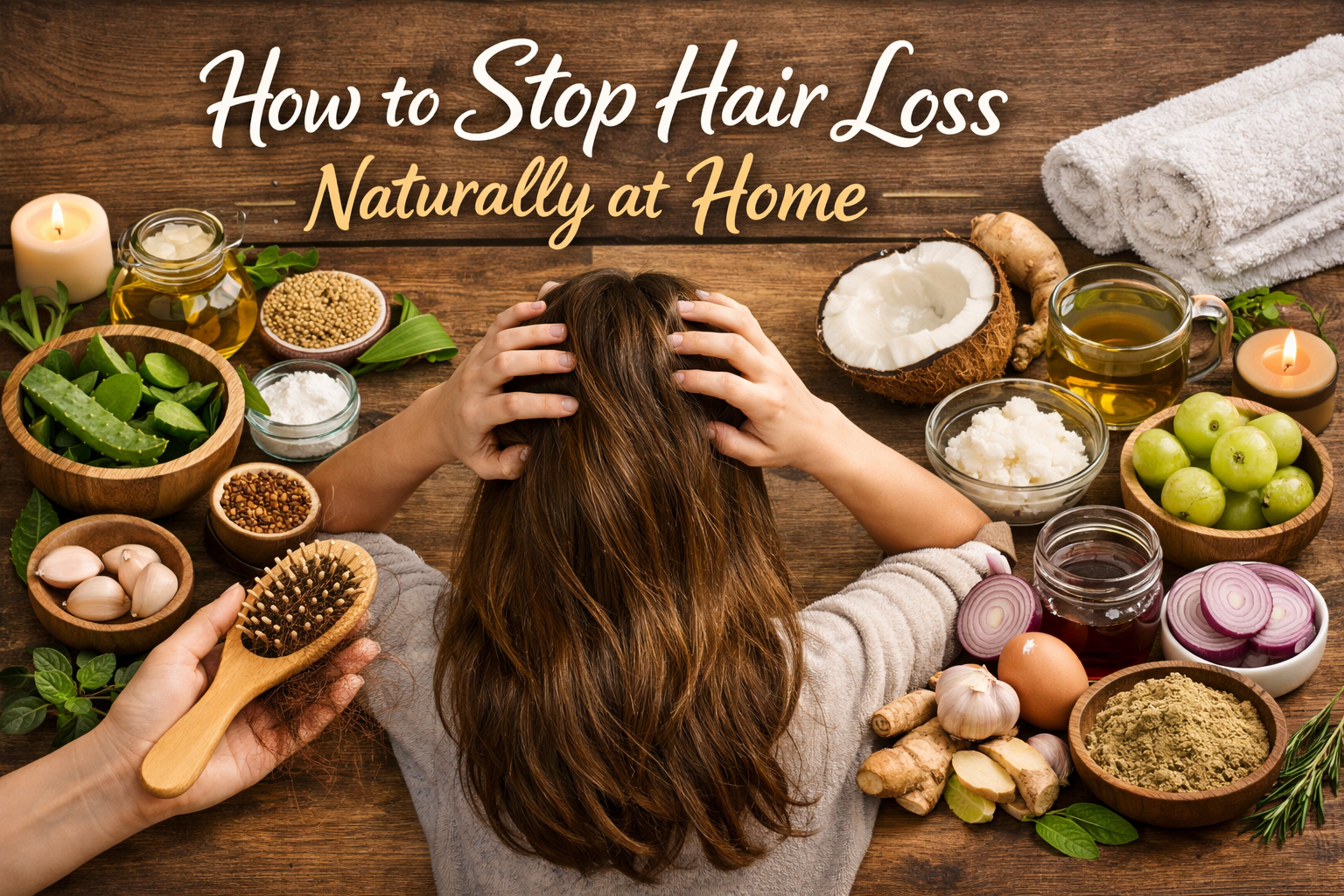
How to Stop Hair Loss Naturally at Home
I didn’t start with a plan.
I started with frustration.
Because when your hair begins to change—when it starts falling more than you expect—you look for solutions that feel close, accessible, immediate.
Something you can do now.
Something that doesn’t require waiting, or complexity, or uncertainty.
And that’s how I found myself turning inward.
Not toward products.
Not toward complicated routines.
But toward something simpler:
What can I do at home, with what I already have?
The Desire for Something Natural
There’s a certain comfort in the idea of “natural.”
It feels safer.
More sustainable.
Less overwhelming.
But at the same time, it raises a quiet question:
Will it actually work?
Because when something feels simple, it’s easy to doubt its impact.
The Shift From Fixing to Supporting
At first, I approached it like a problem to fix.
Something to stop.
Something to control.
But over time, I realized something important:
Hair doesn’t respond well to force.
It responds to support.
And that changed everything.
It Starts With What You Do Every Day
The most powerful changes weren’t dramatic.
They were small.
Repeated.
Consistent.
Things I was already doing—but with more awareness.
And that’s what made them effective.
The Way You Wash Your Hair
I started paying attention to how I washed my hair.
Not just what I used—but how I used it.
Less rushing.
Less pressure.
More focus on the scalp.
Because the scalp is where everything begins.
And treating it gently made a difference over time.
Water Temperature Matters More Than You Think
I didn’t think about water temperature before.
It was just part of the routine.
But hot water can be harsh.
Stripping away natural oils.
Leaving the scalp unbalanced.
Switching to lukewarm water felt like a small change—but it had a noticeable effect.
The Way You Dry Your Hair
I used to rub my hair with a towel.
Quick.
Efficient.
But rough.
And over time, I realized that friction was adding unnecessary stress.
So I slowed down.
Pressed instead of rubbed.
Let my hair dry more naturally.
And that reduced breakage more than I expected.
Brushing With Awareness
Brushing became something I paid attention to.
Not something I rushed through.
Starting from the ends.
Working upward.
Being gentle when my hair was wet.
Because those small adjustments reduced the amount of hair I saw in the brush.
The Role of Simple Oils
At some point, I started using natural oils.
Not excessively.
Just occasionally.
Massaging them into my scalp.
Taking a few minutes to slow down.
And while it didn’t create instant change, it created consistency.
And consistency is what matters.
The Unexpected Benefit of Scalp Massage
The massage itself became important.
Not just the oil.
The act of slowing down.
Of increasing circulation.
Of paying attention to the scalp.
It felt small—but over time, it became part of the process.
Food Becomes Part of the Routine
I didn’t think of food as “hair care” at first.
But it is.
What you eat becomes what your body uses to grow.
So I started paying attention.
Not perfectly.
Just more intentionally.
Adding more protein.
More variety.
More balance.
And that shift showed up in subtle ways.
Hydration: The Simplest Change
Drinking more water felt too simple to matter.
But it did.
Because hydration affects everything.
Including how your scalp and hair function.
And sometimes, the simplest things are the easiest to overlook.
Sleep: The Part You Ignore
Sleep wasn’t something I connected to hair.
Until I did.
Because recovery happens during rest.
And without enough rest, the body doesn’t function the same way.
So I started giving sleep more attention.
Not perfectly—but more consistently.
Stress: The Invisible Factor
Stress is harder to control.
But not impossible to notice.
And noticing it was the first step.
Taking breaks.
Slowing down.
Creating moments of calm.
Not because it directly “fixes” hair loss—
But because it supports the system behind it.
The Mistake of Expecting Immediate Results
At first, I wanted quick change.
Something visible.
Something obvious.
But natural approaches don’t work that way.
They build.
Gradually.
And that requires patience.
The First Signs of Improvement
The changes weren’t dramatic.
But they were real.
Less shedding.
Stronger strands.
Hair that felt slightly more stable.
And those small signs mattered.
Because they showed that something was working.
You’re Not Stopping Hair Loss—You’re Supporting Balance
This was the biggest shift for me.
I wasn’t “stopping” hair loss.
I was creating conditions where my hair could function better.
And that distinction made everything feel more realistic.
Consistency Over Perfection
I didn’t do everything perfectly.
And I didn’t need to.
Because consistency mattered more than perfection.
Repeating small, supportive habits over time.
That’s what made the difference.
You Already Have More Control Than You Think
That was the realization that stayed with me.
You don’t need complex solutions to start making changes.
You can begin with what’s already in your control.
Your habits.
Your routine.
Your awareness.
So, Can You Stop Hair Loss Naturally at Home?
In some cases, yes—especially when the cause is related to lifestyle, stress, or imbalance.
But it’s not about one solution.
It’s about many small ones working together.
You’re Not Fixing Everything at Once
You’re adjusting.
Gradually.
Supporting your body in ways that allow it to rebalance.
And that process takes time.
Final Thought
Stopping hair loss naturally at home isn’t about finding one perfect method.
It’s about understanding the system your hair is part of.
And supporting that system—consistently, gently, over time.
Because the most powerful changes don’t come from something dramatic.
They come from what you do every day.
Quietly.
Repeatedly.
Until one day, things begin to feel different.
Not suddenly.
But steadily.
And sometimes, that’s the kind of change that lasts.